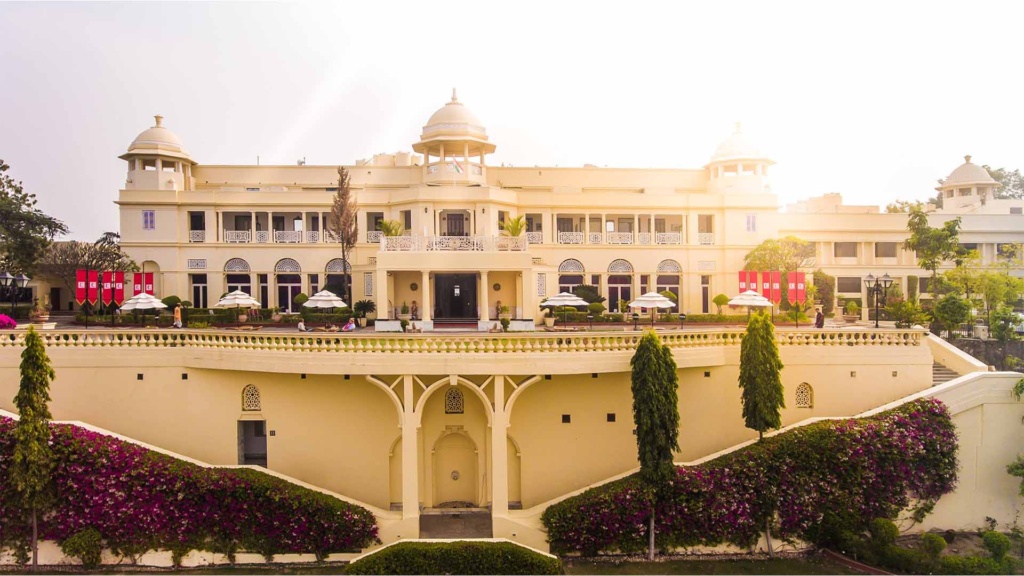
A stay shaped by heat, distance, ochre walls and the rare pleasure of doing very little
By the time Jennifer and I reached Pushkar, it was already past ten at night.
We had ridden in from Udaipur, carrying that particular fatigue a motorcycle leaves in the body after a long Rajasthan day: shoulders tight, palms faintly buzzing, face holding dust in places soap later discovers with interest. Pushkar was still awake. It rarely gives the impression of going fully to sleep. Even late, there were lights near the town, small movements around food stalls, a few voices, the afterlife of traffic, and the sense that devotion and commerce had merely lowered their volume rather than stopped.
Dera Masuda was not in the thick of that. That was the first thing the stay asked us to understand. We had to ride out a little, away from the immediate press of the ghats and lanes, towards Motisar Road, where the town loosened and the night widened. The property’s own site lists it on Motisar Road in Pushkar, and that location became one of the main characters of the stay: useful when we wanted quiet, mildly inconvenient when we wanted the town, and honest in both moods.
At that hour, I was not thinking about heritage. I was thinking about parking the motorcycle, removing my helmet, finding the room and not dropping anything essential in the dark. The old version of me might have wanted to describe the arrival as a desert revelation. The actual arrival was more practical and better for it. We rode in tired, looked for where to stop, and let the engine fall silent.
The property appeared in pieces: ochre walls, arches, open corridors, domes against the night, and the pale geometry of a pool catching whatever light was available. It did not feel like entering a fort, and I do not want to borrow that language cheaply. It felt like entering a designed space after a day of motion, a place that understood the usefulness of courtyards, shade and distance.
That night, the room did not need to impress me. It needed to receive me. After Udaipur, highway, darkness and Pushkar’s late pulse, even the act of putting the bags down felt like an achievement.
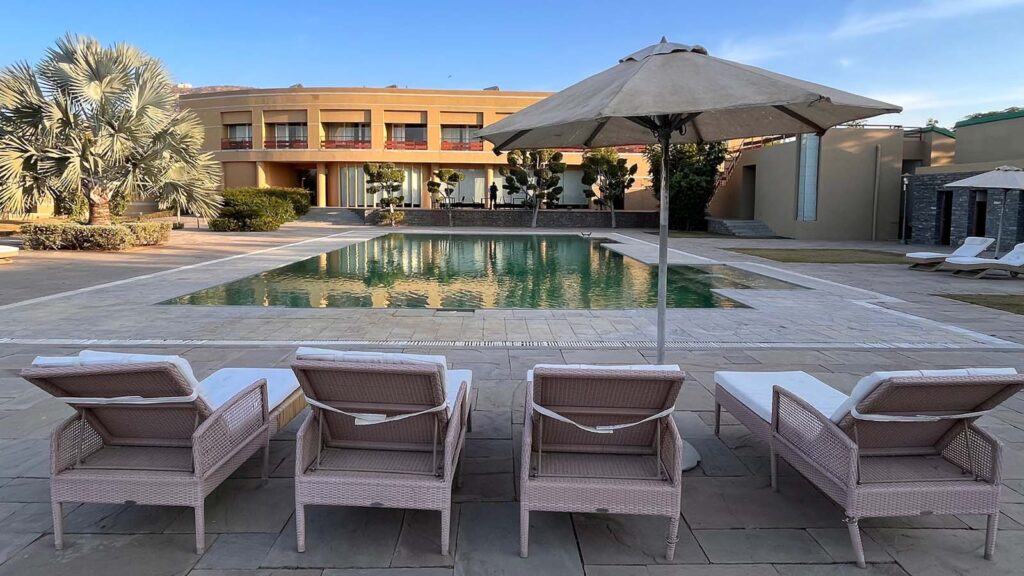
View from the pool overlooking the aravalis
Daylight and distance
Morning made the property clearer.
From the balcony, the pool sat directly in front of me, still enough in the early light to make the room feel more expensive than my tired arrival had allowed me to notice. Beyond it, the Aravallis stretched out in low, dry folds. The view did not have the drama of a high mountain pass or the theatrical blue of a lake. Its gift was proportion. Pool, courtyard, walls, hills, sky. Enough to look at, not enough to overwhelm.
The room and the property worked through materials and movement: stone or marble underfoot, ochre walls catching heat, carved furniture that gave the room weight, open corridors that made shade useful rather than decorative, arches and jaalis that broke light into smaller, kinder pieces. In September, Rajasthan light can still arrive with force. A well-placed shadow becomes more than an aesthetic choice. It becomes hospitality.
The distance from Pushkar town was, on balance, useful. After the noise and density of the ghats, Dera Masuda gave us a buffer. We could return, park the bike, walk through the open circulation and feel the day slow down. But useful does not mean effortless. The location meant the motorcycle remained necessary. A casual stroll into town was not the rhythm of this stay. Each outing needed the bike, and each return had the small logistics of helmet, dust, heat, parking and timing.
That tension made the stay more believable to me. Hotels often sell distance as pure serenity. In real travel, distance has a cost. Here, the cost was manageable because we had the motorcycle and because the quiet paid us back. If I had been dependent on autos for every small impulse, I might have judged it differently. With the bike, the separation became part of the pleasure.
The property was not a place that erased Pushkar. It gave Pushkar edges. We could ride into the town’s noise, heat, bazaars and devotional clutter, then ride back out to a room where the pool and hills restored some order to the senses. That back-and-forth became the real rhythm: town, road, gate, pool, balcony, stillness.
Pushkar and back
Pushkar during the day does not politely organise itself for visitors.
It crowds you with colour, sound, heat, errands, shrines, bargaining, animals, scooters, pilgrims, cafés and the peculiar concentration of a town built around sacred water and tourist appetite at the same time. We went in on the motorcycle, moving through the bazaar and around the ghats with the slow caution a riding day teaches you. There are places where speed feels not just unsafe but rude. Pushkar is one of them.
I did not want this article to become a Pushkar guide. The town has too many stories for a paragraph, and most of them do not belong to a resort stay. What mattered here was contrast. In town, everything pressed close: people, colour, prayer, commerce, cows, fabrics, shop signs, the smell of frying food, the insistence of being asked to look, buy, sit, move, wait. Back at Dera Masuda, space returned.
We also did a camel safari outside the hotel. That distinction matters. It was part of the Pushkar stay, not something I want to fold into the resort’s credit. The ride belonged to the wider landscape: the awkward height of the camel, the dry ground, the way tourist ritual and desert reality often sit uneasily beside each other. I enjoyed parts of it and remained aware of the performance built into the experience. Some travel activities ask you to participate and question them at the same time.
Returning to Dera Masuda after those hours made the property’s distance feel less like a logistical note and more like relief. The pool appeared first as an idea before the water itself: shade, chair, stillness, no bargaining, no temple bells, no need to decide anything immediately. I had come to Pushkar expecting movement. The resort kept persuading me to stop.
That persuasion was strongest in the late afternoon. Heat changes ambition. Plans reduce themselves. The body begins voting against another outing. The balcony becomes sufficient. A poolside lounger becomes a destination. The hills beyond the property seem to move only because the light does.
Hours stayed put
The best part of the stay may have been the part that sounds least impressive: we stayed put.
Breakfast outdoors helped. I asked for ginger tea, and the request felt less like a preference than a correction the body needed. After a motorcycle day, after heat and town and road dust, ginger tea has a way of arriving with more authority than the menu intended. Breakfast by the pool gave the morning a simple structure: cup, plate, light, water, hills. Nothing needed to become a revelation.
The manager told us a brief version of the property’s background, enough to understand that the place presents itself through design, family association and a certain Rajasthan vocabulary of lineage. The official website similarly describes Dera Masuda as the creation of Dushyant Singh and Sangeeta Kumari and connects it to the Masuda family, while also calling it a design hotel resort. I kept the information lightly. It was useful context, but not the reason the stay worked.
What worked was physical: the shade in the corridors, the way the pool cooled the eye before it cooled the body, the balcony’s directness, the fact that after riding and walking and negotiating Pushkar’s intensity, doing very little felt earned. Travel writing often mistrusts idleness because it does not produce many verbs. But idleness has texture. It has a damp towel over a chair, a phone finally left alone, a notebook opened and ignored, the tiny luxury of not leaving immediately.
One evening brought ghazals and drinks, and later Rajasthani food for dinner. I remember the atmosphere more than a precise inventory of dishes: voices, rhythm, the comfort of sitting down after a day measured by heat and movement, the meal arriving not as culinary history but as appetite being answered. The older draft wanted every dish to carry a civilisation. The truer version is simpler. We were hungry. The food was Rajasthani. The evening had music. That was enough.
There is authority in refusing to overstate pleasure. Dera Masuda was not perfect because no stay is. Its distance from town meant every outing needed intention. The resort calm could feel separate from Pushkar’s actual pulse if you let it. And like many properties built around mood, it risked encouraging you to mistake design for depth. But after a long motorcycle ride, in a town that can crowd the senses quickly, those limitations did not spoil the stay. They defined it.
By the second night, I understood the property less as an “oasis” and more as a spatial decision. Stay here, and Pushkar becomes something you enter and exit, not something that surrounds you continuously. For some travellers, that will feel like a compromise. For me, on that trip, with a motorcycle and a tired body, it felt like exactly the right distance.
The sun behind us
On the last morning, we packed the motorcycle.
That is always the moment when a stay becomes real again. Rooms can be elegant, corridors shaded, breakfast slow, but departure brings back straps, bags, chargers, gloves, documents, dust and the small anxiety of whether everything will fit the way it had before. The pool was still there. The Aravallis were still beyond it. The ochre walls had begun taking the early light. But the day had turned practical.
The staff lined up to wave us goodbye. That could easily sound staged if it had not happened, but it did, and because it happened, it deserves to stay. I remember it less as ceremony and more as the final human shape of the stay: people at the edge of the property, us on the bike, the quiet acknowledgement that two nights had ended and the road was taking over again.
The sun rose behind us as we left.
There is a temptation to make that mean too much. I will resist it. It was morning. We were on a motorcycle. The bags were tied down. Jennifer was ready. Pushkar was somewhere behind and around us, the resort receding, the road ahead beginning to warm. The useful distance that had shaped the stay now became distance of another kind, measured not from town to hotel but from one memory to the next.
I looked back once, enough to catch the staff, the entrance, the colour of the walls in the new light. Then the bike moved forward, and Dera Masuda became what good stays often become after departure: not a lesson, not a slogan, but a set of textures the body remembers before the mind files them away ginger tea outdoors, pool water in morning light, Pushkar dust on riding boots, ghazals after dark, and the peculiar quiet of a place just far enough from town to let you hear yourself slow down.