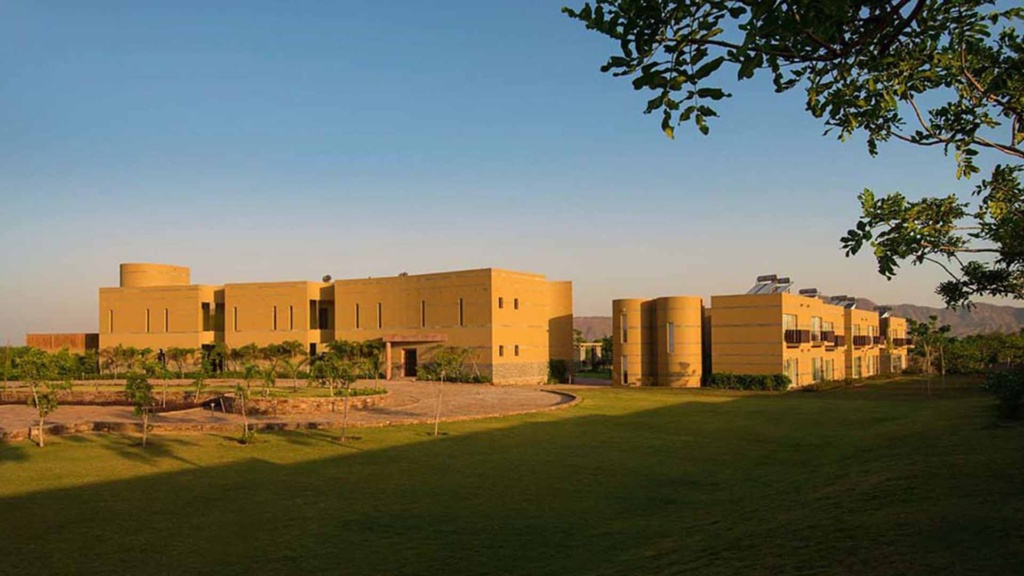
A stay booked because an Agoda rate looked too good to ignore
The palace entered the trip through a discount filter.
I was going to Udaipur in June 2023 for a family event, which meant the journey already belonged to other people’s timings: arrivals, greetings, meals, clothes, calls, coordination, the small administrative weather system that gathers around any family function. Accommodation, in that context, was supposed to be a practical decision. I was not searching for grandeur. I was searching the way one searches before a busy trip: dates in, filters on, free cancellation preferred, price watched with suspicion.
Then The LaLiT Laxmi Vilas Palace Udaipur appeared on Agoda at a rate that looked wrong.
There are moments in travel planning when caution and curiosity begin arguing in the same browser tab. The photographs showed domes, lawns and the kind of scale I associate with weddings, not with one person carrying a laptop and a slightly chaotic bag. The price, however, sat closer to sensible than spectacular. I checked the dates again: 20 June to 22 June 2023. I checked the name again. I refreshed, because adulthood has taught me that many good things online disappear when looked at directly.
The deal remained. I booked it myself, fully self-funded, before common sense could turn into delay.
Only later did the comedy of it settle in. I was not arriving in Udaipur to live like royalty. I was arriving for a family event, with messages to answer, notes to write, clothes to keep uncreased and schedules to obey. The palace was not the purpose of the trip. It was the accidental room around it.
That accident made the stay more interesting. If I had planned a palace holiday, I might have tried too hard to feel grand. Instead, I arrived prepared to use the place like a modern traveller: sleep, work, change, leave for family obligations, come back late, look out of a window, remember to charge the phone.
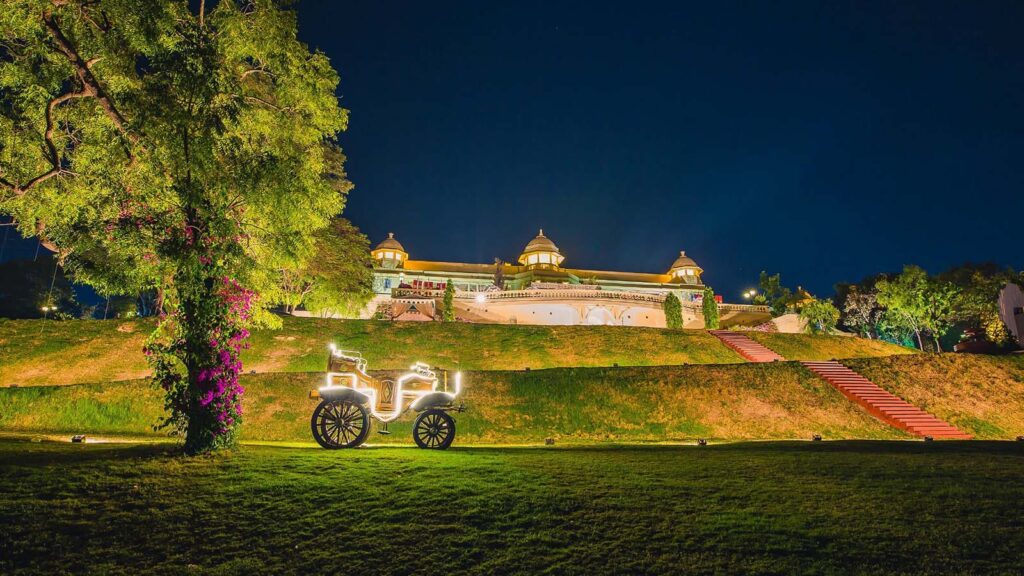
The gardens as seen from the greens.
Up the hill
The cab turned off the busier Udaipur rhythm and began climbing towards the hotel.
That approach mattered. Below, the city had its usual insistence: traffic, shops, voices, the quick compression of lake-city movement. Above, the road softened into a slower ascent. The LaLiT Laxmi Vilas Palace sits opposite Fateh Sagar Lake, and its official history identifies it as a palace built in 1911 by Maharana Fateh Singh. I knew that later in the tidy way one knows things after reading; on arrival, I knew only that the cab was climbing and the hotel was getting larger than my booking decision had prepared me for.
At the entrance, the building did what old hotels do when they still have scale on their side. It made my bag look smaller. The facade, the open space, the height of the ceilings, the sense of lawn and corridor and distance all of it suggested a life designed for slower movement than mine. I arrived with phone notifications still active and the private awkwardness of someone who has booked a palace because it was available at the right price.
Check-in had the expected gestures: a towel, sherbet, polite efficiency. These things can easily become review clichés, but in that moment they worked because June in Rajasthan had already made a case for cold cloth and sugar. I remember the relief of wiping my face and feeling the day briefly become manageable.
The first walk to the room stretched the property out. Long corridors have a way of making even a short stay feel ceremonial. At The LaLiT, they also made me aware of the oddness of being alone in a place built for many. Family events compress you into groups; this hotel expanded around me. The contrast was useful. Somewhere in the city, relatives were gathering and plans were multiplying. Here, for a few hours, my footsteps had room to be heard.
My room was a lake-view room, though the view did not arrive all at once. First came the lawns, broad and green, insisting on the foreground. Beyond them was Fateh Sagar Lake, and farther still, on the horizon, Sajjangarh Fort held its pale shape above the city. It was not a view that needed adjectives immediately. It needed time, and I had just enough.
Between family functions
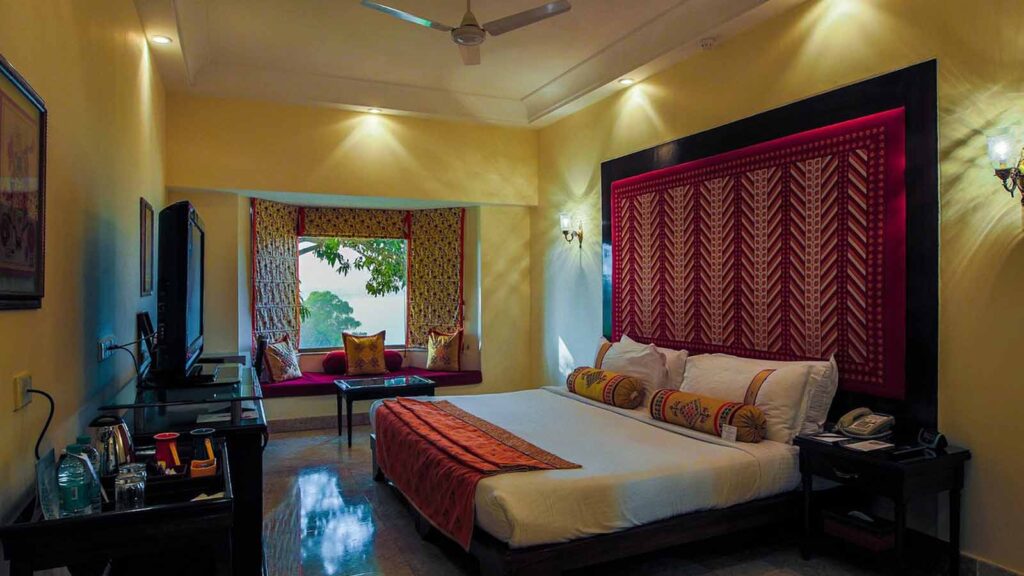
Lake view rooms
A palace being used
The next day, I used the palace in the most unroyal way possible: I opened my laptop.
There is something quietly funny about answering emails from a garden lounge in a palace hotel. The setting asks for leisure, but the inbox does not respect architecture. I sat with my laptop, writing notes and replying to emails, with the lawns in front of me and Sajjangarh visible beyond the lake. Every few minutes, my attention slipped from the screen to the view. The cursor blinked with urban impatience. The fort did not.
That was the real texture of the stay: grandeur interrupted by ordinary use. I was not floating through heritage in a linen haze. I was moving between family commitments, hotel corridors, work notes, phone calls, meals and short pauses where the place managed to pull my eyes away from whatever I thought was urgent. The palace did not remove modern life. It framed it, sometimes absurdly well.
During the day, the property had a working rhythm. Staff crossed lawns. Guests moved between rooms and public spaces. A gardener pointed out a peacock, which is the sort of thing that sounds invented until you are in Udaipur and the bird has no interest in your disbelief. The peacock moved through the grounds with the entitlement of someone whose family had occupied the region long before hotel guests learned to photograph breakfast.
I walked the corridors more than I needed to. High ceilings change a person’s pace. You do not rush as easily under them, or perhaps you become more aware of how ridiculous rushing looks. The hotel had the familiar compromises of a historic property adapted for modern guests: heritage on the surface, switches and signage and service routines underneath, the past and present sharing walls without always agreeing on proportions.
That tension interested me more than polished luxury did. A palace operating as a hotel is not a preserved dream; it is a working arrangement. Someone has to maintain the lawns. Someone has to handle luggage, breakfast, room service, repairs, bills, towels, phones, late arrivals and guests who book on discount websites and then wander around trying to look less surprised than they are.
By the second afternoon, the hotel had stopped being an exception and become a base. I left for family commitments, returned, opened the laptop, closed it, stood at the window, changed clothes, checked messages, looked at the lake again. The palace did not become ordinary, exactly. It became usable, which is more intimate.
Dinner in the room
Friends from Udaipur came over for dinner, and instead of turning the evening into a grand restaurant scene, we dined in the room.
That detail feels truer to the stay than any formal thali description would have. The trip already had enough public gathering elsewhere. In the room, dinner became smaller, warmer and more personal. Plates arrived, chairs were rearranged, people found places to sit, and the lake-view room had to behave less like a hotel category and more like a temporary living room.
I do not need to pretend I remember every dish. What I remember better is the adjustment of scale: a palace room filled with ordinary friendship. Someone laughed too loudly for the room’s dignity. Someone checked a phone. Someone looked out towards the lawn. The conversation moved between Udaipur, family, work, the odd luck of the booking and the strangeness of staying alone in a place that seemed designed for processions.
That evening corrected the solitude of the first night. I had imagined the palace as a private accident, mine because I had found the rate. But it became more generous when shared. Not in a grand way. No staged music, no courtyard performance required. Just friends in a room, dinner unpacked into the evening, the hotel’s scale briefly reduced to the size of a table.
Later, after they left, I walked outside.
The night walk happened, and it is tempting to over-write it because palace grounds at night invite bad behaviour from adjectives. The lawns were real. The quiet was real. The lit building behind me and the darker stretch towards the lake were real. The peacocks, when heard or glimpsed in that half-absurd palace-night way, remained themselves rather than symbols. Udaipur below had not vanished; it had simply become less demanding from up there.
I did not need to imagine kings crossing the lawns or stones whispering history. The present was enough: staff finishing work, guests returning to rooms, lights burning in corridors, a gardener’s earlier peacock still somewhere in memory, and me walking off dinner under a sky that made the hotel feel both grand and slightly lonely.
From the grounds, Sajjangarh sat in the distance, a pale point of reference beyond the lake. The palace I was staying in and the fort on the horizon seemed to hold a conversation whether or not I understood it. I watched for a while, then walked back in because the room was waiting and the next day still belonged partly to family.
Morning and descent
On the final morning, the palace looked less like a surprise and more like something I had briefly learnt how to use.
That is a modest achievement, but a real one. The first day had been disbelief: the rate, the hill, the towel, the room, the lawns, the lake, Sajjangarh on the horizon. By the morning, I knew the route from room to lobby, the way the corridors held sound, the place where I had sat with my laptop, the angle from which the lawn opened first and the lake revealed itself after. A two-night stay does not make you belong anywhere, but it does let you stop performing astonishment.
I packed with the usual last-morning untidiness: chargers found late, clothes folded badly, one final look around the room to make sure nothing had slipped under furniture. The view was still doing its work outside. Lawn, lake, fort. Three layers, each calmer than my schedule.
The cab down the hill returned the palace to proportion. From inside the property, it had felt expansive enough to suspend ordinary time. From the descending road, it became one part of Udaipur again: a hilltop hotel above Fateh Sagar, built from history, maintenance, hospitality, discount algorithms, family trips, garden lounges, room dinners and people like me who arrive because a public rate looked too good to ignore.
I left without feeling that I had unlocked the meaning of heritage. That would be a large claim for two nights and one Agoda booking. I had simply occupied a grand old building in a very ordinary modern way: I slept, worked, hosted friends, changed for family functions, watched peacocks cross lawns, answered emails, accepted sherbet, walked at night and looked out towards Sajjangarh more often than planned.
As the cab joined the city again, the palace receded behind the hill. My phone found signal, messages returned, and Udaipur resumed its full volume. I looked back once, then opened my bag to check if I had packed the charger. Grandeur had done what it could. The rest of the day still needed practical attention