A September 2009 walk through Khari Baoli, where the first thing the market did was make me cough
Prologue After Ice, a Door Opens
The first thing Khari Baoli did was enter my throat.
Not gently. Not as aroma. As chilli dust, sharp and immediate, the kind that climbs behind the nose and announces itself before you have found your bearings. I had stepped out from Chandni Chowk Metro one September morning in 2009 and followed the old Delhi logic of sound, smell and movement towards Khari Baoli. The city had narrowed by then: rickshaw bells, shutters opening, scooters nudging through impossible gaps, men carrying sacks with the strained grace of people who know exactly how much a body can bear.
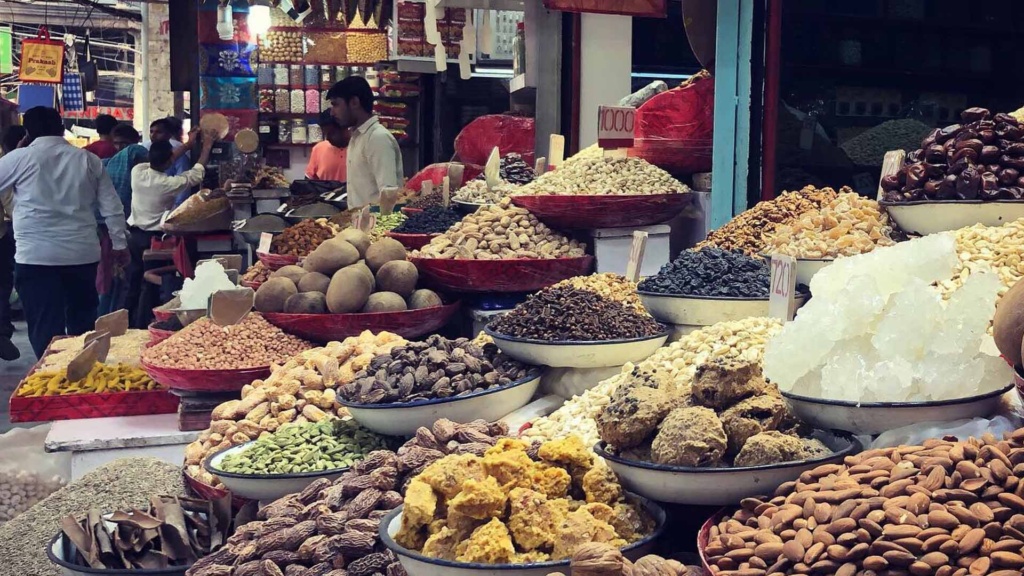
Khari Baoli is widely described as Asia’s largest wholesale spice market, and that phrase is useful only up to a point. SRDC Delhi It explains the scale, not the impact. Scale is a fact; the market was a sensation. Red chillies stacked in sacks, coriander in open mounds, cloves and cumin and fenugreek mixing with diesel, sweat, boiling milk and damp jute. Everything seemed to have weight: sacks, voices, ledgers, hands, prices, even colour.
I had a camera with me, but I learned quickly that the market was not waiting to be looked at. Work was happening. Sacks had to move. Orders had to be filled. Porters had to pass through lanes already too narrow for my hesitation. If I stopped, I was in someone’s way. If I raised the camera too slowly, a man with sixty kilos on his back had to correct my education with his shoulder.
So I lowered the camera and stepped aside.
That was the first useful thing the market taught me: looking is also a form of obstruction if you do it badly.
Spices
Weight, colour, work
The morning was not chaotic in the lazy way that word is often used for Old Delhi. It was crowded, loud and compressed, yes, but it had its own working order. Carts moved diagonally because straight lines were impossible. Men shouted not to create drama but to clear space. Shopkeepers sat behind counters that looked still until a customer arrived, and then the whole arrangement of hands, scoops, paper packets and scales began.
The colours were almost unreasonable. Turmeric looked too yellow to be natural. Red chillies held the kind of red that makes the eyes water before the nose has confirmed anything. Green cardamom sat in small expensive-looking heaps. Cinnamon bark was tied in bundles. Nutmeg had the dull secrecy of something better understood by cooks than by travellers. Rose petals, marigold, sandalwood curls, dried mango, black pepper, sesame, star anise, liquorice, saffron and fennel candy appeared in quick succession, each demanding attention, none willing to wait its turn.
A boy offered me a piece of dried mango. I should have asked first and tasted later. Instead, I accepted too quickly, and the masala caught me with comic efficiency: sweet, sour, hot, sticky, completely confident. I coughed, laughed, and bought a small quantity because embarrassment often makes the most honest purchases.
Further inside, a man waved me into his stall. His name was Imtiaz, real and publishable, a fourth-generation merchant who dealt mainly in black pepper. He showed me varieties I did not know how to distinguish properly then: Malabar, Tellicherry, Vietnamese, smoked, crushed, and one he called “elephant grade.”
I asked what made it special.
“Elephant also sneezes,” he said.
He handed me a sample. I sniffed it and immediately understood the joke with my eyes.
Imtiaz showed me an old invoice from 1952, written in Urdu on yellowed paper and folded with care.
“My grandfather’s first export,” he said. “To London.”
I bought nothing from him that morning, which I still remember with some shame. He did not seem offended. Wholesale markets know the difference between a customer, a browser and a young man learning how little he understands.
Chai, permission, restraint
I had stopped for chai before entering the market, and it still felt like the correct beginning.
The stall was small enough to be missed and busy enough to be trusted: dented pots, milk rising dangerously, tea pulled into strength by repetition. I drank standing up, elbow close to elbow, hot glass held by the rim because the tea was too eager for the hand. Around me, men drank quickly and returned to work. I lingered like an amateur.
The tea was thick, overboiled, sweet, and useful. It settled the first assault of chilli dust and gave me enough confidence to continue being overwhelmed.
Later, I paused at a stall stacked with dried rose petals and sandalwood. A woman stood behind it, sorting with quiet concentration. The colours there were softer: pinks, browns, creams, the shade of things used in weddings, rituals and rooms where scent matters.
“This is the ladies’ corner,” she said. “For rituals and weddings. We prepare blessings.”
I asked if I could take a photograph. She agreed, but I am not publishing that portrait. The permission was for a moment, not for permanent use wherever I please. That distinction became clearer to me over time, but even that morning I knew enough not to treat a face as decoration.
The camera stayed lower after that. I photographed sacks, scales, hands when permitted, shop interiors without identifiable faces, and colours that did not have to return home and explain themselves. A market like Khari Baoli can make a visitor greedy. There is always another frame: a porter under a sack, a vendor cutting twine with his teeth, a hand in turmeric, a man asleep above a pile of ginger. But not every frame is yours because you noticed it.
That is especially true when people are working.
Above the lane
At some point I climbed to a second-floor landing above the market.
I am keeping it unnamed because I do not want to turn an uncertain building into a false landmark. What I remember is the sensation of rising out of the lane rather than leaving it. The air changed first. It was still full of spice, but lighter, as if the smells had separated into layers. A sleeping dog lay near sacks of dried ginger. Faded posters peeled from a wall. Dust sat on railings with the confidence of long tenancy.
From above, the market’s order became easier to see.
Below me, carts pushed through lanes in angles that looked reckless until they worked. Porters paused, adjusted the cloth pads on their heads, then lifted again. Shopkeepers leaned across counters. Customers pointed, argued, accepted, rejected, returned. Women bargained with a precision that made the men beside them unnecessary for several minutes. Sacks moved from truck to shoulder, from shoulder to platform, from platform to shop, from shop to smaller packets that would leave the market under other names.
It was tempting to call the view timeless. That would be lazy. There was nothing timeless about the labour below. It belonged to that morning: September heat, rising dust, real bodies, real weights, real fatigue, real work.
Downstairs again, I watched a porter rest on a crate of sesame seeds, drinking water from a steel tumbler. Sweat had darkened his collar. I asked how long he had been working there.
“Since I was small,” he said. “Like that one.”
He nodded towards a boy nearby, and I do not want to lean too hard on that image. Children in working spaces are not atmosphere. They are a discomfort a writer should not turn into colour.
Then he said, “This place… it is not job. It is breath.”
The line stayed with me because it was not romantic when he said it. It sounded tired, matter-of-fact, almost annoyed at the inadequacy of my question.
What came home
I bought too much, as visitors do when they mistake carrying for understanding.
A small packet of saffron I could not afford. Fennel candy. A brass grinder shaped like a lion’s head, too heavy for sense and too irresistible for restraint. Later, the grinder would be lost at airport security, and the fennel candy would soften in my bag. At the time, each purchase felt like proof that I had participated. I had not, of course. I had merely bought things from people whose day had begun long before mine and would continue after I left.
On the way out, an older man sat cross-legged on a wooden platform, surrounded by sacks of star anise and liquorice root. He did not call me in. He did not perform hospitality. He barely looked up.
“Acha khushbu hai, na?” he said. Nice fragrance, no?
I nodded.
“It’s the smell of home,” he said.
Outside, Old Delhi resumed its wider noise: horns, generators, rickshaws, shopfronts, stray dogs, men selling things I did not need with the conviction of people who knew I might buy them anyway. I walked towards a small canteen not far from the Red Fort and ordered another chai. This one was thinner, less certain of its cardamom, but it gave me a place to sit.
My throat still held chilli. My fingers smelled of fennel, pepper and brass. There was spice dust in the fold of my sleeve and a faint sting at the corner of one eye. I sat with the glass of tea and let the morning settle into something less spectacular and more exact.
Khari Baoli had not been a temple, a ceremony or a secret archive waiting for me. It had been a wholesale market at work. That was more than enough.
When I reached home later, the market had come with me. My clothes smelled of cumin, chilli and smoke. The saffron packet was still safe. The fennel candy had begun to surrender. I took off my shirt and the air around me briefly became Old Delhi again: hot tea, red dust, rose petals, black pepper, sweat, bargaining, work.
I had left the market hours earlier.
The market had not quite left me.