A 2018 stay in Dah–Hanu, remembered through salt tea, apricot oil and the discipline of not turning a home into an exhibit
The day began again only after tea.
I had entered the courtyard in Dah–Hanu in 2018 through a host’s welcome, not as a visitor entitled to look everywhere. That distinction matters. A courtyard is not a museum hall. It does not rearrange itself for a traveller’s curiosity. It continues being a place of work, food, noise, storage, weather, children, animals, tools, jokes, interruptions and small domestic systems that existed before you arrived and must continue after you leave.
The first thing I remember is the warmth. A bukhari held the room together with a kind of practical authority. Low rafters were darkened by years of smoke. Brass and copper utensils caught what little light the window allowed. Drying greens and walnuts hung where they could be kept out of the way. A kettle moved towards urgency. In the corners, sacks of apricot stones waited with the dense quiet of work not yet begun.
My host insisted on tea first. Gur-gur cha came in bowls, salt and butter rising through the steam with a confidence that still surprises the plains-trained mouth. The first sip did not ask to be liked immediately. It asked to be understood in context: a cold region, a working room, a body that had come from the road and needed warmth before opinion.
Around me, the house resumed its rhythm. Someone moved embers. Someone brought bread. Nawang settled close enough to the work to be useful and far enough to be corrected. Padma sat near wool, thread and small objects that would later make more sense to me. Rigzin’s father moved in and out of the room with the quiet proprietorship of someone who knew where every tool slept.
I had arrived with the usual traveller’s hunger for meaning. The courtyard answered with tasks.
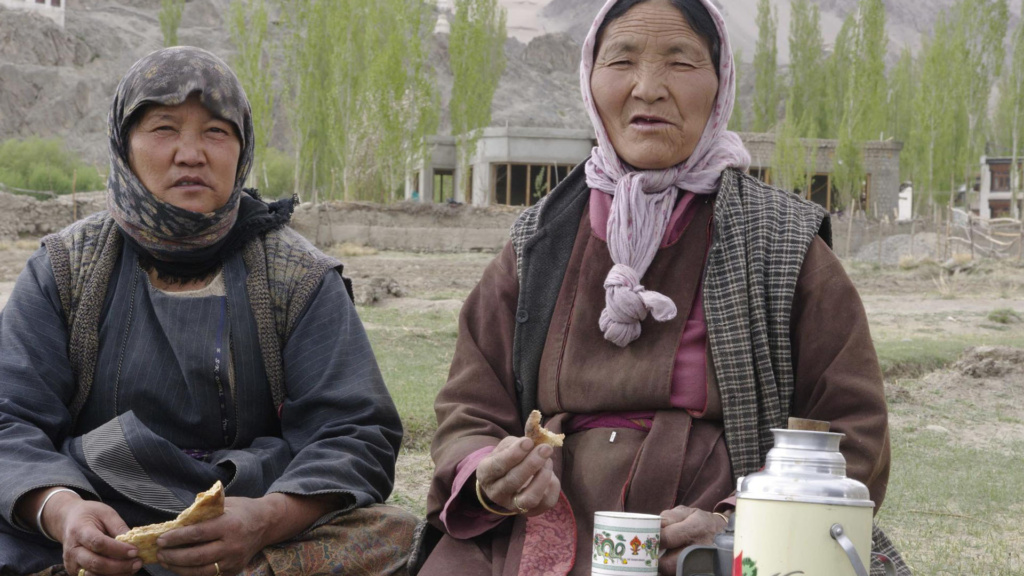
Ladakhi Tribes eating break and tea
Apricot stones
The apricot stones were poured onto a mat with the plain sound of the day beginning.
Chuli was the word used around me, and the stones were not treated as leftovers. They were stored possibility. Inside them were kernels that would become food, oil, medicine, warmth, flavour, winter usefulness — not as metaphor, but as household practice. The work began with cracking and sorting. Bitter kernels to one side. Sweet kernels to another. The terms bari and goos stayed with me because the distinction was not decorative. It determined use.
I was handed a stone and a tool, which is always the moment hospitality becomes more interesting. Being fed is one kind of welcome. Being given work is another. My first attempts were clumsy enough to entertain the room. The shell broke badly, the kernel suffered, and Nawang looked at my failure with the seriousness of a child who had already understood what I was still learning.
The correction was practical, not poetic. Less force. Better angle. Hold it like this. Strike here. Let the seam help you. The next kernel came out cleaner. Not elegant, but usable. That was enough. Around us, the rhythm settled: crack, open, inspect, sort. Hands moved faster than explanation. Conversation entered and left the work without stopping it.
The sweet kernels were easy to understand. They could be eaten, passed around, used to reward patience. The bitter ones required more faith. They carried the rougher smell, the stronger future. A bowl of them grew slowly beside the mat, each kernel removed from its hard little house by someone’s thumb, stone, wrist and attention.
It would be easy to call this timeless. That would be lazy. Nothing about the work felt suspended outside time. It belonged completely to time: to harvest, winter, storage, family need, market use, weather, water and the number of hands available on a given day. The courtyard was not preserving the past for me. It was getting through the afternoon.
Oil from pressure
When the bitter kernels were ready, they were roasted.
The room changed smell first. The apricot dust and smoke sharpened into something warmer and more insistent, almond-like but not soft. The kernels moved in the pan until their skins began to loosen. Then came the basket, the rolling, the patient handling that separates what is useful from what is finished. Nobody hurried this part, perhaps because oil punishes impatience.
The wooden press waited near the wall. It had the look of a thing built for labour rather than display: heavy, dark, creaking in memory even before anyone touched it. Rigzin’s father knew it with the kind of familiarity that does not require demonstration. When the roasted kernels were placed and the mechanism brought to purpose, the room’s attention shifted without anyone announcing it.
Pressing oil is slower than a visitor expects. The first drops do not arrive for drama. They arrive when enough pressure has been earned. The wood creaked. The screw turned. Someone adjusted the vessel below. Nawang watched the spout with such concentration that I found myself watching his watching. Then a bead of oil appeared, gathered itself and fell.
The first oil looked too small for the effort that had produced it. Then more came, not quickly, but steadily enough for the room to relax. A thin stream gathered in the cup. It caught the light differently from water, with a density that made the whole process feel briefly complete. The stones had become kernels. The kernels had become oil. The oil would become food, treatment for skin and hair, something rubbed into winter hands, something added to a dish, something sold or stored.
We tasted it with bread while it was still warm from the work. The flavour had a bitter lift before the nuttier sweetness settled. It was not smooth in the polished way shop-bought oils are smooth. It still carried the memory of shell, heat and wood. I bought oil later at the proper rate, grateful that the transaction kept the exchange honest. Hospitality should not be confused with taking.
That afternoon gave the article its real centre. Not the flowered headgear, not an outsider’s fascination with Brokpa appearance, not the old tourism habit of staring at faces and costume. Apricot work held the day together. Everything else gathered around it.
Flowers at the edge of the room
The flowered headgear was present, but it did not become mine.
That is the cleanest way to write it. I saw it, admired it and left it alone. In the older, less careful version of this story, it would have been tempting to make the headgear the climax: the traveller tries it on, feels its weight, learns a lesson. That did not happen. Out of respect, I did not try it on. The object remained where it belonged: in the household’s keeping, attached to meanings that were not mine to borrow for a sentence.
Padma was working with wool and bright material nearby, and the room had the quiet industry of women making beauty without separating it from usefulness. Tassels, coins, felt, shells, thread — these were not props. They were part of a vocabulary I could observe only as far as I was allowed. I asked questions carefully and received answers that were practical rather than mystical. Some things were for visits, some for rites, some for particular days, some for the pleasure and duty of dressing well within one’s own world.
The correction I needed was not dramatic. I had arrived in Brokpa country already aware of the harmful tourist shorthand that has often described the people of Dah–Hanu through the “Aryan” myth. I did not want to repeat it, but avoidance alone is not understanding. Later reading helped sharpen the discomfort: academic work on the Brokpa of Dah–Hanu notes their Dardic language context and describes the “pure Aryan” image as a tourism-perpetuated impression rather than a simple fact.
Inside the courtyard, that correction was simpler. The people in the room were not living evidence for an outsider’s theory. They were working, feeding us, laughing, sorting kernels, managing household tasks and continuing with a day that had no obligation to become ethnography.
A good cultural encounter often asks the traveller to reduce himself. To ask fewer grand questions. To notice labour before costume. To accept that admiration is not the same as access.
Beyond “True Blood”: Unpacking the “Aryan” Myth in Brokpa Country
Night in the house
By evening, the courtyard had changed its priorities.
The press slowed. The oil was stored. Bowls were stacked. The headgear returned to its place. The room shifted towards supper with the unannounced efficiency of a household that knows how much work remains after visitors have had their revelation. A radio played somewhere as a minor presence, filling the spaces between speech without taking over the room.
We ate thukpa with turnip greens, bread, and the kind of food that makes tiredness move from the bones to the edges of the body. Earlier there had been salt tea, khambir, cheese, apricot jam, dried apricots, buckwheat porridge and the oil itself. Listing the food now risks making the table sound abundant in a decorative way. It was more exact than that. Each thing belonged to season, storage, work or need. Nothing arrived merely to impress us.
I slept there that night, which changed the encounter. A day visit lets you pretend a household exists only in the hours you see it. An overnight stay removes that illusion. There is evening work after conversation. There are sounds after the notebooks close. There is the smell of smoke in fabric, the careful placing of things needed in the morning, the slight change in voices when a house stops hosting and simply lives.
Morning came with tea, sweeping, and the press returning to use. Outside, the khul carried water where it was directed. A gate was shifted, water changed lanes, and the orchard received the attention that keeps fruit from becoming only a pretty word. Smoke was used against the chill. The first movements of the day were not picturesque. They were necessary.
We worked a little more with the stones. I was still slow, but less useless. Nawang seemed to accept this as progress. Padma’s work continued without asking whether I had understood it. Rigzin’s father attended to the press again. The grandmother watched enough to correct and enough to let others continue.
When I left, I carried a bottle of apricot oil I had bought, a few sweet kernels, and the smell of smoke and roasted stone in my clothes. The courtyard did not arrange a farewell. It returned to work, which was the truest kindness it could offer. On the lane back towards the Indus road, I looked at the oil in my hand and understood that the day had not given me a symbol.
It had given me something made by labour, and the responsibility not to turn that labour into decoration.
Petals, Pit-Stops and a Borrowed Headdress: Field Notes from Dah