
A people-first walk through Dah–Hanu’s orchards, kitchens, and classrooms past the mirage of “pure blood,” toward the lived textures of Brokpa/Dard life.
The first thing that stopped me in Dah was a roadside sign. ARYAN was the word doing most of the work. Around it was the familiar language of mountain tourism: rarity, mystery, a people apparently waiting to be discovered. Beyond the sign, the Indus moved through western Ladakh under a grey sky. Apricot trees filled the terraces above it, stone houses climbed the slope, and people were getting on with a day that seemed considerably less interested in ancestry.
I had come to the Dah–Hanu region carrying some version of the story that brings many outsiders here. Dah, Hanu and the nearby Brokpa villages are routinely promoted as the home of the “last Aryans” or “pure Aryans”, sometimes with an additional claim that their inhabitants descend from soldiers left behind by Alexander the Great.
It is a remarkably durable story.
Within my first hour in the village, it was already beginning to feel inadequate.
A boy saw me in one of the lanes, raised a hand and said, “Julley.” Then, in English, he added something close to the phrase I had already seen on the signs: “Welcome to Aryan village.”
I remember my discomfort because I had been expecting the word from a brochure. Hearing it from a child made the situation more complicated.
A little farther on, a man was adjusting stones in an irrigation channel. An older woman was cleaning a copper vessel. Apricot kernels appeared in children’s hands and pockets. There was wood smoke in the lane and water running beside the fields.
None of this answered the question I had arrived with.
It did, however, begin to change the question.
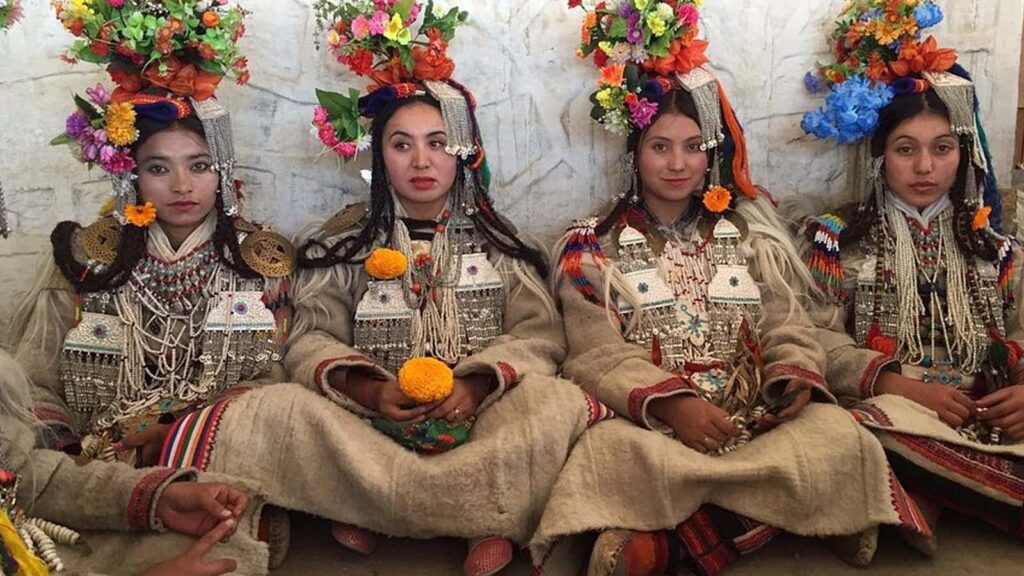
Brokpa’s of Ladakh in their traditional attire
The names people carry
I ended up drinking tea in a village kitchen.
The room was dark compared with the lane outside. There were blackened beams, utensils on shelves, greens drying overhead and a stove working steadily in one corner. Salt tea arrived without ceremony.
When I tried to ask about identity, the conversation moved between words I had been treating too casually: Brokpa, Dard, the name of the village, and the “Aryan” used by outsiders.
I had assumed that replacing Aryan with Brokpa would solve the problem. Later reading made even that less tidy.
Brokpa, also written Brogpa is the name most commonly used in contemporary writing for these communities, but its history is complicated. Ethnographers have recorded it as a term historically applied by Ladakhi neighbors and subsequently adopted locally, while older accounts contain several other names. Some researchers found people identifying themselves most immediately through their villages. Brokskat, the language associated particularly with Dah and neighboring settlements, is closely related to Shina and is generally classified among the Dardic languages.
That mattered because Dardic, Indo-Aryan and Aryan are not interchangeable descriptions of a people.
One can describe a language within the Indo-Aryan branch without turning its speakers into a biological race. That leap from language to blood, from vocabulary to faces is part of what made the older “Aryan” story so powerful.
And so difficult to get rid of.
The source draft of this journey records an elder telling me versions of how outsiders had tried to establish Brokpa origins through appearance and bodily measurement. I no longer think I should repeat that scene as neatly as I once did. I cannot establish from my notes which specific colonial researchers visited which village, much less whether the ancestors of the person sitting beside me were literally measured.
The wider history is clearer.
Nineteenth- and twentieth-century scholarship on the north-western Himalaya repeatedly tried to arrange populations into racial and linguistic types. Later historians and anthropologists have criticized the way categories such as “Dard” were expanded, conflated and made to carry theories of migration and racial origin that the evidence could not sustain. Physical anthropology also developed its own traditions of measuring heads, faces and other bodily features; versions of that approach continued surprisingly recently.
What eventually became the tourist idea of a “pure Aryan” village did not emerge from one traveller or one book. It accumulated.
Language, appearance, folklore, colonial classification and tourism gradually became one story.
When the myth became an attraction
The next layer became easier to see once I started paying attention to what visitors came looking for.
Cameras turned first towards ceremonial dress.
The floral headgear was difficult to ignore: fresh flowers, greenery, metal ornaments and jewellery assembled into something striking enough to dominate photographs of the community. I felt the same pull. My first instinct was to understand what every flower meant.
That instinct was part of the problem.
The original version of this article assigned specific meanings to juniper, marigolds, silver and ibex horns. Looking back, some of those explanations are too exact for me to publish as cultural fact. Research does document important roles for juniper, ceremonial dress and performance in Brokpa cultural life, but symbols do not necessarily carry one fixed meaning across villages, occasions and people.
What I can describe with more confidence is what I saw.
The flowers required work. The jewellery had to be stored. Clothing worn for particular occasions did not remain permanently attached to the people wearing it. At other moments there were ordinary shawls, work clothes, school uniforms and hands occupied with fields, food and household jobs.
That distinction seems embarrassingly obvious now.
It did not always seem obvious to the cameras.
At a women’s cooperative I watched work continue around the visitors. There were looms and small bottles of apricot oil. A notice asked people to seek permission before taking photographs.
The sign interested me almost as much as anything being sold.
It suggested that tourism had already produced its own negotiations: people arrived wanting images; residents had learnt that access to a village was sometimes mistaken for access to everyone inside it.
Read More : Bali’s Duality Where Spirituality Meets Instagram Culture
The “Aryan” story had also become economically useful. That makes it tempting to describe the label simply as something outsiders imposed on unwilling villagers. The history is more complicated than that too.
Anthropologist Mona Bhan has documented how the opening of previously restricted border villages and the promotion of tourism after the conflicts of the late 1990s and the 2003 ceasefire helped turn Brogpa communities into attractions within a broader programme of border tourism. By 2010, she writes, previously inaccessible Brogpa villages were being promoted to visitors, sometimes through explicitly racial language presenting their inhabitants as remnants of a “pure” Aryan population.
Later anthropological work has shown that the identity was not merely imposed from outside. Parts of the community could also use, reinterpret or strategically deploy the Aryan label in tourism and politics.
That is important. People living inside a stereotype are not required to respond to it in only one way.
The Alexander story belongs in the same complicated space.
I heard versions of the claim that the Brokpa were descendants of soldiers who had separated from Alexander’s army and eventually reached these valleys. I have since found the story repeated in tourism literature and discussed in anthropological research. I have not found evidence that allows it to be presented as established history. One recent anthropological analysis points out the chronological problems in treating the community’s own migration traditions as a direct continuation of Alexander’s fourth-century BCE campaign.
It works extremely well as a tourism story because it turns uncertainty into lineage.
History is rarely that obliging.
What remained when I stopped looking for Aryans
Once I stopped organising every observation around ancestry, the village became more interesting.
Water was one example.
I kept noticing irrigation channels running through and above the cultivated ground. One morning I watched stones being shifted to change the direction of the flow. Elsewhere in Ladakh, traditional irrigation channels are managed through local arrangements that determine access, maintenance and turns; even official documents still use khul for such channels in the region.
I did not need to turn the channel into a metaphor. Someone needed water in a field. Someone else would need it afterwards. Stones had to be moved.
The orchards made a similar argument.
Apricots were everywhere in the story I had initially failed to notice: kernels being cracked, fruit being dried or processed, oil being bottled and sold. Visitors could arrive interested in bloodlines and leave carrying the product of trees, irrigation, labour and a short growing season.
At the school, a teacher spoke to me about the languages children moved between. The original draft gives her a series of beautifully formed sentences about history, identity and translation. They are too polished for me to reproduce as verbatim speech without checking my notes.
The substance is more important.
Children here grow up inside more than one linguistic world. Brokskat, Ladakhi, Urdu, Hindi and English can all appear in different parts of life, although patterns vary by village and generation. Even Brokskat itself is not uniformly maintained: linguistic research has noted, for example, its displacement by Ladakhi in Hanu.
That reality is more revealing than the idea of a culture preserved untouched.
Preservation is one of those words travellers like because it freezes the scene at the moment we encounter it. Villages do not have that luxury. Children leave for school. People use phones. Tourism changes incomes and expectations. Religious and linguistic practices change. Borders interrupt older connections. Ceremonial clothes can exist alongside jeans without either one cancelling the other.
One study of Brokpa performance in Darchik describes precisely this tension: practices presented to tourists as timeless “folk” culture are being continually negotiated by people living contemporary lives.
That was much closer to what I had seen.
What DNA does not answer
I had gone to Dah–Hanu with genetics somewhere in the background of the story.
It is difficult to discuss “pure Aryans” for long before somebody eventually asks whether DNA can settle the matter.
It cannot settle it in the way the question expects.
A 2019 study examined genetic markers among Brokpa participants in the Dah–Hanu region. Its results did not support the straightforward genetic picture implied by the popular “pure Aryan” narrative. But it was also a study of particular paternal and maternal lineages, not a test capable of deciding whether an ethnic community is authentic, pure or descended from a named ancient army.
Research has moved further since then.
A 2023 study generated complete mitochondrial genomes from 108 people belonging to three Ladakhi populations, including 32 Brokpa participants. The Brokpa samples showed diverse maternal lineages and evidence of a distinctive demographic history, including a possible population bottleneck. The wider Ladakhi data reflected ancestry connected in different ways to South, East and West Eurasian populations.
In 2026, a peer-reviewed ancient-DNA study from Ladakh pushed the history deeper. Genome-wide data from individuals who lived roughly 1,500 years ago showed ancestry related both to populations represented by present-day northern South Asians and to ancient Tibetans, with the researchers dating admixture between those sources considerably earlier. The finding adds another piece to a picture of Ladakh as a long-standing meeting ground rather than an isolated genetic container.
None of these papers establishes Alexander ancestry.
More importantly, none provides a scientific version of “pure blood”.
Genetic ancestry can tell researchers something about population history. It cannot tell us what ceremonial headgear means to the person wearing it, which language somebody considers theirs, whether a child feels at home in a village, or how a community should describe itself.
Modern genomics is increasingly explicit about that distinction. Race, ethnicity and genetic ancestry are different categories, and racial labels do not map cleanly onto biological populations. No human population is genetically homogeneous in the sense implied by racial ideas of purity.
The phrase “pure Aryan” therefore fails twice.
It turns a complicated human history into a racial category, and then asks genetics to authenticate the category it invented.
The sign on the way out
On my last morning I passed the roadside sign again.
The apricot trees were still there. So were the irrigation channels, houses and fields that had barely registered when I first arrived. Somewhere behind me oil was being pressed and food was being prepared. People were going to school and work.
The word ARYAN was still visible.
It no longer seemed provocative so much as insufficient.
I had arrived thinking the interesting question was whether the people living in these villages really were what the sign claimed.
By the time I left, I was more interested in why so many of us needed the claim in the first place and what became invisible while we were trying to prove it.
There was a bottle of apricot oil in my bag.
I carried that back with me.
The bloodline story could stay on the sign.
“We are not last. We are busy.”
PS : Some names have been changed to protect the privacy of people encountered during this journey. Some dialogue has been reconstructed from field notes and memory. Wording has occasionally been condensed while preserving the meaning of the conversation.