When the Road Became the Mirror
Not All Roads Lead Somewhere, Some Simply Return You to Yourself
“You don’t always travel to find new places. Sometimes, you travel to meet old parts of yourself, the quiet, the cracked, the curious, waiting in the dust where the world forgets to look.”
— The Unwritten Road
It begins with a hum.
Not the kind that buzzes in your ears from traffic or phone screens, but a hum that rises quietly, insistently, from somewhere deep beneath your ribs. A tremor. A longing. Not to escape, but to be tested. To be silenced. To be stripped bare and left staring at the raw, unfiltered shape of who you are.
That’s how Spiti happened.
Not as a bucket list item. Not for reels or ranks or romance. But as a rebellion, soft and fierce against the curated comforts of city life. Against the too-manicured, the algorithm-approved. I wanted something more jagged. Something that might bruise.
So we rode.
Two friends. Two Enfields. A patched-up plan that made more sense in theory than on the trail. No backup vehicles. No bookings. Just more faith than fuel and more poetry than practicality. We weren’t seeking roads. We were seeking reckoning.
What unfolded over the next eight days wasn’t a journey in the travelogue sense, it was a disassembling. A quiet combustion of ego and itinerary. We rode through pine-stitched ridges, across bridges that swayed like prayers, and into villages that looked carved out of memory itself.
We didn’t conquer altitude – it humbled us.
We didn’t chart Spiti – it recharted us.
Each curve was a confession.
Each silence, a sermon.
We mailed letters from the roof of the world, whispered into glacier winds, and spent entire hours riding beside rivers that threatened to swallow not just our wheels, but our certainties. And in the high-altitude air where the gods are said to breathe, we found a version of ourselves that didn’t need fixing or posting just witnessing.
There were no neon signs. No dotted trails on Google Maps. But there were signs: an old monk smiling at nothing, a child offering fossil stones, a valley so still it made your heartbeat sound arrogant.
This isn’t a guide.
It’s not even a story in the usual sense.
It’s a memory, written with dust still under the nails. A journal for the parts of you that don’t speak in status updates but in scars, silence, and soft shifts of soul.
So, if you’re here looking for travel tips, you won’t find many.
But if you’re looking for something else, something quieter, something ancient, then
The road is still warm.
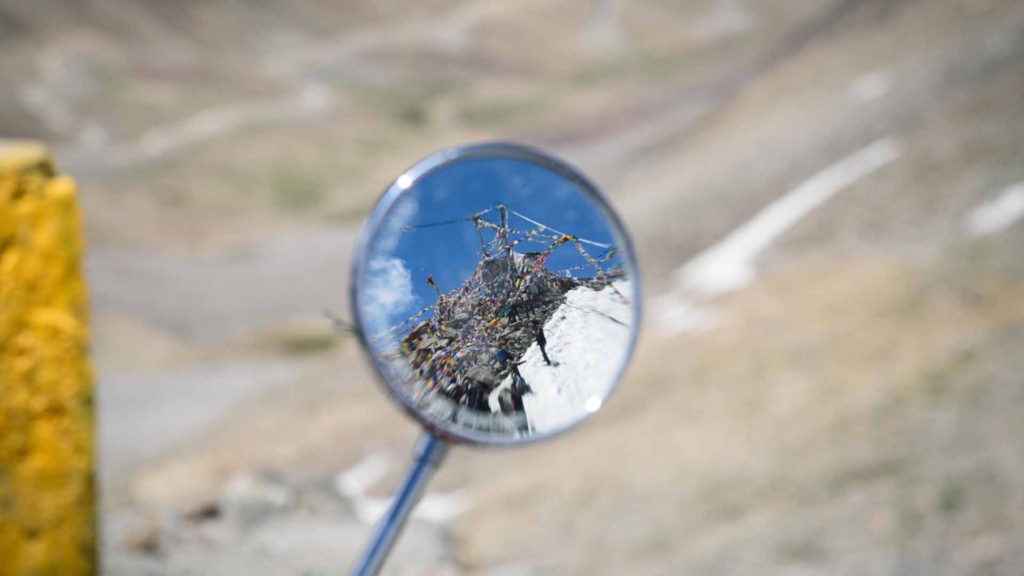
And the mirror is waiting.
The City Sheds Its Skin
Where Engines Become Intention and the Night Folds into Mountains
“Every journey has a beginning, but some feel more like a shedding. The moment you leave the city at dawn – before it’s awake enough to stop you – you’re no longer who you were. You’re someone being rewritten by the road”
— The Unwritten Road
We left Delhi before the city could change its mind.
It was 4:12 AM. The kind of morning that feels less like a start and more like an escape. Our Royal Enfields coughed to life under sodium streetlight halos, the sound of departure echoing down quiet lanes lined with yesterday’s dust and today’s hesitation.
Stracy stood beside her bike, already helmeted, already grinning. She didn’t say much, just a whistle, a nod, and a toss of her head toward the open gate. We weren’t saying goodbye. We were simply slipping away.
There’s something sacrilegious about revving an engine in a sleeping city. But Delhi, in its deepest slumber, felt forgiving. It’s a place that knows the ache of restlessness. That understands when someone needs to leave without applause.
The early miles through Haryana were cold and metallic. Tractors woke. Dhabas lit their first fires. Buses yawned diesel into the sky. But my thoughts were elsewhere – curled ahead of me on roads I hadn’t ridden yet – Spiti. It didn’t feel like a destination. It felt like a secret we were riding toward, one twist at a time.
By Karnal, the sun began to bleed onto the tarmac, soft gold stretching into our visors. Stacy’s silhouette danced in my rearview like a stubborn idea. Fields blurred. Time slowed. It’s a strange thing – how the farther you ride, the less the clock seems to matter.
We stopped briefly outside Solan, where the trees thickened and the air bit back. It was the first time the wind smelled like pine – like something older, something sacred.
In Shimla, we sat on cracked plastic chairs, inhaling greasy momos and nuclear-hot chai. It was loud, chaotic – the last gasp of familiarity before the silence of altitude. A newlywed couple asked where we were headed. “Spiti,” I replied.
They smiled, but their eyes asked a different question: Why?
I didn’t answer. Because I didn’t know. Not yet.
We reached Narkanda just before dusk, the road a ribbon unwinding into twilight. The sky was heavy with mist, the kind that settles in your collar and whispers warnings you don’t want to hear. Our homestay was crooked, leaning into the mountain like it, too, was tired. No Wi-Fi. No heater. Just chipped mugs, a rusted kettle, and a view that forgave everything.
That night, Stacy and I lay in our separate beds, the windows cracked open to the mountain’s breath. A full moon poured silver into the room like it had something urgent to tell us.
“Do you think we’re actually ready?” she whispered.
I stared at the ceiling, listening to the wind nudge the glass.
“I don’t think the mountains care,” I said. “And I think that’s the point.”
Where the Road Disappears Into the River
Between the Pine-Scented Ridges and the Gods of the Baspa Valley
“Some roads are carved not just into mountains, but into memory the kind where each turn feels like a whispered prayer, and each drop of gravel under your tire feels like fate thinking aloud.”
— The Unwritten Road
We left Narkanda just as the sun was reaching for the treetops, casting long gold fingers across the sleepy valley. Our engines were slower to warm than the sky, but something in the air – crisp, wild, faintly resinous quickened our pulse.
It wasn’t just a new day. It was a departure from the known.
The roads through Rampur curved like questions we weren’t ready to answer. The Sutlej followed us like a warning – relentless, rising and falling in white-knuckled rage. There’s something unnerving about a river that never pauses. It doesn’t babble. It booms. It doesn’t invite. It dares. We didn’t speak much. Stacy rode ahead, a silhouette framed by dust and sunlight. Her shoulders seemed tighter than yesterday. Or maybe I was just noticing things more – the way one does when the world gets quieter around them.
Near Sangla, a dhaba materialized out of pine and stone. A man with eyes like clouded glass served us paranthas and said nothing until we were almost done. Then, simply:
“The gods live close in Chitkul. Ride respectfully.”
And just like that, the road changed tone.
The stretch from Sangla to Chitkul isn’t just narrow, it’s unnerving. The kind of path where every hairpin comes with a heartbeat. No guardrails. No illusions. Just dust, drop-offs, and the raw honesty of terrain that doesn’t care if you pass or not.
But oh, what a view.
Below the Baspa River, foaming wild like a creature unleashed.
Above ancient, indifferent peaks, their crowns still dipped in snow, watching.
And in between: US.
Two dots on bikes. Riding a thought. Chasing a feeling.
We reached Chitkul as the sun tilted westward. No triumph. No fist pump. Just a breath let out after being held too long. The village met us with stillness. Wood-smoke. The sound of water running under footbridges. Kids with shy grins. Old women with eyes that had seen every season twice.
Stacy looked around and murmured, “End of the road.”
I shook my head, grinning through dust-chapped lips.
“Start of something else.”
That night, we stayed in a wooden home where the stairs creaked like they had secrets. The view from the balcony wasn’t just beautiful, it was humbling. The kind that makes you feel small in the best way.
Lying in bed, wrapped in layers and listening to the wind paw at the corners of the house, I thought of Delhi – its urgency, its screens, its performance of purpose.
And I knew… whatever version of me left the city wasn’t the one lying here, staring at a cracked ceiling, quietly unlearning everything I thought I needed.
Edge of the Known World
Where the Trees End, and the Stars Begin to Speak
“Somewhere between the fading pine and the first cracked mountain, you stop navigating and start surrendering. What lies ahead isn’t a road it’s a shedding.”
— The Unwritten Road
The sun rose reluctantly in Chitkul, not with drama, but with the slow suspicion of a hermit peeking out of stone shadows. Here, mornings aren’t a spectacle. They’re a negotiation. Between cold and light. Between movement and silence.
We loaded the bikes with stiff fingers, breath hanging in the air like secrets we weren’t ready to speak. The Royal Enfields were beaded with dew not just water, but memory. The kind that clings.
The descent out of Chitkul felt surgical. The road narrowed again, carving itself around cliffs like it didn’t trust our intentions. It didn’t care how early it was. The terrain demanded respect, not awe. And that silence that had stitched itself into our bones only grew deeper.
A section near Rakcham had given way to a rockslide. Just enough space remained for a single tire and a little courage. Stacy went first. Her taillight blinked like Morse code: I’m okay | You come next | Carefully.
By Reckong Peo, the world felt louder again. Scooters buzzed. Fruit carts argued. An auntie sold us mango juice that tasted like Delhi trying to sneak back in. The town was a tether. A checkpoint. We stopped for fuel, recharged dying phones. The network bars teased, then vanished. I didn’t mind. I wasn’t trying to be found.
Lunch was barely edible. But the view? The view was a language we were beginning to understand – jagged, indifferent, and ancient.
The road beyond Peo turned lunar. The trees disappeared. The green gave way to rust and gravel, and the sky changed color every ten minutes. No villages. No milestones. Just wind. Rock. Time. It felt like riding through the fossil of a forgotten planet.
Along the way, we passed pilgrims who carried nothing but smiles. Donkeys tied to prayer flags. Monks who waved as if they recognized something in us – maybe the hunger. Maybe the ache.
A signboard nailed to nothing read:
“Darling, I like you. But not so fast.” The Himalayas have their own sarcasm. It was reassuring.
As dusk thickened like syrup, Nako revealed itself, stone homes stacked like thought, crooked prayer wheels, and a small lake that shimmered like an eye remembering something sacred. We parked the bikes by a low wall and just stood there, watching the wind skim across the water.
We were high now. Not just in altitude, but in awareness. Everything had slowed. Thoughts. Movements. Expectations. That night, we stayed in a mud-walled room with no fan, no heater, no electricity after 8. Just blankets and breath. But the stars outside?
The stars were a cathedral.
A map of truths we forgot we once believed in.
I lay in the dark, eyes open, remembering every time I had trusted the city to light my path.
And how gently the night here proved me wrong.
Where the Wind Wakes the Gods
Between Dust and Green, a Valley Murmurs You Into Stillness
“Sometimes, it’s not the mountain that humbles you – it’s the green after days of grey. The sudden beauty you didn’t earn, arriving like grace.”
— The Unwritten Road
Leaving Nako felt like exiting a dream you weren’t quite done living. The lake, the stone, the silence they stayed behind like verses left unfinished. But journeys don’t wait for longing. They stretch onward, indifferent and magnetic.
The road to Pin Valley didn’t begin so much as dissolve from under our tires. Dust blew in long sighs, and sometimes the edges vanished altogether landsides softened the margins, blurred the borders between what was earth and what was air. Below us, the Spiti River carved a canyon too deep for metaphors. It didn’t run; it tore. A streak of white rage between ancient walls.
We passed Tabo without stopping. Even its thousand-year-old monastery couldn’t pull us off course. Something about the word Mud had a strange gravity. As if the road itself had memory and knew where it was meant to lead us.
And then – the green.
It came quietly, like forgiveness. A gentle rebellion against all the rock and ruin. Poplar trees lined the path like monks in formation. Barley fields unfurled in soft, deliberate steps. Wild rose bushes blinked from the corners of terraces like shy lovers.
Pin Valley had arrived.
We slowed. Not because the terrain demanded it, but because the soul did.
By the time we reached Mudh, the light was stretching long and soft across the valley. The village didn’t announce itself – it whispered. Six or seven houses. Prayer flags strung like thoughts left to the wind. A single narrow road where children played with sticks and echoes.
We stayed with a woman named Dolma. She didn’t say much. Just poured butter tea that steamed like comfort and offered us space like it was currency. When we tried to pay, she laughed and poured more.
That night, the electricity failed, as if on cue.
Candlelight painted the walls in golden breath. Stacy read from her notebook, something about dust being a language, something about silence being fluent. I traced our route onto a page, my pen bleeding from cold fingers. No one checked their phones. There was no network, no distraction – only wind, whispering its way through prayer wheels.
Later, I stepped out alone. The moon was barely above the ridgeline, and the stars good gods, the stars had cracked the sky wide open.
The cold knifed through my jacket. But I stood still. Not because I was brave.
But because I wasn’t afraid.
Not anymore.
Of Mummies, Dust, and the Strange Comfort of Isolation
Where Silence Deepens, and the Bones Still Breathe
“There are places where time forgets to move, where the wind carries more memory than sound, and where even the dead seem wiser than the living.”
— The Unwritten Road
We left Mud reluctantly, our backs stiff, our hearts slower to start than the bikes. The silence there hadn’t just filled the space; it had rooted in us. It was the kind that didn’t just hush your thoughts – it rewrote them.
You don’t leave a place like Pin Valley.
You retreat.
The descent back to the Spiti highway was ruthless. A shallow stream greeted us early, deceptively gentle, then icy enough to make our boots pointless. Further ahead, a loose gravel patch threw Stacy’s bike sideways – one moment she was there, the next, just a rising plume of dust. When it cleared, she was laughing, blood on her knee, ego dented but whole.
Neither of us said much. The road to Gue didn’t encourage conversation. It swallowed words, massive cliffs rising like cracked spines, switchbacks drawn by an unsteady hand, air that grew thinner with every breath.
Gue appeared suddenly, a speck of stone and spirit carved into the dry bones of the mountain. A place so small, you’d miss it if not for what it holds: a 500-year-old monk, mummified in prayer. We stood before him, unsure of protocol. His legs crossed, hands folded, spine straight. Teeth intact. The skin parchment-thin, but unmistakably alive in some unfathomable way.
It wasn’t peace I saw on his face.
It wasn’t pain either.
It was something in between. Something that felt like… thinking.
A man – the caretaker, perhaps a monk, perhaps something else, stepped out of the shadows. I asked, “Why hasn’t he turned to dust?”
He smiled gently.
“Faith is a preservative.”
I wrote that down. Not in my travel journal, but on a scrap of paper. Folded it into my wallet. Like a talisman. Like a truth you don’t want to lose in a more cynical place.
From Gue to Kaza, the road opened up wide stretches, fewer turns, a deceptive comfort. But the wind was cruel now. It didn’t breeze. It sliced. Grains of sand stung our cheeks like small punishments. Our gloves weren’t enough. Our scarves weren’t barriers. This was no longer just travel. It was pilgrimage.
By the time we reached Kaza, the town looked like salvation. And yet, strangely, like intrusion. White buildings. Stupas. Children laughing. Food smells. Mobile towers. Modernity, yes – but too sudden. Too loud.
We checked into a quiet guesthouse, where the walls sighed with old incense and the beds squeaked like reluctant memories. Stacy lay on her cot, staring at the ceiling. We didn’t speak for hours.
That evening, we sat across from each other with mugs of lemon ginger tea, hands thawing slowly.
She said, almost to herself,
“I think that mummy saw more life than most of us ever will.”
I nodded.
Not because I understood it all.
But because some truths don’t ask for comprehension. Only stillness.
Letters to the Sky and Gods in the Fog
Where Fossils Speak, Monks Whisper, and Time Waits on a Postcard
“In places too high for ambition and too quiet for doubt, you begin to hear the parts of yourself that don’t speak in cities.”
— The Unwritten Road
If Kaza was a breath, then today was the slow exhale. One of those rare days when the road doesn’t ask for much, just your attention, your reverence, your willingness to be remade.
We started late. Not out of laziness, but respect. The sun needed time to warm the spines of the valley, and we needed time to let the dust settle in our own.
Our first stop: Hikkim, home to the world’s highest post office.
And what a contradiction it was. A red metal box nailed to a wall. A room the size of an apology. And a man, calm, old, slightly bent sorting postcards like sacred texts. He didn’t look up much. As if he knew exactly what each traveler had come to write.
I scribbled a note to myself. A letter I may never receive.
“Dear future me,
I hope you still remember the weight of dust on your eyelids,
and the silence that held you like a friend.”
We dropped it in the box with something close to ceremony. Stacy saluted. I bowed.
From there, the road coiled upward toward Langza, where the Buddha watches over the valley with a gaze that’s either amused or eternal. The wind picked up, snapping prayer flags in Morse code. Children ran across the stone courtyard, chasing marbles. Laughter bounced off the mountain like it had nowhere better to be.
A boy, no older than ten – handed me a fossil stone.
“It was a sea,” he said, pointing at the peaks.
“And this,” he added, “was a creature once.”
He said it like a teacher. Like a priest.
Like he knew he was handing over time itself.
We didn’t say much at Langza. Some places aren’t meant to be narrated. They’re meant to be felt deep in the ribs, where longing and stillness meet.
Then came Key Monastery, that mythical outpost etched into the mountain’s shoulder like it had been grown, not built. We parked the bikes and walked up in silence – boots on ancient stone, hearts half-expecting revelation.
Inside, butter lamps flickered like fragile hopes. The air was thick with incense and the scent of aged wood. Monks moved like wind shadows, murmuring mantras not for show, but because they always had. We sat down, cross-legged, uninvited but not unwelcome. For half an hour, we simply breathed. That was enough.
I looked at Stacy, a woman who never stopped talking, sitting still, eyes closed, unmoved by everything but the weightlessness of the moment. For the first time in days, she looked rooted. Whole.
Outside, the fog had rolled in. It swallowed the peaks, erased the edges. Then it parted, just enough for one last look at the monastery, now blurred like memory. And somehow, the world felt more… shaped.
We rode back to Kaza as twilight painted the sky in bruised violets. There was no fanfare, no last-minute detour. Just the quiet return to a room that smelled of old books and boiled potatoes.
Dinner was soup and chapatis.
It wasn’t remarkable.
But we ate like men nearing the end of a pilgrimage.
Every bite tasted like something sacred.
Stacy poured us two mugs of lemon tea and lifted her quietly.
“To the monk in the fog,” she said.
And I raised mine in reply.
“To the boy with the sea fossil.”
Where the Moon Waited
The Lake, the Light, and the Quiet That Undid Us
“There are places that don’t just reflect your face, but your fatigue, your longing, and every silent version of you that never had words. Chandratal was that place, the mirror, the road had been leading us to all along.”
— The Unwritten Road
We left Kaza zipped to the chin, the weight of the journey gathering behind us like wind in a prayer flag. Our bikes sputtered awake, old bones creaking, gears reluctant. The valley didn’t see us off with a smile. Just a stillness that felt like quiet approval… or quiet warning. We weren’t sure which.
The road to Chandratal isn’t a road. It’s a dare written in stone, water, and altitude.
Past Rangrik, the tarmac dissolved into gravel, which quickly turned to nothing at all. Snow-fed streams crossed the trail like small rebellions. By the third water crossing, my boots were sloshing, socks heavy, spine vibrating with every jolt. Stacy caught a patch of loose shale and wobbled, her rear wheel spinning wildly before finding ground again. Her thumb went up. Her eyes were not smiling.
We didn’t laugh.
Not anymore.
At Losar, we refueled with instant noodles and nervous glances at the sky. The clouds had dropped lower, and the wind started speaking in that clipped mountain tongue, the one that says, “I don’t care how far you’ve come.”
And then came Kunzum La.
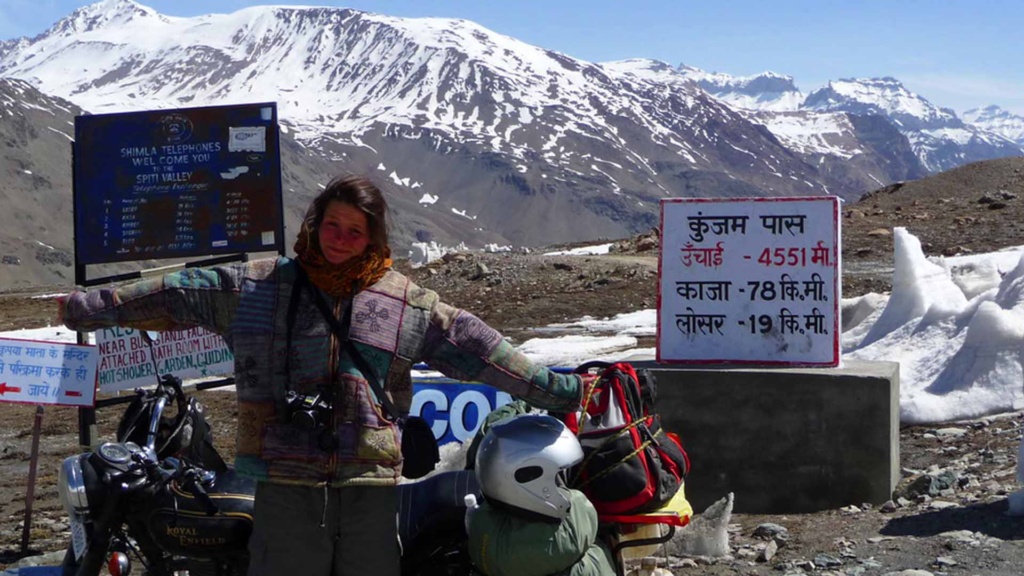
The pass wore its flags like scars. We stopped to turn the prayer wheels, part tradition, part superstition. Just in case. From there, the trail turned lawless. Not a road but a suggestion, 14 kilometers of surrender.
Stacy stood on her pegs, riding with the rhythm of someone who had stopped resisting. I followed, less out of bravery, more because turning back had stopped being a choice somewhere in Pin Valley. Every bounce off rock was a question: how much more can you take?
And then, like breath withheld too long…
Chandratal.
It appeared with no sign, no announcement, just the sudden hush of presence. A blue too still to be real. A mirror edged in glacier, sky, and disbelief. No shimmer. No ripple. Just… stillness. The kind that unravels your noise.
We parked the bikes in reverence, walked the last kilometer like pilgrims, boots crunching shale, silence stretching between us.
When we reached the lake, we didn’t take out our phones. Not even Stacy, who once took a selfie on the way to the loo. The lake didn’t invite capture. It invited surrender.
I crouched by the water and saw not my reflection, but my fatigue, my doubt, my longing, all suspended in that blue hush.
That night, we pitched our tent under the clearest sky I’ve ever seen. There was no network. No other campers. No noise but the wind threading itself through the guy ropes like a lullaby. Dinner was peanuts and silence.
The sky was biblical. Stars crowding in with a kind of ferocity, as if trying to be seen by us one last time. One fell, streaking a perfect line across the black, and vanished.
Somewhere, a yak coughed. Somewhere, our older selves waited.
Wrapped in fleece, breath misting in the cold, we lay back and stared through the flap.
Stacy whispered, “If I die tonight, bury me here.”
I whispered back, “We already have.”
Because something did die there.
The impatience. The hurry. The need to narrate.
In its place, something quieter bloomed.
Not peace.
Not yet.
But… permission.
To be lost. To be quiet. To not explain.
We were meant to ride to Manali the next day.
But the road — and something deeper — had other plans.
We were no longer riding through the mountains
We were becoming them.
The Detour Divine
Where Frost Bled into Fern, and the Road Rewrote Us
“There are journeys we plan, and then there are those that find us mid-road, whispering detours like prophecy. The road to Manali was closed so the soul turned its face toward Lahaul.”
— From the traveler’s notebook, somewhere near Sissu
Morning at Chandratal broke like a hush. The kind of quiet that tiptoes through fabric and bone. Outside our frost-glazed tent, the world was paused the lake still as myth, the mountains holding their breath.
Our boots were stiff with ice. Helmets cold as prayer bowls. Sameer tried to stretch and groaned, “I feel like a broken spoon.” But he smiled that crooked smile the one he wears when something aches good. We moved slowly, like men peeling themselves from a dream not quite finished.
The plan at least on paper was simple.
Chandratal to Manali. Warmth. Comfort. The end.
But ten kilometers in, a shepherd wrapped in wool flagged us down near Chhota Dara.
“Rohtang’s jammed,” he muttered. “Landslide. Could be hours.”
He might as well have said: Go another way. Go further.
Stracy looked at me. I didn’t say a word. Just turned my head to the shadowed shoulders of the Lahaul Valley, stretching northward, unpromised.
The bikes idled for a second longer then fell silent.
“I don’t want to go back yet,” I said, not fully to her, not fully to myself.
She didn’t argue. Just reached into her saddlebag, pulled out a crumpled map like a gambler lighting his final match.
“Let’s go,” she said. “To wherever the road wants.”
We descended.
The trail curled downward in dizzying loops. Stones gave way to moss, browns to lush green. The wind shifted tones no longer the high-pitched screech of Spiti’s emptiness, but a softer hum, like a lullaby written in leaves.
Lahaul welcomed us.
Where Spiti had tested us, Lahaul invited. The landscape felt gentler, slower, as if it had been watching all along and now finally stepped forward, offering tea and forgiveness.
We stopped at Sissu, that quiet halfway village that felt more like a doorway than a place. A tea shack. Two old women gossiping while shelling peas. A stack of greasy pakoras that tasted like absolution.
“You’re not going to Manali?” one of them asked, eyes squinting with curiosity.
Stracy smiled, her beard dusted with salt. “Not yet.”
From there, the road unraveled beside the Chandra River, glittering like a long-held note. Somewhere near Tandi, where two rivers meet, we pulled over.
Stracy sat on a boulder. Helmet off. Eyes far.
The water below sang in stereo. Not loud just constant, like a truth too tired to shout anymore. We sat without speaking. Not from exhaustion. Not even awe. Just presence. The dust had settled. In our boots. In our bodies. In our heads.
The detour that beautiful, unsolicited offering from the road had become something else entirely. That evening, instead of beds and Wi-Fi, we pitched camp again. By choice.
The moon was thinner now. A comma in the sentence of sky.
Stracy lay back on the earth and said, “I don’t know if I’m ready to return.”
I looked at the stars, smaller somehow in the Lahaul air.
“Maybe we don’t have to. Not all of us anyway.”
Because the road that fickle, wonderful creature had done something irreversible.
It had carved something out of us.
And in its place, it had planted the quiet.
Epilogue: Where the Road Leaves Its Echo
Of Dust, Detours & What Remains
“The road doesn’t change you. You do. The road just strips away everything that isn’t real.”
— The Unwritten Road
Eight days.
Through silence, through snowmelt, through switchbacks that whispered death and skies that murmured divinity.
We came looking for views.
We found mirrors.
We thought we’d conquer Spiti.
But Spiti doesn’t ask to be conquered.
It waits.
And then it watches as you unravel.
We rode through hunger and hail. Fell on gravel and rose with laughter. Slept in cracked mud rooms and woke to stars that looked like they were bleeding light. There were no milestones, no bucket lists ticked only the gentle but firm undoing of the need for either.
The engines roared, but inside our helmets, it was the silence that thundered.
We mailed letters from heaven.
We stood at the world’s edge and forgot to speak.
We ate Maggi under monasteries older than memory.
We crossed rivers that didn’t care if we lived or learned.
And somewhere between Mud and Kaza, between Chandratal and the valleys of Lahaul, we were no longer chasing a destination.
We were becoming one.
This wasn’t a ride guided by GPS or Google pins. That technology died somewhere after Nako. The phone became a metal paperweight. But the wind? The dust? The old men in wool caps pointing with eyes instead of fingers? They became the map. The riverbanks became pages. The stones were punctuation. The wind a dialect we didn’t speak but understood.
We didn’t return through Manali.
The road had collapsed. A landslide, they said. But we didn’t grieve it. The mountains just weren’t done with us. So, we turned toward Sissu, toward the valley of unplanned grace. Toward a sentence we didn’t expect to write. And maybe that’s what this ride always was an unfinished story we had the privilege to interrupt with our presence.
And when I think about it now, it’s not the photographs I return to.
It’s the bruises. The mud under my fingernails. The grin Stacy gave me when her bike skidded and she stood up laughing, blood mixing with dust like some warrior in a forgotten poem.
The land didn’t give us answers.
It gave us permission.
To lose our way. To fall. To feel.
To stop pretending we knew what we were doing.
Every cracked suspension, every shiver of altitude biting at our lungs they weren’t failures. They were offerings. Reminders that we had been fully there, fallible and alive.
And now, back in the city, beneath strip lights and deadlines, we carry that dust like incense in our lungs. We walk slower. We speak softer. Something inside us refuses to forget.
Maybe one day, we’ll spot each other across a crowded metro platform, hear the distant thump of a Royal Enfield echoing from someone else’s commute and without a word, we’ll smile and ask the question:
“You hear it too, don’t you?”
The engine warming up again.
The road, whispering once more.