A night at Suvarnabhumi, between an arrival stamp and a flight to Kuala Lumpur
Midnight queue
At Suvarnabhumi, sometime after midnight in July 2024, I stood in the immigration queue with my passport open in one hand and my documents softening slightly from the warmth of my palm.
I had arrived alone. That always changes the way an airport feels. When you travel with someone, fatigue gets distributed between two bodies. Alone, you become responsible for every document, every signboard, every half-heard announcement, every mistake your tired brain might make. I had five hours before my onward flight to Kuala Lumpur, where I would leave with Camilla and Jenna, two friends I had made in Bangkok. We had been staying at the same hotel, discovered we were heading out on the same route, and allowed the friendship to become practical in the easy way travel sometimes permits.
But first there was the small matter of being processed.
The hall had the particular brightness of airports that do not believe in night. Fluorescent light flattened everyone equally: families, backpackers, business travellers, monks, children asleep against luggage, people who had clearly dressed for a different temperature and were now regretting it quietly. Bags rolled over the tiles with the same dry rattle. Announcements rose and fell above us, too polished to be comforting.
I was tired enough to start doing what tired travellers often do: inventing lives for strangers.
A monk in saffron robes stood several rows ahead, still in a way I envied. A businessman kept checking his phone, then the queue, then his phone again. A grandmother held a transparent plastic bag with medicine bottles inside. A German backpacker behind me hummed under his breath. A woman in bright lipstick carried instant noodles and kept adjusting her blouse. A child asked for water too loudly, and several adults smiled because children are allowed to puncture bureaucracy in a way the rest of us are not.
The older version of this story would have told you who they were.
It would have given the grandmother a destination, the businessman a crisis, the monk a lesson, the woman a secret, the backpacker a whole cheap-beer biography based on his sunburn. Standing there, I understood the temptation. Airports make people visible and unknowable at the same time. You see exhaustion, posture, documents, bags, shoes, gestures. You do not see the life.
So I tried to stay with what was actually in front of me.
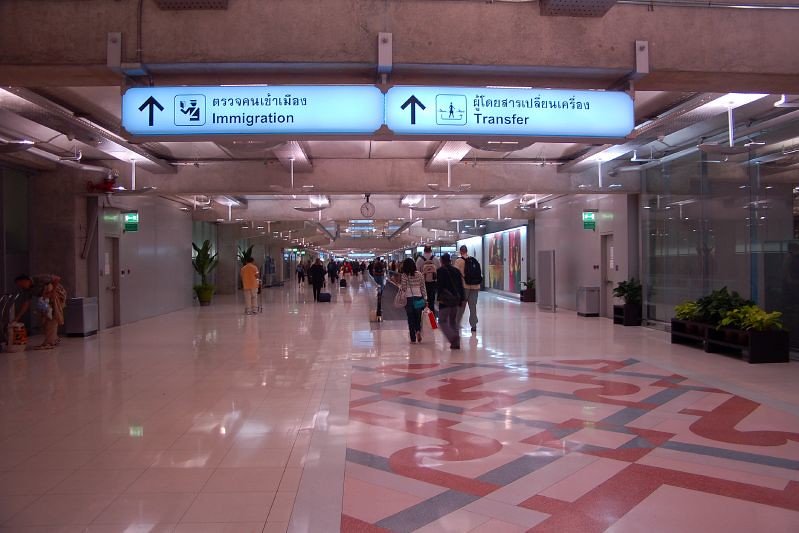
Airport corridors
The desk
The queue moved the way late-night queues move: slowly enough for irritation, steadily enough to prevent rebellion.
By the time I reached the counter, I had rehearsed the small choreography of compliance. Passport ready. Documents ready. Expression neutral. Smile available but not over-eager. Shoulders relaxed in the unnatural way one relaxes when being observed by authority. I had gone through visa-on-arrival formalities and immigration counters before, but repetition does not remove the strange intimacy of the moment. A stranger sits behind glass, and for a few seconds your tired body becomes a file.
The officer took my passport without small talk. He checked the documents, turned a page, looked at the screen, then gestured towards the scanner. I placed my fingers where the machine wanted them. It beeped. He did not comment. I did not fill the silence.
That was the whole scene: document check, fingerprint scan, silence, stamp.
The stamp landed with a soft, practical thud. Nothing in the hall changed. No music rose. No door opened dramatically. My passport slid back towards me, and my body released a breath I had not noticed it was holding.
I walked away from the counter with the odd lightness that comes after being permitted to continue. It was not triumph. It was simply movement resumed. Behind me, the queue kept folding into itself. Another traveller stepped forward. The officer looked down again. The machine continued.
What I could actually see
After immigration, the airport widened into corridors, shuttered shops, open counters, sleeping bodies and cleaning staff moving with a steadiness that made the rest of us look temporary.
Cleaning staff passed with carts and mops, navigating around bags, feet and half-conscious travellers. One man paused near a row of seats, leaned briefly on his mop, then continued. I bought a bottle of water and offered him one too. He hesitated, accepted it, and nodded. That was all. No speech, no lesson. Just water moving from one tired person to another.
In the waiting area, people had made beds out of whatever the airport had failed to provide. Backpacks became pillows. Jackets became blankets. A father sat upright while a child slept against him, guarding the sleep as if it were luggage. A woman shifted on a row of chairs so another traveller could stretch out. Someone adjusted a fallen bag near a sleeping passenger. These were not grand acts of kindness. They were small corrections to discomfort.
At one point, a man praying near a gate laid out a small cloth and lowered his forehead to the floor. Around him, passengers continued their airport work: checking phones, opening snacks, whispering, looking up at screens. Nobody interrupted him. That restraint felt important. Not reverent exactly, just decent.
Language became practical. A Japanese traveller mimed drinking tea while asking a Thai security guard about a lounge. An Indian woman at a counter repeated “SIM card” until the cashier understood and produced one with a triumphant grin. In the bathroom queue, a man pressed his hands to his stomach apologetically and I nodded him ahead. When he came out, he gave me a thumbs-up.
None of these moments needed interpretation beyond what happened. Need crossed a gap. Gesture did the work that grammar could not.
Five hours in the terminal
By then hunger had arrived, though not the honest kind. Airport hunger is often boredom wearing the body’s uniform.
I bought coffee and mango sticky rice. The coffee was hot enough to be useful and not good enough to deserve description beyond that. The mango sticky rice was sweeter than I expected and more comforting than it had any right to be under fluorescent light. I ate slowly because eating gave the waiting something to do.
Around me, Suvarnabhumi kept rearranging itself. Announcements called flights in voices designed to be clear rather than human. Names of cities appeared on the departure board and disappeared into gates. People woke suddenly when a sound resembled their flight number. Others slept through announcements that probably mattered to them. A man argued softly at a counter — “No, I confirmed this online” — while the agent listened with the face of someone who had heard the sentence in many accents.
Camilla and Jenna found me closer to the departure side, where the night had thinned but not ended. There is a specific relief in seeing familiar faces inside an airport: not joy exactly, but the sudden reduction of responsibility. We had not known one another long. A hotel, a few conversations, the discovery of a shared route, and suddenly we were the kind of friends who could compare gate numbers and watch each other’s bags while someone went in search of coffee. Travel sometimes builds friendship not by depth but by timing.
We compared fragments: flight times, gates, food, sleep, the kind of nonsense conversation people have when their bodies want a bed and their tickets want obedience. The three of us were heading towards Kuala Lumpur, but for those hours the route felt less important than the shared waiting. We were not in Thailand in any meaningful way anymore, but we had not reached Malaysia either. We were simply in the airport’s custody.
Somewhere in those five hours, the airport stopped being a place I was passing through and became the place itself. Not Bangkok, not Kuala Lumpur, not arrival, not departure. Just tiled floor, warm passport, coffee cup, mango sticky rice, screen light, documents, announcements, and people waiting beside lives I had no right to finish in my head.
That may have been the only real lesson of the night: attention is not the same as ownership. To notice someone is not to know them. To stand beside a stranger at midnight is not permission to turn them into a character.
Seat 32A
When boarding finally began for Kuala Lumpur, the waiting area changed temperature without the air changing at all.
Bodies that had been folded over bags straightened. Passports emerged. Phone screens brightened. Families counted children. People checked tickets they had already checked many times. Camilla and Jenna moved ahead, then slowed, then we joined the line in that loose, obedient way passengers do when the gate opens and everyone pretends not to be anxious about overhead-bin space.
The scan beeped. My boarding pass survived. I walked down the aerobridge with the dull gratitude of a person who had been awake too long and was now being allowed to sit in a numbered place.
Seat 32A was real, and it was a window.
I put my bag away, sat down, and let my shoulder touch the cold curve of the aircraft wall. The cabin smelled of fabric cleaner, recycled air and people trying to remain polite while exhausted. Camilla and Jenna were somewhere nearby, no longer strangers from a hotel but companions in the same narrow metal tube. Outside, Bangkok sat in darkness and light at the same time. Service roads glowed. Aircraft moved like slow insects. The terminal held more people whose stories I did not know and did not need to complete.
As the plane pushed back, I looked through the window and watched Suvarnabhumi begin to slide away. The runway lights arranged themselves into lines so precise they seemed unreal. Then the engines gathered force, the cabin tightened around its own noise, and the ground loosened.
Bangkok’s lights spread beneath us: gold threads, black gaps, highways, water, neighbourhoods reduced to pattern. I had spent the night among faces, documents, counters, cups, gestures and small acts of fatigue. Now all of it was below me, shrinking into a city I had entered, waited inside, and left again.
I pressed my forehead lightly to the window. The glass was cool. Seat 32A held me in place as the lights thinned, then blurred, then became only brightness under cloud.
For once, I did not try to make a story out of every face.
I watched until Bangkok disappeared.