Village life, memory and the lower Indus beyond a war name
The name before the place
By the time I rode west from Leh in early June 2015, Batalik was already a name in my head, but not yet a place.
That is a dangerous way to arrive anywhere. Names collected from news, maps and other people’s sentences tend to harden before the road has a chance to correct them. Batalik, for me, carried the weight of 1999 before I had seen a single field, kitchen, lane or water channel there. It belonged to the shorthand of border reports and conflict memory, a word that seemed to come with ridges already attached to it.
The motorcycle was a better teacher than my imagination. It did not care for abstractions. It cared for heat, fuel, gravel, suspension, water, the angle of a turn and the fact that I was travelling alone with an Inner Line Permit already folded somewhere safe among papers I would need at checkposts. I rode out through Lamayuru first, the land opening and folding in its familiar eroded drama, and then began tracing the lower Indus corridor through villages whose names I had heard in fragments: Garkon, Hanu, Dah, Darchik, Batalik.
The road changed the word slowly. It took away the loudness I had brought with me. There were no cinematic announcements, no sudden soundtrack of frontier seriousness. There was only the Indus moving beside the road, stone walls holding fields in place, apricot trees beginning their summer work, children watching a motorcycle pass, and people whose days had more important tasks than becoming symbols for a traveller.
I had two weeks in the corridor, which is still not enough to know it, but enough to stop treating it as a headline. That became the purpose of the journey, though I understood it only later: to let Batalik become smaller, more ordinary and therefore more real.
Villages at the Indus Elbow: Life Along a Quiet, Unseen Fence
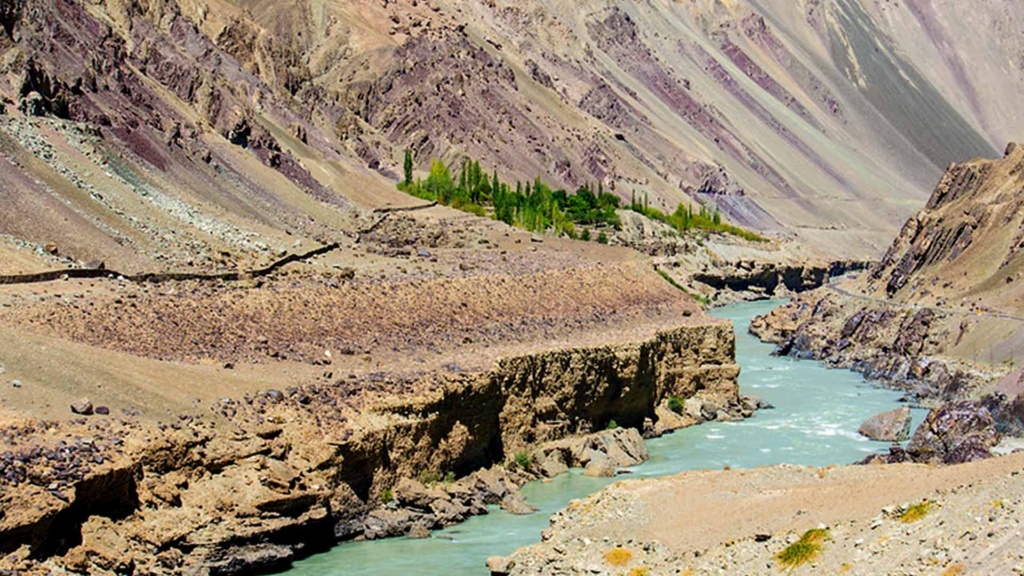
Indus at the bend
The lower Indus
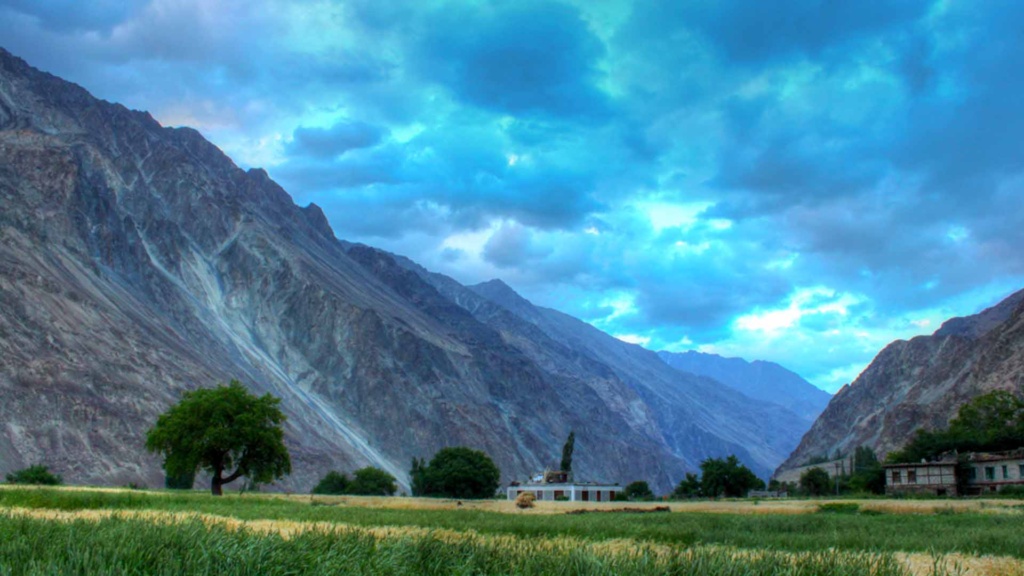
The road west had a different tone from the better-known Ladakh circuits. It did not perform for the camera in the same way. The Indus was often present without being picturesque, green-grey and muscular, carrying cold from higher places into a valley of orchards, channels and stone. The villages along it seemed built from negotiation: with slope, water, winter, road, memory, and the administrative caution that comes with living close to a sensitive line.
At Garkon and then towards Hanu and Dah, I began to notice how much of daily life was organised around water. Channels ran beside paths and through fields with the authority of systems older than signage. Someone always seemed to know where water had to go next. A turn, a blockage, a small opening or closing these were not scenic details. They were the village’s working grammar, though I hesitate to use that word because the valley did not need literary help from me. It was already precise.
The Brokpa/Dard identity of villages like Dah and Hanu often gets flattened by outsiders into a few exotic phrases. I had heard some of those phrases before travelling, and I was already suspicious of them. In the villages, the more useful thing was to pay attention to what was in front of me: fields, houses, headgear, work, water, refusals, jokes, the timing of tea, the way a person decided whether a stranger deserved another answer. I did not need to turn people into a cultural exhibit to notice that I was moving through a distinct and deeply rooted place.
One afternoon, I asked an elder if I could photograph her. She was wearing traditional headgear, with flowers and metal details arranged in a way that was both ordinary and carefully held. She refused with a smile. That moment stayed because it corrected me without humiliating me. She did not owe me her face just because I had arrived with curiosity. I put the camera down and kept the conversation, which was the better bargain.
I carried that refusal with me through the rest of the corridor. It changed how I looked. A person not photographed does not become less memorable. Sometimes they become more so, because memory is then required to work without ownership.
Beyond “True Blood”: Unpacking the “Aryan” Myth in Brokpa Country
Batalik after the headline
Batalik arrived without the drama my imagination had prepared for it.
There were houses, lanes, a mosque, shopfronts, fields, the river nearby, and the practical rhythm of a village that did not pause for my arrival. I found a homestay and stayed there on a self-funded basis. Fatima, who can be named, became the person through whom the village first settled into a human scale. She did not perform hospitality. She practised it: food, bedding, tea, instructions, the small corrections that keep a guest from misunderstanding a house.
The room was simple, and because it was simple I remember it clearly. A place to put the bags. A bed. Light entering without ceremony. The relief of taking off riding gear after the day’s heat and dust. The motorcycle outside, cooling into small metallic clicks. After many hours alone on the road, even the sound of someone moving utensils in another room felt like company.
Dinner was not a syllabus, though the old version of me would have been tempted to make it one. There was home food, warm and practical, the kind that brings the body back from the road before the mind starts asking large questions again. I remember eating with the attention hunger gives to ordinary things. I remember Fatima moving between kitchen and room with the efficiency of someone who had other work beyond my comfort. That, too, was a form of kindness.
Only after the village had become a place of rooms and food did 1999 enter the conversation. Not as a speech. Not as a performance. More as a presence that could not be entirely avoided. Batalik was one of the names associated with the 1999 Kargil conflict, and that history still sat in the landscape, but not in the way a visitor might expect. It was not always visible in memorial language. Often it was in pauses, in where someone did not elaborate, in the practical caution around roads and photography, in the way people continued to live with a past that outsiders tend to arrive already interpreting.
I decided not to push. There are memories that should not be extracted because a traveller needs emotional weight for an article. The more time I spent there, the clearer this became: the village had survived history, but survival was not the only story it was telling.
Morning work
Morning made Batalik easier to understand than evening had.
The village woke through work. Water had to move. Animals had to be managed. Tea had to be made. Apricots had to be checked, sorted, watched or discussed, depending on their stage in the season and the household’s patience. The lanes filled not with spectacle but with errands. Someone carried something. Someone called out. A door opened. A child ran with no symbolic purpose whatsoever, which is the best kind of child scene in travel.
I walked without trying to convert everything into meaning. The Indus held its own course below, colder and more forceful than the gentle order of the channels suggested. Apricot trees gave shade in courtyards and along edges. Stone walls leaned into their labour. A shop became a place to buy what I did not strictly need because in small places, spending a little money honestly is one way of participating instead of merely observing.
Because I was there for nearly two weeks across the corridor, the days began to lose the impatience of arrival. I could sit longer. I could accept not being told everything. I could ride to the next village and return with less of the collector’s urgency. There is a difference between gathering material and staying available to a place. I was only beginning to learn it.
A short ridge walk near Batalik gave the older history a physical outline, but I want to keep that memory brief. We climbed only enough to see how the village sat in relation to slope, river and road. Someone indicated areas connected to past fighting without turning them into a tour. I looked, listened and did not ask for more than was offered. The point was not to stand above Batalik and decode war from the land. The point was to understand that people below had to keep living after the ridge became quiet again.
From up there, the village looked smaller but not simpler. That is the mistake distance makes. It reduces detail. Back in the lanes, detail returned: a water channel flashing in sun, Fatima’s doorway, apricot leaves moving lightly, the sound of my motorcycle being kicked awake after too long in one place.
Road out to Kargil
When I left Batalik, I did not feel that I had “understood” it. That would be too easy, and possibly rude. I had only corrected my first mistake.
I had arrived with a war name. I left with a road of smaller things: Fatima’s kitchen, the elder’s refusal of a photograph, water dividing through fields, apricot shade, a brief ridge, the Indus carrying its cold argument beside the valley, and the repeated discipline of not making every silence speak for me. Batalik had not erased its history. It had simply refused to be reduced to it.
The ride out towards Kargil carried that correction in the body. The motorcycle moved through dust and heat. The road tightened and opened by turns. Behind me were Batalik, Barchik, Dah, Hanu and Garkon, not as a string of names for a caption, but as lived pauses along a corridor I had entered too loudly and left more carefully.
At a bend, I stopped to retie luggage and drink water. The engine ticked in the sun. My gloves were stiff with dust. Below, the Indus kept moving, indifferent to my improved understanding. I looked back once, not for a final lesson, but to check the road before joining it again. Then I started the motorcycle and rode on towards Kargil, carrying less certainty than I had brought, which felt like the right weight for that valley.