
A stopover that became the quietest memory of a long motorcycle ride home
The decision happened on the shoulder of the road, not at a reception desk.
It was January 2025, and Harbal and I were riding back from the Rann of Kutch towards Delhi on motorcycles. Beawar had been the plan for the night, because maps have a way of making distance look reasonable when you are still fresh in the morning. By 8 PM, that plan had begun to look less like discipline and more like ego.
The engines ticked as they cooled. Trucks passed in hard strips of light. The dark beyond their headlights was dense enough to make every kilometre feel borrowed. Beawar was still about 200 kilometres away. On a car journey, perhaps that number can be negotiated. On motorcycles, after a long day out of Kutch, with tired shoulders and the body beginning to make small mistakes, it felt like a warning.
We did the familiar roadside arithmetic. Push on and reach late, or stop somewhere near Sheoganj and accept that the road had won the day. The second option sounded less heroic and much wiser.
Phones came out. The usual anonymous choices appeared first: highway hotels, square buildings, bright signs, rooms that promised little beyond a bed. Then one name slowed the scrolling: Vriksh Jawai The Farm Stay.
A farm stay. Three rooms. Somewhere off the main road. The kind of place that could be terrible if the approach failed, or memorable if the night was kind.
We turned off.
That was when the road became a trail.
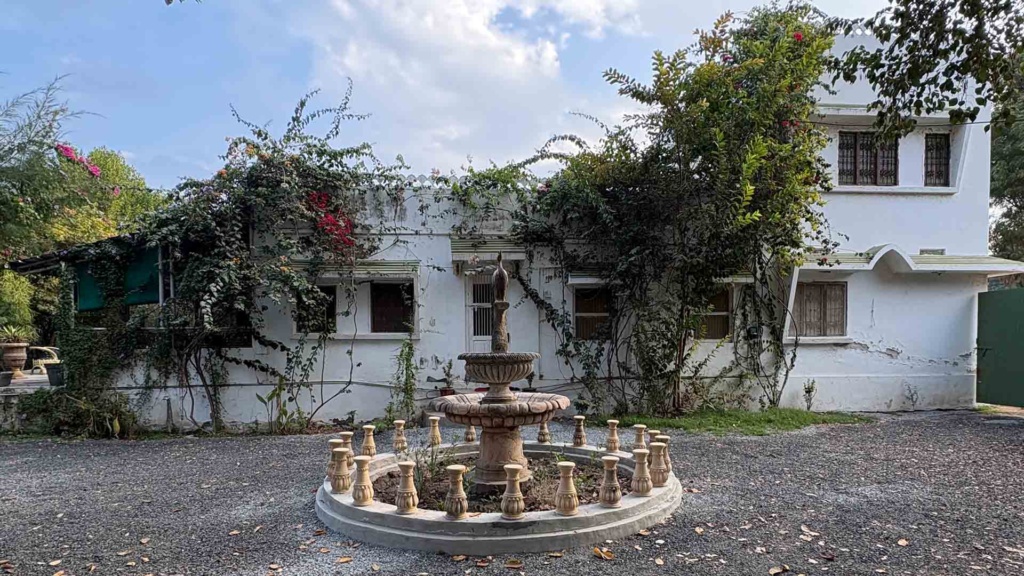
Exterior
The trail to the farm
The approach to Vriksh Jawai was the first honest inconvenience of the stay.
In daylight, it might have felt charming. At night, after a long ride, with motorcycles loaded and tired wrists on the throttle, the track demanded attention. Gravel shifted under the tyres. The beam of the headlamp caught scrub, stones, fields, sudden bends, then nothing. The highway noise thinned behind us until only the crunch of the track, the engine note and the occasional dog bark remained.
I remember thinking that a place can be peaceful in photographs and still make you earn the last kilometre.
Then the property appeared.
Not dramatically. No big-lit entrance, no resort-style announcement. Just a low, old-stone presence in the dark, lantern light at the entrance, trees and fields around it, and the feeling that we had come too far off the road to still be in the road’s mood. Vriksh Jawai The Farm Stay is listed publicly around the Sheoganj/Sumerpur area on Koliwara Road/Sodha Farm, but in the moment it felt less like an address and more like relief. MakeMyTrip
The host met us at the gate. I am keeping his name out unless needed, but the rawla-family background was part of the evening and can stay because it was spoken of naturally, not presented as a sales pitch. He carried himself like someone used to land, guests, stories and late arrivals. There was no fuss about our timing. No performance of hospitality. Just the practical kindness of getting two tired riders inside.
The property was small, as promised: three rooms, thick walls, arches, clean bedding, thoughtful light, modern bathrooms folded into an older rural structure. It was not luxury in the polished chain-hotel sense. It was comfort after fatigue. That distinction matters. After a day of road noise, a clean room, a working bathroom, a quiet courtyard and somewhere to put wet or dusty riding gear can feel more luxurious than anything with a spa menu.
Beyond the rooms, the farm opened into darkness: fields, trees, low walls, sit-outs, the occasional movement of a bird or dog beyond the light. Peacocks announced themselves almost immediately. Their calls cut through the night with that strange combination of elegance and alarm only peacocks manage.
Somewhere in the conversation, the host mentioned leopards.
“If you’re lucky,” he said, “you may hear them.”
It was a good line, and it stayed with me because it did not promise anything. Jawai has a reputation for leopards, and Rajasthan Tourism describes the Jawai Dam region in Pali as known for leopard sightings and bird watching. But wildlife is not room service. It does not arrive because you have booked a stay. Rajasthan Tourism
That night, after the highway, the possibility was enough.
Rain over dinner
Dinner was the moment the stopover changed character.
We sat outdoors first, or close enough to the open air for the farm to remain part of the meal. The table was simple. The food was direct: dal, hot rotis, sabzi, rice, pickle, ghee. Vegetables from the farm, food made without the need to decorate itself, the kind of dinner that understands what a long ride has done to the body.
I do not want to overstate it. It was not “profound” because a brochure would like it to be profound. It was good because it was hot, honest, local to the place, and served when we were tired enough to be grateful without being theatrical.
Then the rain came.
At first, only a shift in the air. Then a rumble. Then fat drops striking the ground hard enough to change the smell of the night. We moved closer under the veranda, plates still warm, glasses refilled, the farm turning wet around us. The rain made the fields audible. It struck leaves, stone, soil, roof, metal, all with slightly different notes.
The host joined us, and the evening lengthened.
He spoke about Sheoganj, Jawai, his family, the rawla connection, the land around us, and the odd balance of running a small stay in a place people often approach with leopard expectations already loaded in their heads. We spoke of cities too — Delhi’s restlessness, Bombay’s exhaustion, and why silence unsettles people who claim to want it.
Harbal and I were no longer discussing how far Beawar had been. That plan had dissolved somewhere between the first roti and the first serious burst of rain.
This is what a good small stay can do. It does not erase the road; it lets the road drain out of you slowly. One plate, one story, one sound of rain at a time.
When we finally walked back to our rooms, the ground had collected puddles. Our shoes made small wet noises. The peacocks called again from somewhere beyond the light. The motorcycles stood outside, dark and patient, as if they too had accepted the halt.
Sleep came quickly.
Leopard country, peacock morning
Morning arrived through peacocks before it arrived through any alarm.
They were in the courtyard, moving with complete ownership of the place. The rain had washed the farm clean. Leaves held drops. The air smelled of wet soil, dung, grass and something floral from the edges of the property. The fields looked larger in daylight than they had felt at night.
Breakfast was simple: eggs, toast, fruit, masala chai. Again, the strength of it was not variety. It was place. I would not call it a grand spread, and I do not think the property needed one. After a night like that, a strong cup of chai and food served without hurry felt correct.
We did take a wildlife drive connected to the stay, but I want to keep that part honest. The drive was less about spectacle than expectation: scrub, rock, the sense of leopard country, the habit of scanning ridgelines, the guide or host’s familiarity with places where animals might move, and the knowledge that seeing nothing is also part of wildlife travel.
The article should not turn Jawai into guaranteed leopard theatre. That kind of language harms both the writing and the place. What I remember more clearly is the waiting: eyes adjusting to stone, the shape of scrub, peacock calls, birds lifting from fields, the strange alertness that comes when a landscape has predators in it whether or not it chooses to show them.
The property’s real gift was not a sighting checklist. It was the space between expectation and hospitality.
We had come tired, with a practical need: stop riding before fatigue turned dangerous. Vriksh Jawai gave us more than a bed, but not in the inflated way stay writing often claims. It gave us a quiet room, a rough approach road, rain over dinner, peacocks in the morning, a host willing to sit and talk, and a reminder that rural luxury is often not about abundance. It is about fewer things done with attention.
That includes imperfections. The approach road was rough enough to matter. Late arrival made the trail feel longer. This is not the kind of property to choose if you want everything to be frictionless, brightly signed and sealed off from the surrounding land. It is better understood as a small farm stay near Jawai/Sheoganj, close enough to the highway to save a tired rider, and far enough from it to change the night.
Back to the highway
By departure time, the sky had cleared.
The motorcycles were loaded again. Wet shoes had dried enough to be useful. The bags were strapped down, gloves found, helmets checked. In the courtyard, peacocks moved like the property belonged to them and we were only being politely tolerated.
The host came out to see us off.
There is a specific tenderness in leaving a place you had not planned to reach. Had we pushed on towards Beawar, Vriksh Jawai would have remained only a name on a map, one more option ignored in the stubbornness of a long-distance ride. Instead, it became a night of rain, food, conversation and sleep.
The engine started. The rough trail waited to take us back to the main road. Behind us, the host raised a hand. The peacocks called again from the courtyard as we eased the motorcycles forward, slow over the stones, careful with the tyres, still carrying the smell of wet earth from the farm.
Soon the highway returned: trucks, speed, noise, the old arithmetic of distance.
But for a few kilometres after we rejoined it, I rode differently. Not slower exactly. Just less interested in defeating the road.
Sometimes a stopover is only a stopover.
And sometimes it is the road admitting, gently, that you were tired before you were ready to admit it yourself.