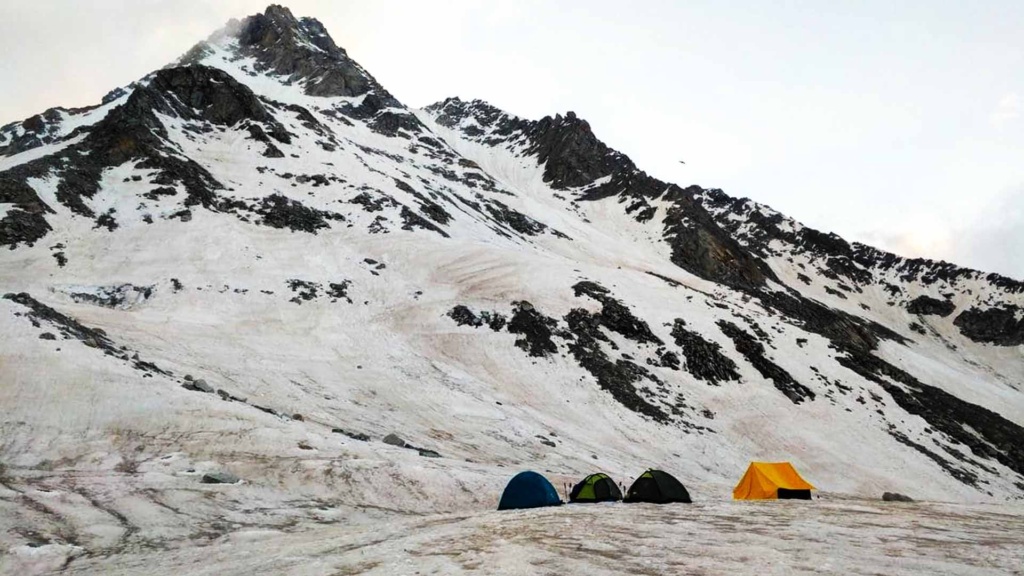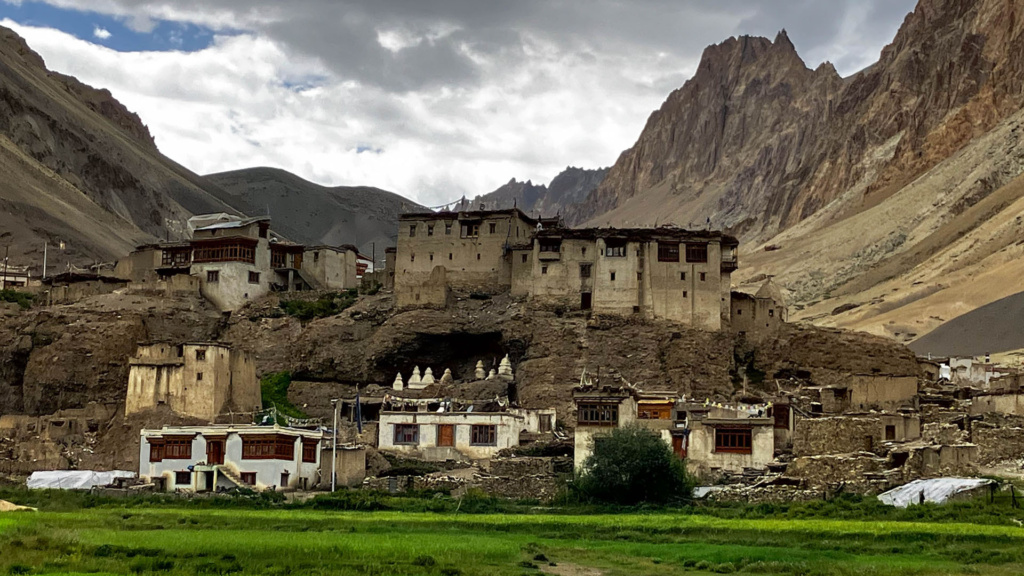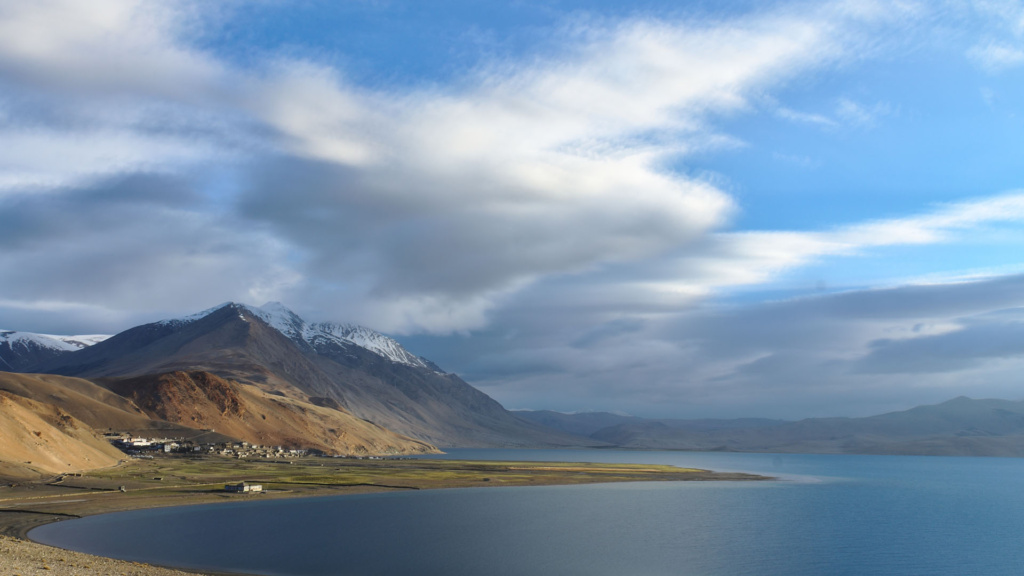
Hunder in February 2016, with camel breath in the cold and snow still holding the ridges
The first thing the dunes did was fill my shoes.
Not dramatically. Not like a desert from a film. Just a slow, stubborn trickle of cold sand finding the gap between sock and boot, reminding me that Hunder was not there to perform emptiness. It was February 2016, and I had come alone to Nubra, travelling from Leh over Khardung La, stopping at Diskit, and reaching the Hunder dunes before evening began to close.
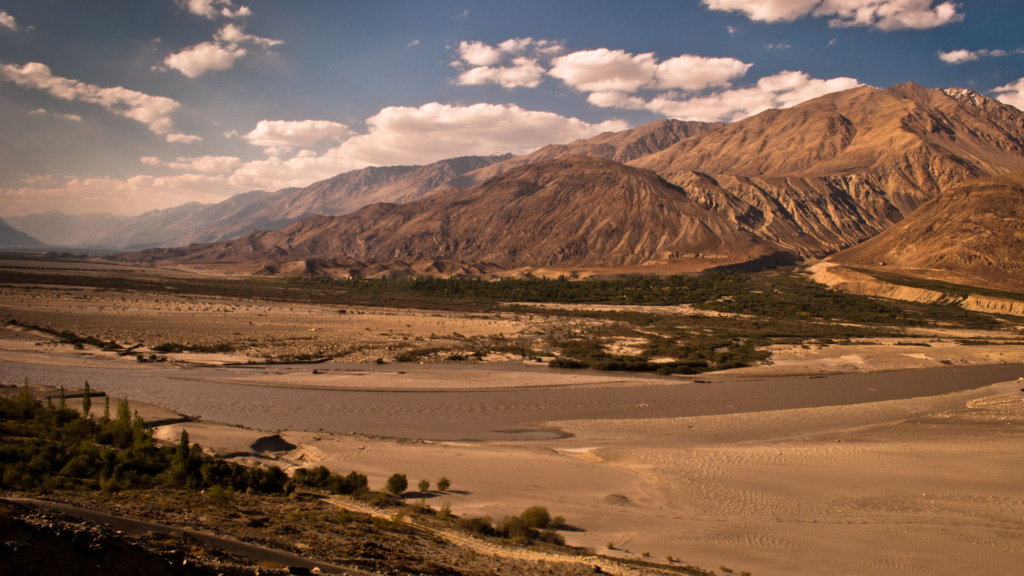
The air was sharp enough to make each breath visible. Snow sat on the far ridges. The sand beneath my boots was pale, corrugated and colder than it looked. Somewhere behind me, a few locals moved between animals and vehicles with the practical rhythm of people closing a day. There were tourists too, but not many. This was not the busy camel-safari hour I had half expected. The place felt used, inhabited, working — not empty.
That mattered.
Hunder is often described through its contrast: sand in a high Himalayan valley, double-humped Bactrian camels, snow mountains, river light. Official Ladakh sources also identify Nubra with Hunder’s dunes and Bactrian camels, but standing there, the facts mattered less than the arrangement of the evening: sand underfoot, snow ahead, sky widening above, and the cold doing its quiet audit of every careless layer.
I had not come to ride a camel. I watched and photographed them instead. That choice was not a grand ethical declaration. It was simply what felt right that evening: to stand aside, watch the handlers work, watch the animals kneel and rise, and not convert every encounter into a ride.
Cold Desert
Diskit before Hunder
Earlier that day, Diskit had given the evening its background.
I had stopped at the monastery before coming to Hunder. Dosmoche had recently touched the valley, and the traces were still there: the courtyard, ritual objects, masks, butter-lamp smoke, the Maitreya watching over the valley, monks moving between the ordinary and the ceremonial without needing to explain either to me. Dosmoche is officially associated with Leh, Likir and Diskit, but what stays with me is not the public description; it is the feeling of arriving after intensity, when a place is returning to its daily breath.
Yargon Tungshak was also part of that visit, though not on the dunes themselves. I witnessed it at a Nubra monastery, not as some spectacle spilling theatrically into the sand. The drums, masked dancing, instruments and movement were real, and some of the ritual meanings were explained to me by people there. But in this article, I do not want to over-interpret them. I was an outsider with a notebook, not a scholar of the ceremony.
The safest truth is this: the day had sound in it before it had sand.
Drums. Horns. The murmur of people gathered in winter clothes. The smell of tea and tsampa. Skyu and khambir. Butter tea. Khapse. Food that belonged to weather as much as to appetite. By the time I reached Hunder, the festivals were not scenes I needed to describe again. They were residue in the body: drumbeat, smoke, salt, cold, colour.
The dunes received all of that and made it quieter.
Stanzin, Nyima and the hour of light
The camels stood in small groups on the leeward side of the dunes, their double humps making them look both ungainly and perfectly designed.
They were not romantic in the simple way photographs make them seem. They were large, bored, intelligent, occasionally argumentative, and more convincing than any metaphor I could bring to them. Their breath hung in the cold. Their bells made small, irregular sounds. One younger camel kept testing the rope as if evening were a negotiation. An older camel watched me with a stillness that felt less like wisdom than professional patience.
That was Nyima.
Stanzin, her handler, was real and publishable. He stood beside her with the unforced familiarity of someone whose day is made of animal moods, weather and waiting. He told me her name meant sun.
“She is Nyima,” he said. “Sun.”
He traced the curve of her hump with a mittened hand. “Her mother walked to Yarkand when my grandfather was small. Now she walks to the river and back.”
The line carried history without trying to become a lecture. I knew, broadly, that Bactrian camels in Nubra were tied to older trade routes and local livelihoods, but I did not need to enlarge that into a Silk Route essay. Stanzin had already made the point better by placing one animal between an old route and an evening’s work.
“Every animal carries a map,” he said, “even when we shorten the routes.”
I wrote that down.
The sun lowered, and the dunes changed quickly. The sand held ridges of shadow. Snow on the mountains shifted from white to blue to something closer to metal. The sky kept its clear Ladakhi intensity longer than seemed reasonable, then began to soften at the edges. The Shyok’s braids, visible from the road and across the valley floor, held silver where the light found them.
I took photographs, but not many. Low tourist activity made the evening easier to watch honestly. There were no crowds blocking the animals, no rush of rides, no loud performance of desert romance. Mostly locals, a few visitors, handlers finishing work, camels kneeling or rising with groans that seemed to come from a deeper chamber than the throat.
Stanzin pointed at the sky.
“Sky changes by the minute,” he said, “but every day the script is good.”
He was right. It was one of those February evenings that did not need improvement.
Cold shadows and the morning after
After sunset, the cold became less polite.
It entered through sleeves, around the neck, under the cap. My breath lifted as small white signatures. Frost later gathered on my jacket. The dunes, which had looked soft in the sun, became harder in shadow, their edges more exact. A thin moon lifted above the ridge. Stars appeared without drama, then suddenly seemed to be everywhere.
Stanzin sat with me for a while on the sand and offered chang from a bottle wrapped in a sock. The scene was real, and it can stay because it was not there for colour alone. The bottle passed between cold hands. The drink was colder than expected. We spoke in short sentences because the evening had already done most of the work.
He gestured towards the river channels.
“Every year new islands, every year old channels,” he said. “Like families.”
Later he spoke about Dosmoche in Diskit, about the way elders remembered festivals through animals, weather and milk, not only through masks and dates. When I asked about Yargon, he shrugged.
“Gods wear masks when people forget.”
Then, nodding towards the camels, he added, “They never forget. They carry the old road in their bones.”
I would normally soften lines like this because they sound almost too perfect. But you confirmed the dialogue, so I am keeping them carefully and sparingly. The important thing is not to make Stanzin a symbol. He was a handler, a local man in a cold evening, speaking while his animals shifted in the sand.
There were other signs of life. Dogs near the village. A jackal’s call somewhere beyond certainty. Fox prints the next morning. A heron lifting from a backwater at dawn. Earlier, upstream, a kiang had turned its head with the bored elegance of an animal that had not asked to be part of my travel writing.
The morning after belongs here only briefly.
I woke early at the Hunder camp, drank salty tea, and returned to the dunes before the day had fully gathered itself. The sand had been rewritten. Camel prints crossed my own. Fox tracks ran neatly along a ridge. The river had shifted its shine. Snow peaks held a blue that lasted only a few minutes. Handlers were already tying ropes, checking animals, preparing the day without ceremony.
Dawn made the place quieter, but evening had been the real centre.
Walking back
The walk back through the cold is the scene I would end with.
Not the festival. Not the camel history. Not the river braids. Just the simple act of leaving the dunes after dark, sand still in my shoes, fingers stiff, camera cold against my side, and the last camel bells thinning behind me.
A pair of boys near a tent offered Maggi and tea. Steam fogged the opening. I sat on a plastic stool that wobbled slightly and ate noodles too hot for the cold and too full of chilli for wisdom. They asked about Delhi as if it were another climate system entirely. I described summer heat, traffic, a river that does not behave like the Shyok, and they laughed.
Outside, the moon had climbed higher. Sand looked almost like snow in places. Snow looked like stored moonlight. The sky had become too large to finish looking at.
A dog walked with me for part of the way, then abandoned me without explanation. I crossed the last stretch slowly. The place I was staying appeared as a dark shape with one warm rectangle of light. I paused at the doorway, not because I had a thought worth preserving, but because my body wanted to mark the change: cold to warmth, sand to floor, sky to ceiling.
Inside, the room smelled faintly of wool, tea and damp boots.
I entered with sand in my shoes, frost on my jacket, and no better summary than the title had already given me.
Sand. Snow. Sky.