Notes from several returns between 2012 and 2021, where dunes, convoys, orchards and new roads kept sharing the same valley
At Khalsar, the road divides
The fork at Khalsar is where Nubra begins to explain itself without giving you a full answer.
Most of my arrivals into the valley between 2012 and 2021 came the familiar way, from Leh over Khardung La. Sometimes I crossed on a motorcycle, sometimes in a car, and once after enough walking elsewhere in Ladakh that even sitting still felt like a form of travel. The pass always made the body pay attention first: thin air, loose stones, snow in some seasons, dust in others, and that peculiar Ladakhi lesson that no view is free from effort.
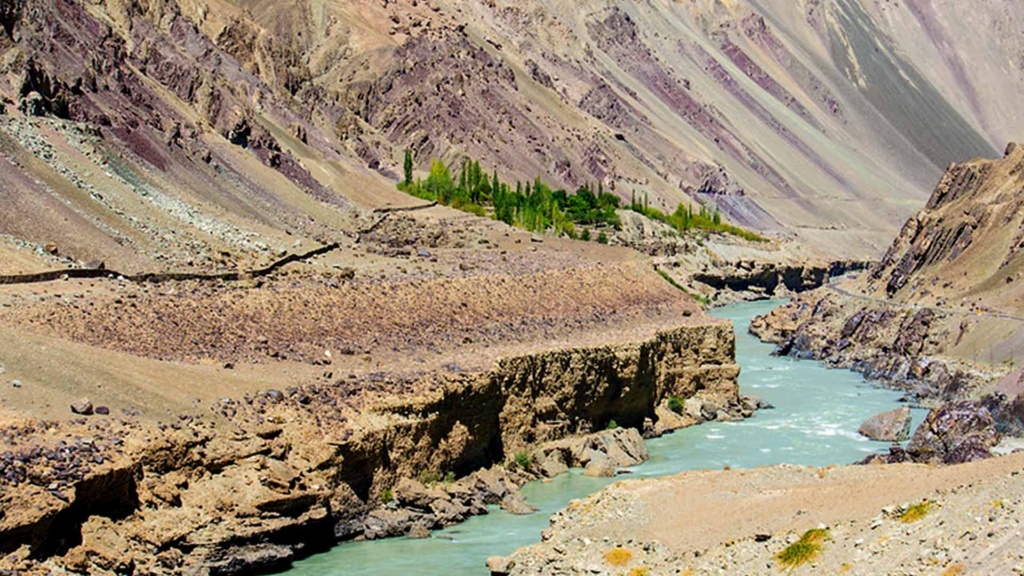
Then the road dropped. The valley opened. After the tightness of the climb, Nubra felt almost excessive: wider sky, broader flats, rivers making space, villages appearing with poplars, fields and walls. Official descriptions place Nubra north of Leh, with Diskit as the main town and Hunder, Panamik and the dunes among its better-known visitor points. That is accurate enough, but it does not explain the feeling of arriving there after Khardung La, when the road suddenly stops being only a road and becomes a set of choices.
At Khalsar, one direction pulls towards Diskit, Hunder and Turtuk along the Shyok. Another pulls towards Sumur, Panamik, Ensa and the quieter side of the valley. The names are not just route options. They are different speeds of looking. One side carries dunes, monasteries, tourists, camel rides and the long reach towards villages close to a border history. The other carries hot springs, orchards, water channels, gompas, fields and the road sense of people who live where visitors only pause.
I kept returning because Nubra never settled into one category for me. It was beautiful, yes, but beauty was the least complicated thing about it. The valley held army convoys and apricot trees in the same frame, new houses and old water channels, guesthouses and fields, prayer flags and road-widening work, tourists photographing camels while residents measured the day by irrigation, market errands and winter preparation. It was not a contradiction to be solved. It was a place where several futures were already living side by side.
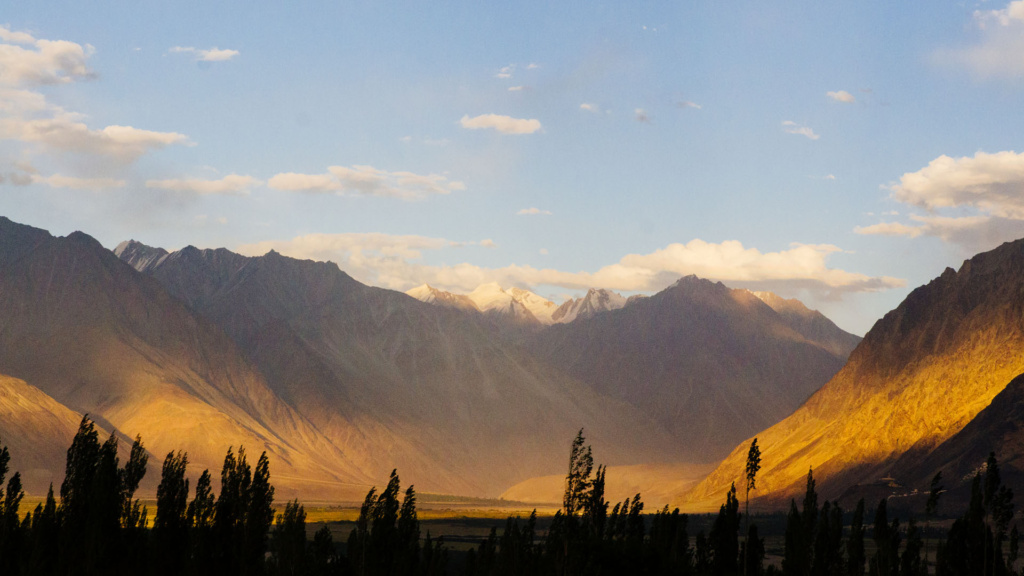
Nubra Valley
Diskit, Hunder and the visitor’s valley
Diskit was often where the valley became legible.
The monastery and the large Maitreya statue are easy to turn into postcard material. They sit above the valley in a way that encourages photographs and elevated thoughts. From up there, the rivers, road, fields and dunes arrange themselves into a pattern that looks almost calm. On the ground, nothing is that simple. Vehicles move, horns sound, someone is repairing something, someone is buying vegetables, someone is late, someone is carrying fuel, and a monk crosses the courtyard with no interest in becoming a traveller’s metaphor.
I remember climbing there on different visits with different versions of myself: the early traveller who wanted every view to mean something, and the later one who had learnt that a view is allowed to remain physical. Wind, steps, painted walls, the weight of the sun, the valley below. That was enough.
Hunder changed more visibly. The dunes were always the obvious draw, and the double-humped camels made the place famous in the visitor imagination. Official Ladakh material lists Hunder’s sand dunes and Bactrian camel safari as key Nubra attractions, which explains the tourism pressure but not the mood of standing there while business and landscape negotiate with each other in public.
I have seen the dunes busy, with people arriving in bright clothes, bargaining for rides, posing, laughing, leaving footprints that the wind later edited. I have also seen quieter hours when the sand held the cold or the last light and the camels looked more patient than anyone had earned. What changed over the years was not only the number of visitors. It was the confidence of the infrastructure around them: more organised activity, more places to stay, more signage, more surfaces where the valley had begun preparing itself for being consumed.
It would be lazy to scold tourism from the comfort of being a tourist. My own returns were part of that pressure. I used roads built and maintained by others, drank tea in shops, stayed in rooms, paid for food, took photographs where it was appropriate and benefited from the very changes I sometimes felt uneasy about. Nubra made that discomfort difficult to avoid. The dunes were not pure, and neither was I.
Water, orchards and the slower side
The other arm of Nubra slowed me differently.
Towards Panamik, the valley began to feel less like a spectacle and more like a working system. The hot springs are well known, and official sources list Panamik as one of Nubra’s main attractions. But what stayed with me was not a claim of healing. It was steam, concrete, wet feet, towels, instructions, people waiting their turn, and the ordinary human comedy of everyone believing they can stay in hot water longer than they should.
Around the villages, water seemed to have a stricter intelligence. Channels moved through fields and courtyards with the quiet authority of a timetable. Apricot trees appeared not as travel decoration but as work: fruit to sort, dry, store, sell, eat, press, carry. In good seasons, the branches made abundance look effortless. It was not effortless. Someone had tended the tree, directed the water, repaired the wall, watched the weather and done the labour before a visitor arrived to call it beautiful.
Ensa Gompa, reached on one of those returns when I still believed I had more stamina than I did, gave a different kind of distance. The climb and the wind stripped away the casualness with which I had put it on the day’s list. From above, the valley looked organised by forces larger than itinerary: river, slope, field, settlement, road, army movement, monastery, weather. I remember the quiet less as silence than as scale. It made my plans feel small, which was useful.
Yarab Tso was smaller and more private in mood. I went there with the careful feeling that some places should not be made loud by arrival. The lake does not need the burden of being called magical. It was water held among rock, green and still enough to change my voice without instruction. We stayed lightly, or tried to. Some places make you aware not of how much you can take from them, but how little you should leave behind.
Tirith brought the middle distance: not the spectacle of Hunder, not the austerity of a high gompa, not the edge-feeling of Turtuk. I remember lawns, trees, a table, evening light, work done for a few hours in a place where the valley continued around the screen. Those moments matter because they show another Nubra: not only dramatic, not only sacred, not only strategic, but livable.
Roads, borders and the pressure of change
Nubra’s roads have changed in the years I have known them.
Some changes were obvious: better surfaces in stretches, new buildings, more guesthouses, new houses, towers and wires, the signs of modern infrastructure arriving with confidence. Some changes were quieter: a village looking less surprised by visitors, a café where there had once been only tea, a road that no longer felt like a rumour, a family house adding rooms for guests. I saw enough to know that “development” is too blunt a word for what was happening. For residents, these changes could mean work, education, access, medical reach, connection, money, aspiration. For travellers, they could mean comfort and convenience. For the valley, they also meant pressure.
The Shyok road taught me not to trust maps too easily. I rode or drove it in years when the road still felt as if it had to renegotiate itself with the river. Sections could be rough, wet or uncertain, and the advice of people who had just come through mattered more than the confidence of a screen. The Shyok had a way of making human planning look temporary. Even when the road improved, the memory of its older moods stayed with me.
Turtuk belongs in this essay because it belongs to one of Nubra’s far-reaching futures. I have written about it separately, and it deserves that room. Here, I will say only this: the village made the idea of “borderland” human. Apricot trees, wood, stone, language, fields, soldiers, visitors, memory — all of it existed together without asking to be simplified for me. Turtuk was not an edge in the dramatic sense. It was a place where people lived with edges as part of the day.
The Thoise-area road presence made another truth visible. I am keeping that description deliberately general. Convoys, military movement, airstrip awareness, disciplined driving, the sound of helicopters at times these were part of Nubra’s atmosphere on several visits. They should not be turned into spectacle. The valley is close to strategic realities that travellers should acknowledge without treating them as scenery.
That coexistence is part of Nubra’s difficulty. A visitor may arrive for dunes, monasteries and photographs, but the road also carries supplies, duty, construction material, schoolchildren, vegetables, fuel, soldiers, pilgrims, guides, mechanics and families. One afternoon, after a puncture between Diskit and Khalsar, I watched a small roadside repair turn into the kind of practical generosity that has saved many Ladakh days. A man fixed what needed fixing. A child observed the whole procedure with grave interest. A dog slept through the important parts. The river flashed in the distance as if overdoing the background.
The puncture did not become a lesson. It became a delay, then a repair, then movement again. That is often how places hold you best: not by announcing meaning, but by letting competence enter the day exactly when needed.
Leaving the fork unresolved
Every time I left Nubra, I carried less certainty than when I entered.
The climb back towards Khardung La was never just the reverse of arrival. The same road changed direction and became harder. The valley, which had opened itself below, now began to fold away behind me. At Khalsar, the fork stopped being a choice and became memory: Hunder’s dunes in one direction, Panamik’s water in another, Turtuk farther along the Shyok, Tirith somewhere in the middle distance, Diskit watching from its hill.
By then, the article I wanted to write about Nubra had also changed. It could not be a clean praise song. It could not be a simple complaint about tourism either. I had been part of the traffic, part of the money, part of the looking. I had benefited from roads that also brought pressure, stayed in places that existed because the valley was becoming more accessible, and loved landscapes that residents had to live with after visitors went home.
Near the higher road back to Leh, the air thinned again and made the body practical. Gloves tightened. The engine note changed. Prayer flags pulled hard in the wind. A convoy might pass; a tourist vehicle might stop badly; a dog might sleep in the least sensible place available. Ladakh has always mixed grandeur with inconvenience more honestly than most places.
The final look back never resolved Nubra for me. That is why I kept returning. It remained forked: orchards and convoys, dunes and monasteries, guesthouses and fields, new houses and old channels, border caution and ordinary laughter, road work and river mood. The valley did not need me to choose one version. It needed me to stop pretending one version was enough.
Then the road climbed, and Nubra dropped out of sight the way it always did: not disappearing, only becoming something I would have to return to before I could claim even a little more understanding.
“It wasn’t like this.”
“This is how it is.”
Between those sentences, a valley keeps choosing.