
A 2014 stay in Upper Karzoo, remembered through hot water, thick blankets and the small work of being cared for
By the time I reached Nordan Guesthouse in Upper Karzoo, I had stopped pretending that my first day in Leh would be graceful.
I had flown in from Delhi in 2014, which is both the fastest way to reach Leh and one of the most efficient ways to remind the body that geography has consequences. One hour you are in the plains, making ordinary plans. A little later you are at altitude, moving slower than your confidence expected, with a dry throat, a slight heaviness behind the eyes and the strange feeling that even unpacking requires strategy.
I did not want a grand arrival. I did not want to begin Ladakh with a list of monasteries, cafés, passes and viewpoints. I wanted a bed, hot water and a room where I could put my bag down without having to perform excitement. That is not the kind of desire that appears on travel posters, but it is often the most honest one.
Nordan Guesthouse did not announce itself like a hotel trying to win you over. It felt like a house that had made room for travellers. Whitewashed walls, wooden details, a quieter lane, the faint sense of being slightly away from Leh’s more restless centre. I remember stepping in with the small embarrassment of someone who has arrived tired before the journey has properly begun.
Nordan, the host, was real and present in the way good hosts often are: not theatrical, not over-explaining, simply noticing the condition in which a traveller has arrived. There was butter tea. There was the relief of holding a warm cup before I had made sense of the room, the stay or even my own breathing. The salt and fat surprised my Delhi mouth, but my body understood before my palate did.
That first cup did not turn Nordan into “home”. I distrust that phrase in travel writing. But it did something more useful. It made the first hour in Leh gentler.
Breathless in Leh: My First 48 Hours
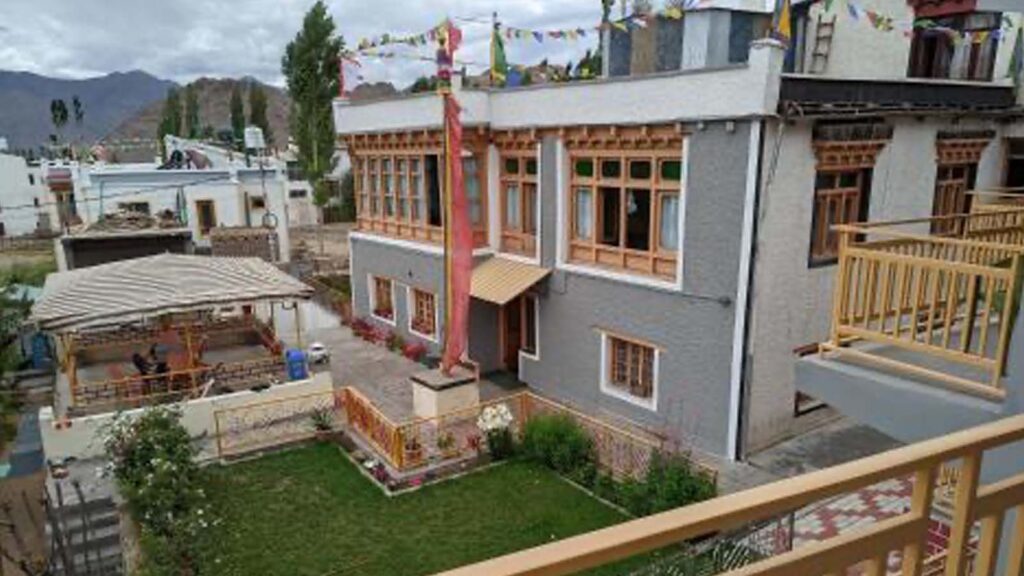
The views of the Ladakh range
The room and the window
The room worked because it did not try too hard.
There was wood underfoot and around the windows, the kind of material that changes the sound of a room. Boots landed more softly. A chair and desk gave me somewhere to empty pockets, write badly, sort batteries, open maps and pretend I was more organised than I was. A thermos of hot water sat with cups, simple and more valuable than anything ornamental could have been at that altitude.
The bed was the main event, though it did not look like one. Thick blankets, layered properly, doing the quiet labour that hotels with more vocabulary often fail to do. In Leh, warmth is not a decorative feature. It is the difference between sleep and a long night of bargaining with your own circulation. I remember climbing under those blankets the first night with socks still on, body tired from the sudden altitude, and feeling the day loosen one knot at a time.
The attached bathroom mattered too. Hot water mattered more. These are not romantic details, but they are the honest architecture of comfort in a cold desert town. You can admire mountains all day, but at night the body asks smaller questions: can I wash my face without flinching, can I sleep warm, can I fill a cup, can I wake up feeling less defeated than I arrived?
The window looked towards the Stok range. I will not pretend I spent every hour in reverence before it, but I did stand there often enough to remember the changing light. Morning made the mountains clearer than seemed fair. Evening softened them, taking away edges first, then colour, then certainty. The view did not need me to say anything large about it. It only needed me to be still for a few minutes.
That became one of the room’s quiet gifts. It gave me somewhere to recover from Leh without leaving Leh behind. The town was outside; the mountains were outside; the road was waiting somewhere beyond both. Inside, there was wood, water, wool, a desk, a bed and enough quiet to return to myself slowly.
Food that did its work
Food at Nordan was not memorable because it was elaborate. It was memorable because it arrived when it mattered.
There was butter tea, which I learnt to respect before I learnt to enjoy. There was thukpa, warm and filling, the sort of bowl that makes conversation unnecessary for a few minutes. There was dal-rice, vegetables, chai, and the dependable comfort of meals that seemed designed less to impress than to restore. After a day of walking too fast in thin air, that kind of food feels less like cuisine and more like repair.
I stayed fifteen nights, long enough for meals to stop feeling like events and become part of the day’s rhythm. Morning chai. Hot water. Something simple before stepping out. Something warm when I returned. The repetition mattered. Travel often asks for novelty, but altitude asks for routine. Drink, eat, rest, slow down, repeat. The body improves when it is not surprised every hour.
The garlic soup scene is one I trust because it was small. I was not dramatically ill, but I was not well either. The altitude and dryness had caught up with me: throat rough, body low, the kind of tiredness that makes even a blanket feel like a plan. Garlic soup came to the room, or close enough to the room in memory that the gesture still arrives before the bowl. It was not fancy. It did not need to be. It was warm, sharp, and exactly what the evening required.
That is where the older draft would have become grand and started talking about hospitality as culture, survival and philosophy. The truer version is quieter. Someone noticed I was unwell. Something warm was made. I drank it. I felt better.
There is no need to enlarge that beyond its size. Its size is the point.
Fifteen nights of returning
A stay of fifteen nights changes the relationship with a guesthouse. The first night is shelter. The second is orientation. After that, if a place is good to you, it becomes a rhythm.
Nordan became the place I returned to after learning how slowly Leh wanted me to move. I walked the market, climbed when I had the breath for it, sat when the altitude reminded me that stubbornness is not fitness, and came back with dust on my shoes and a face burnt slightly sharper by the sun than I had intended. The guesthouse did not compete with the day. It received it.
I remember the routine of arrival at the end of an outing: boots dealt with, bag lowered, hot water poured, jacket hung or abandoned, notes half-written before sleep began making its case. Some evenings I had enough energy to look out towards the Stok range. Some evenings I had only enough to sit on the edge of the bed and be grateful that the room was warm enough to make decisions unnecessary.
The shawl scene belongs here because it says more about Nordan than any rating table could. I had stepped out underdressed for the cold, or perhaps stayed outside longer than the clothes allowed. The chill arrived quickly, as it does in Leh once the sun’s authority weakens. A shawl was brought. Not ceremonially, not as a grand gesture, just because I needed one and someone noticed before I admitted it.