A high altitude race through Leh, altitude, cold breath and a finish line I still return to
Before the start
I began race morning with a protein bar, coffee, and the kind of confidence that looks better in a hotel room than it does at altitude.
It was 14 September 2014, and I was running the Ladakh Half Marathon. I had been in Leh for nearly a month by then, long enough to stop treating every staircase as a personal insult and long enough to become slightly foolish about my own preparedness. I had trained across Nubra Valley, done early runs, learned how thin air changes simple ambition, and still, while pulling on my race layers in the dark, I felt the old nervous question rise: what if the altitude had only been waiting for race day to embarrass me?
Outside, Leh had that pre-dawn cold which makes metal, fingers and thoughts behave more slowly. The town was awake in fragments: runners adjusting bibs, volunteers moving with purpose, cups of tea appearing in hands, the occasional laugh too loud for the hour. I remember checking my layers again, not because they needed checking, but because small rituals are easier than fear.
The start near Shanti Stupa gave the morning a strange theatrical height. Below us, Leh was still half-shadow, half-prayer flag, half-road. I had heard the stories from past runners: jawans cheering, Ladakhi children running together, the mani wall somewhere along the course, planes coming low through the morning mist, the final stretch thick with noise. I had absorbed those stories as if they were part of the route map.
But stories do not run for you.
When the race began, I tried to be sensible. For perhaps a few minutes, I was.
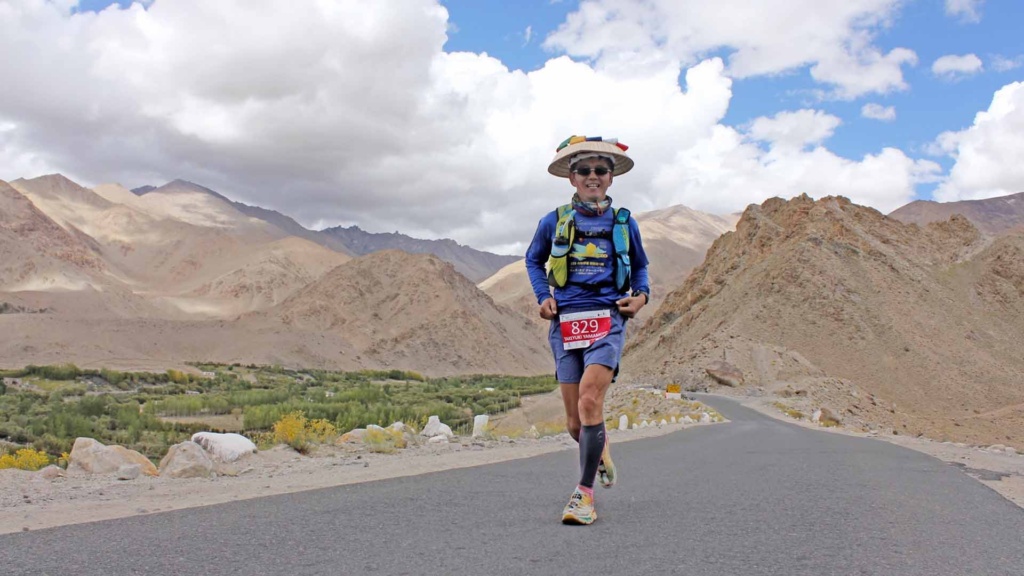
Ladakh Marathon
When the plan broke
The plan broke early, on the climb.
I do not remember it as dramatic. There was no cinematic collapse, no heroic moment where I looked at the mountains and discovered a second soul hidden in my lungs. It was simpler and more insulting than that. My breathing lost its rhythm. The pace I had imagined became a negotiation. My legs were willing, then less willing. The altitude did not attack me. It merely stopped cooperating with my assumptions.
That is one of the peculiar humiliations of running in Ladakh: the landscape does not need to be hostile. The road can be smooth, the sky clear, the crowd generous, and still your body begins filing complaints. Every small rise becomes an argument. Every runner passing you seems to have made a private arrangement with oxygen.
I slowed down before pride could make the decision for me. That was probably the first useful thing I did that morning. I had come to run, not to prove I was made of tougher material than I was. The race began turning from performance into management: breathe, settle, shorten the stride, do not chase the runner who has just passed you, do not waste the downhill, do not panic when the chest tightens.
The road moved through familiar parts of Leh and its edges: Skara Road, stretches where the morning opened out, turns where the sound of shoes multiplied, places where the crowd arrived suddenly and then thinned again. I remember armed forces jawans along the route, their encouragement straightforward and loud enough to cut through fatigue. I remember Ladakhi children running in little bursts, some holding hands, some laughing, some keeping pace for a few metres before vanishing back into the roadside.
None of it made the race easier. It made it harder to quit mentally, which is not the same thing but is sometimes enough.
The long middle
Somewhere between mile seven and ten, the race became less about distance and more about staying inside the next kilometre.
There was a huge mani wall, and a mani wheel, and that particular Ladakhi habit of placing devotion directly beside movement. I did not stop. I looked, registered stone, colour, turning, breath, and kept going. In another mood, on another day, I might have paused and tried to make meaning out of it. During the race, meaning was reduced to practical things: is the next step steady, is the breathing manageable, is the cold still only cold?
Planes came low overhead in the morning mist, descending towards the airport while we moved along the road below. It was an absurdly Leh moment: runners on tarmac, mountains holding the edges of the sky, aircraft cutting through the thin air as if altitude were a technical problem and not an emotional one. I remember looking up once and nearly losing my rhythm, which felt like the sort of mistake only I would make.
The middle of a race is rarely where photographs live. It is where bargains live. I will run until that bend. I will not walk before that group of children. I will drink at the next station. I will let the next kilometre be ugly if it has to be. The half marathon did not feel impossible, but it did keep asking for honesty. Every time I tried to pretend I was fine, the air corrected me.
By then, I had stopped thinking of the runners around me as competition. Some were clearly faster. Some were suffering quietly. Some had the calm faces of people who had done harder things before breakfast. I was somewhere near the back, and that was where the race became mine. Not heroic. Not elegant. Mine.
The finish
The finish announced itself before I reached it.
Noise gathered first. Then bodies. Then the odd bright details that memory keeps even when it drops important things like time: a hand waving, someone leaning over a barrier, a tourist with a camera, a runner bent forward with both hands on knees, a volunteer pointing tired people towards the line. The end was at NDS Memorial Stadium as I remember it, and by the time I came in, I was no longer interested in looking composed.
There was a sign in the crowd: “You were born to run!”
It should have been cheesy. It probably was. At that moment, it worked on me completely.
I crossed the line within the time limit, somewhere at the end of the field, with no exact timing left in my memory and no need to invent one now. I was wheezing. My lips had gone blue from the cold. My body was shaking in that confused way it does after effort, when it has not yet been informed that the task is over. Someone took blurry photographs. I smiled in some of them, cried in at least one, and looked alarmingly unlike an athlete in most.
That is the finish I trust: not triumphant, exactly, but undeniable.
The old version of me wanted the line to prove something large. That I was tough. That I belonged in Ladakh. That altitude had accepted me. The real finish was smaller and better. I had started at Shanti Stupa worried about the air, made mistakes early, slowed down, kept moving, and reached the stadium without needing to turn the whole thing into theatre.
For a while after finishing, I could not say much. That was useful too.
What stayed afterwards
The race did not change my life in one bright, film-trailer instant.
It changed something quieter: my relationship with altitude, and with my own panic inside it. Before the Ladakh Half Marathon, altitude had been a force I respected but also slightly feared. After that morning, I did not respect it less. I respected it more accurately. I understood that confidence at altitude is not swagger. It is listening early, adjusting without shame, and accepting that the body has the final vote.
That mattered on later journeys. It mattered on high roads, on cold walks, on days when breath became the first plan and everything else had to follow. It gave me a kind of confidence that was less loud than motivation and more useful than bravado. I had evidence now, not that I could conquer anything, but that I could stay with discomfort long enough to make better decisions inside it.
For some people, a half marathon is a weekend goal. For me, that September morning became a hinge. I kept returning to the moment before the finish when the crowd noise rose and my legs, which had been negotiating for kilometres, agreed to finish the argument. I kept returning to the protein bar in the dark, the coffee, the layers, the early climb that humbled me before the race had properly begun.
I do not know whether it was the best day of my life. That is the sort of sentence age eventually teaches you not to spend too quickly.
But I know this: whenever Ladakh later asked more of me, some part of me went back to that finish line at NDS Memorial Stadium. To the cold. To the wheeze. To the stupid, perfect sign. To the feeling of having finished near the back and still feeling, without exaggeration, that I had crossed something important.
For a few minutes after the race, I stood there shivering, medal heavy against my chest, trying to breathe normally again.
Then I smiled and let the photograph be blurry.