A July 2015 trek through river crossings, tea rooms, tents and the slow correction of pace
The first hard climb
The Markha Valley began for me with the sound of boots on stone.
Not revelation, not transformation, not the clean silence travel writing likes to promise. Just boots, loose grit, breath, straps, sun on the back of the neck, and the mild embarrassment of realising that a pack becomes heavier when the trail stops pretending to be kind.
It was July 2015, and I was walking with a group. That matters. The original memory had sometimes rearranged itself into solitude because walking has a way of making even shared effort feel private. But we were not alone out there. There were other bodies setting pace, stopping for water, adjusting loads, asking practical questions and occasionally lying to themselves about how much farther the next halt could be.
Our route was the long, familiar Markha line: Leh to Zingchen, then Yurutse, Ganda La, Shingo, Skiu, Markha, Tachungtse, Nimaling, Kongmaru La, Shang Sumdo, Hemis and back to Leh. Public trek descriptions broadly place Markha Valley inside the Hemis National Park landscape and commonly describe the crossing of Ganda La and Kongmaru La, but this is not a route guide. It is the memory of one July trek, with old conditions, old halts and a body that learned the route through effort rather than itinerary.
We drove from Leh to the trailhead, and the road gave way to the older discipline of feet. Zingchen was our first threshold, and one of the places where we stayed in a homestay rather than a tent. That first evening still sits in the body as warmth after dust: a room, tea, the relief of putting down a bag, and the small comfort of knowing that tomorrow’s climb had not yet started.
By Yurutse, the valley had begun taking away excess language. Houses, fields, animals, a slope waiting above, light moving quickly over rock. I remember the group becoming quieter as Ganda La entered the day not as a name but as work.
The climb to Ganda La was one of the hardest parts of the trek. Approximate elevations vary by source and route note, so I would keep the number light — around 4,900 to 5,000 metres — and let the body describe what the number cannot. The air thinned. Conversation shortened. Stops became less decorative and more necessary. The trail climbed through stone and dust, and every time I thought the pass should be near, the land found another way to continue.
At the pass, prayer flags moved in a hard wind. The view opened, but I did not have the energy to turn it into philosophy. I remember standing there with the group, aware of relief, aware of fatigue, aware that reaching a pass is not an ending but a permission to begin the descent. The descent towards Shingo asked for knees, patience and a kind of attention that is different from climbing. Going up burns the lungs. Going down negotiates with joints.
By the time we reached lower ground, the day had already stripped the trek down to its honest materials: wind, stone, feet, tea, and the ordinary kindness of stopping before pride becomes expensive.
Onwards to Markha Village
River days
The Markha route became more generous after the first shock, but not easier.
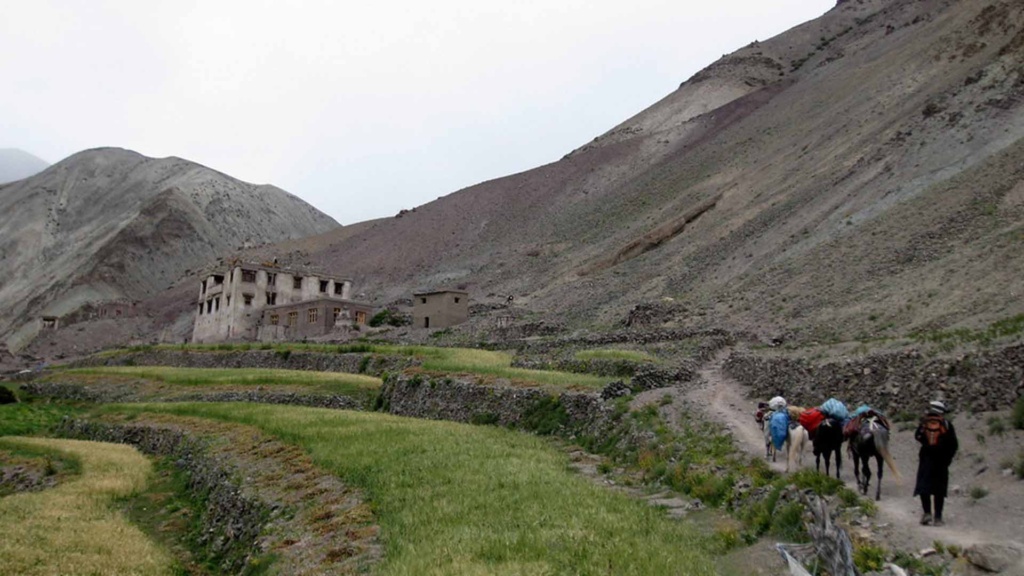
From Shingo towards Skiu, the valley began changing its scale. Stone walls, narrower paths, bends that revealed houses slowly, and the first real sense of walking through a lived corridor rather than across scenery. Skiu was another homestay night, and I remember it through the things the body keeps: tea after walking, food that arrived without drama, a room where socks and tired knees seemed to have more authority than conversation.
Meals mattered on this trek because effort made them precise. Butter tea, sweet tea, thukpa, maggi, skyu, apples, soup, biscuits, chapati, vegetables with cumin, gur-gur cha — all of these belong to the memory because you confirmed they happened. They should stay, but not as an endless catalogue of rustic charm. Food on trail is not charm. It is repair.
Skiu to Markha was the day of river crossings and half-promises from the trail. The river did not stay politely on one side. There were bridges, and there were places that were not bridges at all. We crossed where the route asked us to cross, sometimes barefoot, sometimes with the help of a stick, sometimes with shoes and resignation. Cold water has a way of making the mind very clean. It removes all decorative thought and leaves only foot placement, current, stone, balance, the weight of the pack, and the knowledge that everyone is watching while pretending not to.
The crossings were not heroic. They were awkward, necessary and cold. That is why they were useful.
At Chaluk and on towards Markha, the tea houses and village stops gave the day a human rhythm. A woman turning chapatis on a tawa. A boy writing his name in dust. A kettle blackened by use. Dogs sleeping with the confidence of residents. These details can remain because they are not trying to explain the valley. They simply show how a trekking day is held together: by people who live or work along the trail, and by walkers who arrive with more hunger than elegance.
Markha village felt large after the smaller halts. We stayed in a homestay there, which changed the day’s ending. After tents and long paths, walls feel almost extravagant. I walked to the ruined monastery above the village and looked back at the valley with the kind of tiredness that makes distance believable. Mani walls, chortens, prayer wheels and gompa stops all happened on this trek, but they should stay observational. A trekker passing through does not need to interpret everything he sees.
The route after Markha is where the earlier draft needed correction. Hankar belongs after Markha, onwards towards Umlung and the higher ground. That placement matters because the valley’s tone changes there. The land begins preparing the body for Nimaling and Kongmaru La.
Higher ground
The walk from Markha towards Tachungtse and beyond felt like the trek becoming less social.
Not because people disappeared, but because the altitude began taking space inside the body. The group was still there, but each person had their own arrangement with fatigue. Some walked ahead. Some slowed. Some spoke less. I began listening more closely to my own steps because the body had become a better guide than mood.
Past Hankar and Umlung, the valley narrowed and opened by turns. Red rock, dry slopes, fields giving way to rougher ground, animals in the distance, and the repeated sound of wind against loose clothing. Tachungtse was another necessary pause. The original draft gave it too much polish; the actual power of that stage is simpler. You arrive tired. You eat. You look up. Kang Yatse begins to feel less like a photograph and more like a presence that changes how the evening sits.
Nimaling was one of the clearest memories of the trek.
We slept in tents there, and the meadow did not soften the altitude. It gave space, yes, but also wind. The kind of wind that does not need drama because it has repetition. It worried tent ropes, entered gaps, pressed fabric against the body in the dark and made sleep arrive in pieces. You confirmed the Kang Yatse view, the hired tent, and the wind night, so they should remain as the centre of this section.
The fatigue near Nimaling was not illness. No grand altitude emergency, no cinematic collapse. Just fatigue sharpened by height: slower movement, shorter breath, the sense that every small action had acquired extra steps. Unzipping a bag, finding a layer, walking a little uphill, bending for a bottle — all of it required more negotiation than expected.
We saw wildlife along the route, but the rewrite should keep the sightings modest: bharal or blue sheep on slopes, a golden eagle overhead, a fox, dogs around villages and camps. Hemis National Park sources list bharal/blue sheep, red fox and golden eagle among the fauna associated with the wider landscape, but this article should not become a wildlife promise or a checklist.
At Nimaling, Kang Yatse held the evening without needing a long description. The mountain was there. We were tired. The wind made the tents speak all night. That was enough.
Kongmaru La and the exit
The morning of Kongmaru La began with fewer jokes.
That is how difficult walking announces itself in a group. People do not become solemn all at once. They simply take longer over zips, laces, bottles and straps. Breakfast is quieter. The first steps are careful. Everyone knows the pass is waiting, and nobody wants to spend their best energy talking about it.
Kongmaru La is often given around 5,200 metres, though exact figures vary by source and map. I would use “around 5,200 metres” and move on. The number is useful only because the body confirms that it is high.
The ascent was one of the hardest physical moments of the trek. The path climbed in a way that broke progress into small, repeated decisions: walk to that rock, breathe, adjust strap, walk to the next bend, stop before the lungs become dramatic, continue. The group stretched out. The wind increased. The pass arrived slowly and then all at once.
At the top, flags moved hard. The view opened in several directions, but the first emotion was not awe. It was relief. Then cold. Then the awareness that the descent still had to be walked.
The descent into the Shang side was harder than it looked from above. Red rock, narrow sections, loose ground, the body already tired from the climb. The gorge compressed sound and movement. River crossings returned in another form. A tea shack in a patch of light became exactly what it needed to be: a place to sit, drink, eat something simple and let the knees remember they were still part of the team.
By Shang Sumdo, the arrival of a road felt almost absurd. After days of walking, a vehicle looks both rude and miraculous. We got in with the particular silence of trekkers who are grateful but not ready to admit how done they are.
We did stop at Hemis Gompa, and it can remain, but briefly. After a long trek, a monastery does not need to be turned into a separate essay. I remember entering with the body still carrying the trail: dust on shoes, tired legs, hat in hand, the sound of drums or chanting, the coolness of interior space, and the slight difficulty of standing still after so many days of forward motion.
Then Leh.
Back to the bed in Leh
The final scene of the trek was not a pass, not a monastery, not even the jeep ride.
It was my bed in Leh.
That may sound small after Ganda La, Markha, Nimaling and Kongmaru La, but the body chooses its own endings. We reached Leh with trail dust still on us, knees carrying descents, and the smell of sun, sweat, tea and tent fabric somewhere in the clothes. The guesthouse room felt too still at first. A bed with a mattress that did not move in the wind seemed almost excessive.
I put the bag down and sat before removing my shoes. That is how tiredness tells the truth. The trek returned in pieces: the Ganda La climb, cold water around the ankles, tea in Skiu, Markha’s room, the wind at Nimaling, the slow ascent to Kongmaru La, the red descent towards Shang, Hemis as a pause, and finally this bed in Leh receiving the whole distance without needing to understand it.
I lay down and felt the body continue walking for a while. Feet twitched. Knees complained. The shoulders remembered straps. Somewhere outside, Leh carried on with evening: a vehicle passing, a dog, a voice in the lane, the ordinary human sounds that become luxurious after days of wind and stone.
The Markha Valley did not leave me with a grand lesson. It left me with a more reliable measure: how slowly a tired body lowers itself onto a bed after walking through river, rock, tea, altitude and weather.
That was enough.