Reading a road and learning that some hints are enough
The ordinary road out
The ride began as a Pangong ride.
That is important, because the mistake would be to give it too much drama from the start. In June 2016, I left Leh alone on the motorcycle with a plan that looked ordinary enough on paper: Leh, Karu, Sakti, Chang La, Durbuk, Tangtse, Pangong. It was the kind of route many Ladakh travellers say almost casually after they have survived the first few days of altitude and begun to mistake familiarity for permission.
The morning out of Leh had the usual practical rhythm: fuel, layers, gloves, papers, water, the small private audit a rider performs before trusting himself to a high road. The bike carried the day’s optimism better than I did. I was already thinking beyond Pangong, because travellers are often guilty of asking the next question before answering the one under their wheels. In tea shops and on maps, I had seen and heard the phrase Chang Chenmo. It sat somewhere beyond the edge of what a regular route allowed, not as a destination I could claim, but as a direction that made the map feel unfinished.
I had my Inner Line Permit, and in 2016 it went up to Marsimik La. That gave the day a legitimate shape, but not a blank cheque. Ladakh has a way of placing temptation beside caution and asking which one your hands will obey. I did not fully understand that in the morning. I only knew that I wanted to see how far the road would let me read.
Karu passed in the usual clatter of petrol, tea and road dust. Sakti arrived with the climb beginning to gather itself. By the time the road started rising towards Chang La, the idea of “just riding a bit farther” had already become a passenger. It sat quietly, like all dangerous passengers do.
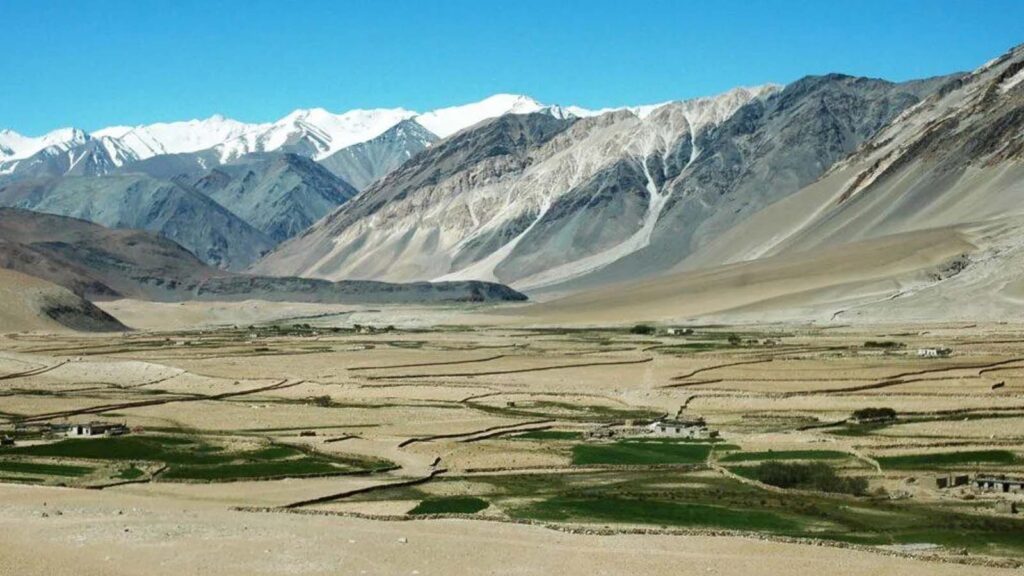
Phobrang Village
Chang La, then Tangtse
Chang La in June still had enough winter left in its bones to keep a rider honest.
There were wet patches, old snow in shaded corners, meltwater crossing the road where the mountain had not finished changing state. The pass was not theatrical. It was simply work: throttle, balance, breath, watching the surface, not staying too long where the body and machine both knew better. Prayer flags moved in the wind with more stamina than I had, and the usual signboards reminded everyone that the pass was not a place to loiter for romance.
The descent towards Durbuk and Tangtse loosened the ride. The road began to feel less like an exam and more like a corridor. I have always liked that part of the route because the body relaxes before the mind does. You begin to believe the difficult part is behind you. That belief is often premature in Ladakh, but it is pleasant while it lasts.
Tangtse restored order. It is one of those places where a journey changes tone without making a speech about it. Papers matter there. Directions matter. So does the way you ask a question. My permit was checked, and the answer to my unspoken curiosity was made clear without drama. Marsimik La was within the day’s permitted imagination. Chang Chenmo was not something to improvise towards.
The officer or jawan I spoke to did not deliver a polished line for my notebook. He did what people posted on sensitive roads often do: he kept the exchange practical. The advice was simple enough to survive paraphrase. Stay within the permit. Pay attention to the boards. Do not turn curiosity into a problem for other people.
That was the first real lesson of the day, though I took a few more kilometres to accept it.
Pangong, briefly
Pangong arrived with its usual unfairness.
You can be thinking of documents, caution and road limits, and then the lake appears and all sensible thought is briefly interrupted by blue. In June, the season had shifted enough for travel to feel possible, but the landscape still carried the severity of height. The lake did not need a long description here, because this was not meant to be a Pangong story. It was a waymark, a bright interruption before the road began asking quieter questions.
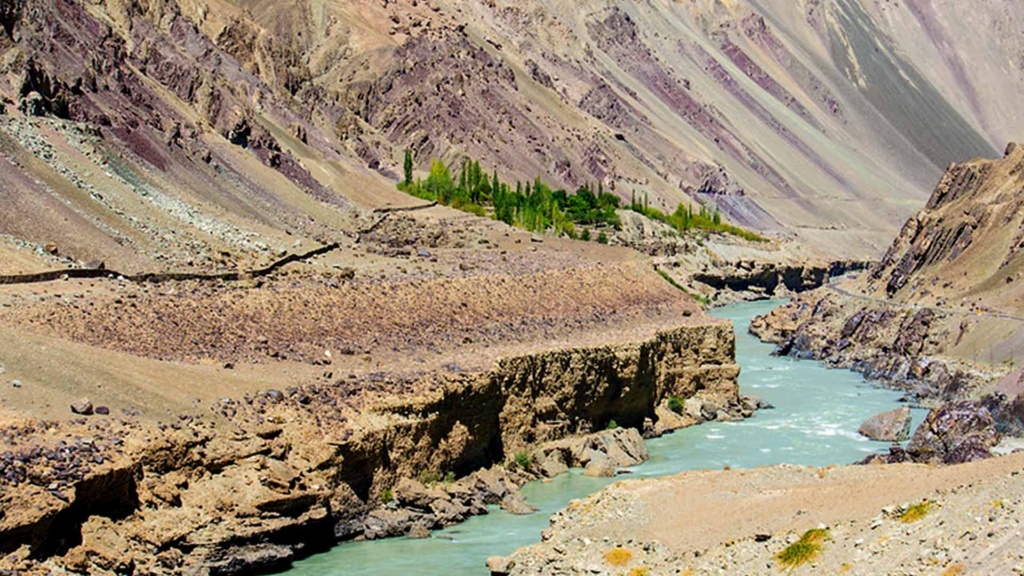
I did not linger in the way the lake encourages you to linger. The temptation that day lay northwards, towards Phobrang and the roads whose names had been sitting in the back of my mind. From the Pangong side, the route began to thin out. The lake loosened its hold, the ground opened, and the road became less sure of how much it wanted to offer.
There were boards. Some gave direction. Some gave warning. Some asked for the kind of obedience that has nothing to do with fear and everything to do with good sense. I saw no-photography and no-stopping instructions in places where the landscape might have tempted a careless traveller to reach for a camera. I put the camera away. That small act felt less like compliance and more like manners.
The farther I moved towards Phobrang, the more the ride changed from adventure into responsibility. The surface, wind and openness were still beautiful, but beauty was no longer the main fact. The main fact was that this was a sensitive borderland road, and I was a visitor with a permit, a motorcycle and a habit of asking roads to explain themselves.
At Phobrang, the answer arrived without cruelty.
The checkpost did not need to be dramatic. A barrier, a conversation, a look at the permit, and the clear understanding that the road I had been imagining was not mine to continue. The exchange was polite. The limit was firm. Because my permit went up to Marsimik La, there was no need to pretend the day had become a failure. The failure would have been to argue with a boundary that had been explained.
I turned the motorcycle around.
It did not feel heroic. It did not feel humiliating either. It felt like one of the few clean decisions a rider gets to make in a place where roads, weather, paperwork and geopolitics are all larger than his enthusiasm.
After the no
The ride after a no is different from the ride before it.
Before, the body leans towards possibility. After, it has to learn acceptance without turning bitter. I rode back with the usual mixture of relief and leftover hunger. Some part of me still wanted the road to unspool farther, to make the map simple, to let curiosity become a story with a photograph attached. Another part of me, the more useful part, understood that the photograph was exactly the problem.
There is a discipline in leaving some roads undescribed. Not because they are mystical, and not because secrecy makes better prose, but because certain places sit inside layers of military, administrative and local reality that a travel article should not disturb. The official permit systems and protected-area circuits in Ladakh continue to be specific and regulated, and current listings still show that routes in areas such as Pangong and Marsimik La are handled through defined circuits rather than casual wandering. That later knowledge only confirms what the road had already told me in 2016: access is not the same as entitlement.
On the way back, the landscape returned to its physical self. Wind across open ground. A motorcycle engine working at altitude. Dust settling where it could. The bright, hard light of Ladakh making every object look closer than it was. I saw kiang move across the distance with the ease of animals that belong to the plain in a way a rider never will. I also saw black-necked cranes, a sight that slowed the mind more effectively than any warning board. Ladakh Tourism identifies Pangong as habitat for rare birds including the black-necked crane, but what mattered to me that day was simpler: I had seen them, and the road had already taught me not to disturb what did not need me.
The shepherd-map scene happened later, and I keep it because it was funny in the way real corrections often are. I had stopped with the map out, trying to reconcile lines with what the day had allowed. A shepherd watched me watching paper, then made it clear in ordinary gestures and speech that the direction occupying my mind was not the direction for me. There was no aphorism. No mountain wisdom arranged for a writer. Just a local man amused by a traveller attempting to negotiate with a map after the land had already answered.
We drank tea instead. That was a better use of the afternoon.
Tea and the road back
There was also a tea tent, the kind of small roadside shelter that can feel more important than any viewpoint after enough riding.
The woman there asked enough to understand where I had been and where I had not gone. I do not remember a perfect sentence from her, and I will not invent one. What I remember is the tone: practical, unsurprised, approving of restraint in the way people are when the landscape has trained them better than ambition trains visitors. We spoke of wind, road, tea, ordinary things. The border did not need to be mythologised; it was already present in what was not said.
That is what the day eventually became: not the story of reaching Chang Chenmo, but the story of not converting a hint into trespass. In my earlier travelling life, I might have treated that as an incomplete journey. By 2016, Ladakh had begun correcting me. A road does not owe completion. A permit does not owe expansion. A signboard does not owe interpretation. Some instructions are simple, and the elegance lies in obeying them.
Back in Leh, the day ended without ceremony. The bike was dusty. My hands were dry and marked by the usual mixture of throttle, glove and road. The map went back into the bag with its unanswered line still folded inside it. My host in Leh, who knew enough about the ride to ask without asking too much, understood that I had turned back. The response was not praise exactly. More a small recognition that I had not made someone else’s job harder.
That was enough.
I washed my hands, rubbed at a stubborn line of grease near the thumb, and emptied the last of the thermos. Somewhere beyond Phobrang, beyond the limit I had accepted, the roads I had imagined still existed without me. The knowledge did not make me restless that evening. It made the room quieter. I had gone as far as the day allowed, and for once, the road not taken did not feel like a wound. It felt like a road left correctly alone.