Fear, focus, and the art of breathing at 17,000+ feet.
“You don’t conquer a pass. You arrive at it one breath at a time.”
The Mountain That Stayed
I didn’t come back to Ladakh in 2012 for photographs, bragging rights, or the myth of the “highest.” I came back because the first time I left, something of me stayed behind caught in prayer flags, stitched into wind, lulled somewhere between a curve and a sky. The mountain had not asked for anything; it had only presented itself, stark and unnegotiable. In the months after my first trip, I’d wake to the memory of a blue so raw it hurt, of roads that thought they were rivers and rivers that thought they were mirrors. Sometimes it was only a scent diesel in cold air or the sound of a crow calling into a valley that answered with silence.
Second trips are dangerous. The first time you arrive wild with wonder and ignorance; the second time you arrive with memory, and memory has its own gravity. Back home I had promised myself I wouldn’t chase the exact same moments the same tea stall, the same bend where I’d seen a convoy dissolve into light. But some places don’t allow neat frames. They change shape when you return. They demand you do the same.
Khardung La sat in that demand like a riddle. Posters and T-shirts called it the “Highest Motorable Road,” though facts and altimeters bickered quietly in the background. The signboards didn’t care for academic precision; neither did the wind. What mattered wasn’t the number in feet. What mattered was what those feet did to your breath, your patience, and your pride.
I told myself, this time, I’d ride with less drama. No rushing, no chasing a summit for the summit’s sake. I would ride it like a long inhale, like a prayer. Which is a romantic way of admitting: last time, I’d been scared.
Leh, Before The Climb
Leh in 2012 was not yet the Instagram daydream it would later become; it was a town caught between an old rhythm and a new tourism, a place where German bakeries leaned into monasteries and phone signals climbed hills like yaks. The main bazaar still felt local in the mornings. A mechanic could fix a clutch cable with a grin and a piece of wire. Prayer flags faded honestly. Cafés closed early. And at dusk, from a rooftop, you could watch the light pour over Shanti Stupa, then fold neatly behind ridgelines like a monk folding robes.
Acclimatization is romance’s worst enemy and survival’s closest friend. I did the sensible things: walked slow, drank water until it bored me, counted steps on the climb to Leh Palace. I woke with a light throb behind the eyes, not pain exactly, more like a reminder. Breathing here wasn’t a background task; it was a decision you made often.
The motorcycle was a familiar companion the same heavy thump, the same stubborn mercy. I checked cables and chain, tightened mirrors, cleaned the plug, nodded to the mechanic who said what he had surely said to a thousand riders: “Go slow. Don’t fight the bike. Don’t fight the road. And if it rains, stop. Nothing noble in falling.”
That last line lived in my pocket like a talisman.
The permit lay folded in my wallet for North Pullu, a thin membrane of bureaucracy between me and the road. The plan was simple: leave early, climb to Khardung La, drop into the first shadow of Nubra, then decide push further into the valley or sit beside the river until the day taught me a different plan. Plans in Ladakh have the lifespan of butterflies. I wrote mine anyway.
Morning, on the Edge of Breath
I left before the bazaar yawned open, before the chai stalls hauled cardamom into steam. The air bit clean through the jacket and gloves, and the engine’s first cough felt like waking an animal that still remembered snow. A few dogs stared as if I were disturbing a secret. Above the town, the road turned into a line of intent, rising quickly, as though impatient.
You can’t watch the road and the sky at the same time here not without paying for it. Yet the sky kept calling, big and blue and endless, making the road look like a sketch someone had forgotten to rub out. I disciplined my eyes into a rhythm: mirror, corner, surface, horizon repeat. The thump became a metronome; the body found the geometry again: weight into pegs through turns, loose arms, chin where the front wheel dreams of going.
First bend: a prayer wheel at a hamlet’s edge, spinning itself awake.
Second bend: a group of schoolchildren, cheeks bitten red, waving like flags.
Third: an army truck descending, the driver lifting two fingers off the wheel a gesture that somehow contained blessing, warning, and camaraderie.
I remembered the first ride years ago, how loudly my fear had spoken then how it filled my helmet and sat heavy on my shoulders. This time, the fear was there, but quieter, more like a companion you respect than a dictator you obey. Maybe that’s all courage is: fear obeying a better rhythm.
By the time Leh had shrunk to a scatter in the rearview, the mountains had reasserted their rule. Switchbacks opened like old scars. The BRO’s hand-painted wisdoms “Be gentle on my curves,” “After whisky, driving risky,” “Better Mr. Late than Late Mr.” were not jokes now; they were sutras. I found myself nodding at each as if they were the monks of this mechanical monastery.
And then, as the gradient sharpened and the air thinned, something shifted. Breath wanted attention. At sea level, we breathe with arrogance. Here, we bargain.
South Pullu: Paper, Dust, and Tea
South Pullu arrived the way military places do: abrupt, efficient, unromantic. The road widened as if taking a breath of its own. A makeshift building, a barrier that looked older than its paint, a queue of vehicles performing the slow dance of surrendering documents. Men in olive, a smell of diesel braided with dust and smoke, a tin kettle that had seen more sunrises than I had.
I killed the engine and the silence roared in. A soldier’s eyes softened when I removed my helmet; a conversation unfolded in lean sentences.
“Second trip?” he said, flipping the permit with a practiced thumb.
“Second,” I said.
“You still remember to go slow?”
“I learned to count,” I smiled.
He poured tea into a cup with a nick on the rim and slid it toward me with a nod. The tea was sweet enough to tint the edges of the world. I watched the parade of machines trucks that carried the mood of a mountain, small cars collaborating with gravity, a biker like me dragging a foot through gravel as if to anchor himself to the earth.
Paper stamped, chin dipped, the barrier lifted, I listened to the bike become sentence again. Past South Pullu, you hear more of your head than your engine. Your thoughts change tone at altitude. Some lines in you go taut; others slacken. Your pulse learns a new drum.
The Long Middle: Where Roads Forget They Are Roads
Between South Pullu and the summit, the map looks like someone’s heartbeat after they’ve read a letter that mattered. The road turned to reluctant tarmac, then to gravel, then to something that had once aspired to be a road. Meltwater trickled across corners like veins; the rocks arranged themselves like moral tests.
The trick up here is not bravery. It’s attention. Rocks are not your enemies; they are simply themselves. Pick a line. Stick to it. Let the bike dance a little. Don’t stiffen; stiffness is how you lose. A foot down here is a candidate for betrayal stones shift, and the mountain has no interest in your balance.
Breathing. I discovered an odd rhythm the last time, and found it again without trying: count five in, hold two, out six. It sounds absurd to choreograph air, but we choreograph everything: meetings, meals, moods. Why not breath? The counting gave my mind a job so it didn’t invent catastrophes. Fear is most creative when it’s bored.
A truck ahead, labored, found its own music diesel coughing, metal thrumming, the voice of work. I waited. In Ladakh, overtakes are not maneuvers; they are courtships. You ask politely. You go only when the road offers herself. The driver signaled with a flick of his fingers, the kind some men use to flick a cigarette. I passed slow, nodding gratitude that felt older than both of us.
The air cooled its knives further. Strips of snow bled into shade, then into shadow. The BRO signboard that claimed kilometers to the pass looked like an inside joke the kind you are always on the edge of understanding.
A corner iced with the memory of last week’s weather; the back wheel licked sideways, a quiet, terrifying kiss. Reflex stiffened me; the road scolded. I let go into the slide, trusted weight, throttle, and the bike obeyed physics with grace that felt like forgiveness.
At a bend that looked like an unanswered question, I pulled over. Sometimes you have to stop before the road stops you. I killed the engine. The wind tried to take the empty space. Snow squeaked under the boots. I pressed gloved fingers against rock and felt nothing stone does not care for warmth. Breath formed small worlds in the air and vanished. In the silence something loosened in me. Not confidence that’s a brittle thing but a slow, strange calm.
From that pullover, the mountain made it plain: I am not a problem to be solved. I am an experience to be undergone.
I swung the leg back, thumbed the starter, listened to the thump that told me it was alright to be small.
The Pass: Flags, Light, and the Gentle Fraud of “Highest”
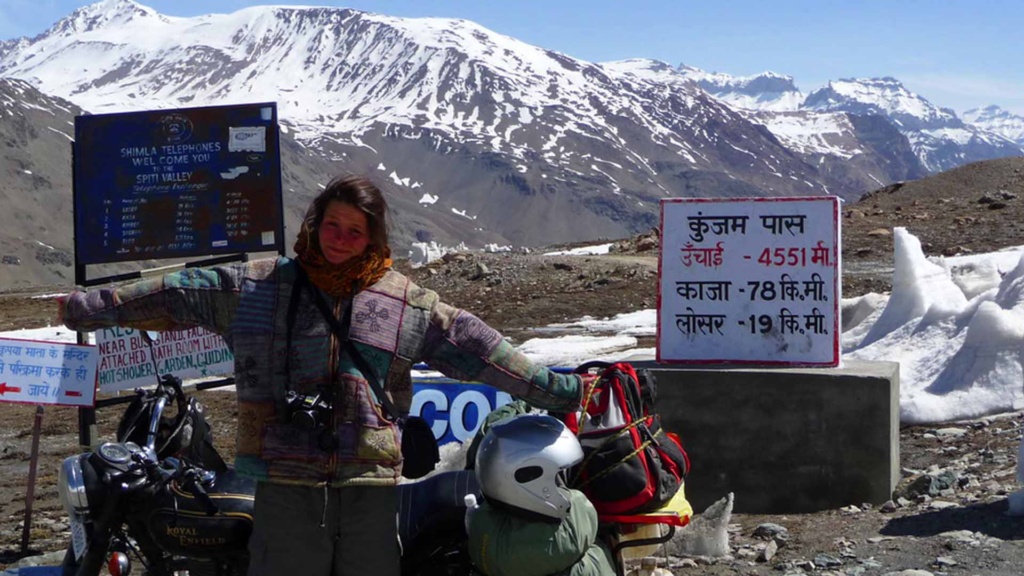
At Khardung La the wind is a resident, not a visitor. It lives there full-time, owns the place, rents it to your arrival one minute at a time. The signboard was what it has always been bold yellow, bragging lightly, carved into a thousand traveler photographs much braver than the road itself. I parked in a line of machines paused mid-story: bikes crusted in mud and story, SUVs with families collecting oxygen and anecdotes, a truck driver staring into a distance that had no desire to be stared into.
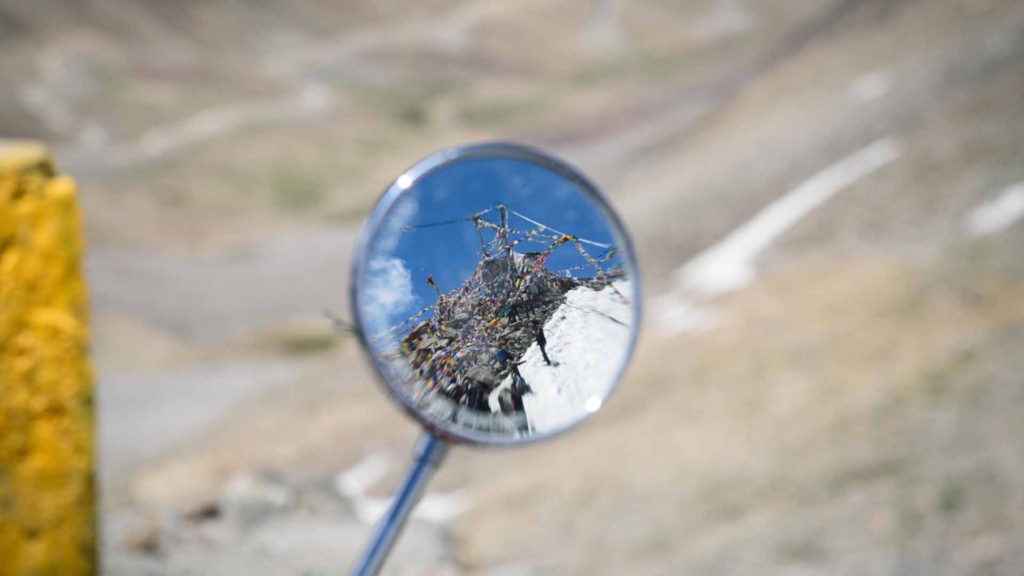
Prayer flags made the sky wearable. They snapped with a music of their own, carrying all our private fears in public color. I removed the gloves, flexed the fingers blood is slow up here and let the cold write its own runes across the skin.
A soldier offered biscuits. Another offered advice about black ice. A third returned a helmet to a man who didn’t want to admit he had left it on the wall two minutes ago. The tiny temple at the top had hands folded to it in twenty languages; I added mine in the language of breath. I wasn’t sure what I was asking. Maybe only for the permission to remember this place without lying to myself about it.
Inside the cement shop with the tin roof, a woman poured black tea so intense it felt like a small piece of night, hot enough to argue with the air. A biker from Maharashtra grinned through a mouth of cracked lip and said, “Second time?”He had the gift of saying things as if he had always known them.
“Second,” I repeated, and the word felt like a ritual.
What had changed? Not the road. The road was still a road pretending to be a river. The mountain was still indifferent in a way that made you trust life again. What had changed was me: the timeline of my fear, the way I laid down expectation like a heavy bag, the way I understood that this isn’t achievement; it’s arrival. Which is, in its way, the greater achievement.
I didn’t stay long at the top; lingering becomes a dare you don’t have to accept. A few photographs, not of my face against the signboard but of small things: a torn flag knotted to a wire, a crow stitching the wind with its wings, a child’s mitten forgotten on a bench blue against grey. I’ve never been good at selfies. The mountain didn’t ask for evidence anyway.
On the way back to the bike, a jawan caught my eye and pointed to the sky with a grin. “Weather’s a politician,” he said. “It changes quicker than you can complain.” We both laughed in the way two people do when they are not in a hurry.
Then I tipped the bike off the stand, felt gravity help for the first time in hours, and turned the front wheel toward the downward.
The Descent: Fear’s Quieter Brother
Down is where you discover whether the story you told yourself at the top can hold its own weight. Brakes are theology on descents; you can be fundamentalist or you can be nuanced. I tried to be nuanced engine braking, gentle hands, let the mountain have what it requires. Snowmelt tuned streams into chord progressions across the surface. Rocks misplaced themselves under the tires and then, generously, placed themselves back.
A convoy materialized, a small train of steel and dust. We crawled together in a patience none of us had invented. At a lay-by, I let them by and inhaled a small mercy that smelled like hot clutch and cold air. The road’s crib-notes were all still true: Don’t speed. Don’t panic. Don’t turn fear into a second rider. Above all, don’t forget to breathe. It’s ridiculous how often you can forget to breathe.
At one corner the sky widened without warning, and the valley below wrote itself into the view. Nubra, pale and braided with rivers that were drawing maps even as I watched, dunes that looked like small, strange deserts had made their home in a bigger one. The light apologized for nothing. I thought of continuing, of dropping into that other world and letting it take me deeper into itself. But I also thought of the return, of the sun’s impatience with me, of the way dusk at altitude is not a color but a decision.
At North Pullu the ritual repeated itself: barrier, uniforms, paper, tea. There is a gratitude that goes beyond manners when you present documents in places like these. You are saying: I understand this land isn’t a theme park. I understand I am not the only story here.
On the return climb toward the pass from the other side, the bike found a different song, the engine being generous despite thin air. At times I felt myself tense into the memory of the earlier slide; then the road offered a clean strip, and the memory let go. We forget that the body remembers better than the mind. You have to teach it new things gently.
At the top again, I did not stop. A small salute to the signboard with two fingers an echo of the truck driver’s earlier grace and I let the bike carry me back toward Leh, where roofs make squares of sky and evenings make soup taste like home.
Interlude: Breathing Lessons
On the straight beyond the worst of the broken road, I pulled over and removed the helmet for a minute to let the scalp learn wind again. The breathing count came back, not from fear now but from gratitude. Five in. Two hold. Six out. The exhale is where the truth lives. Someone once told me: “Exhale is trust.” Letting go of air you might need is a vow you renew a dozen times a minute and never notice.
On passes like Khardung La, breath is intention. You cannot haul yourself up by force. You invite yourself upward by attention. Maybe that’s why so many of us come back not to prove, but to practice. You can say that in fancier words presence, mindfulness, surrender but it is all one thing: breath turning fear into focus.
2012: The Year Before the Noise
Second trips carry the risk of nostalgia dressed as purity. I could scandalize you with how 2012 felt quieter, how there were fewer cameras and more eyes, how the tea stall at the top had no queue for a photo beside a sign. But even then, there were plenty of us. And even then, a boy in a wool cap posed in that proud way children do when they know the world is noticing them. The valley does not care what year we arrive; it only notices that we leave different.
What I do remember distinctly from that year was the lack of a safety net. If you fell, you didn’t ask the internet what to do. You asked the man beside you. If you couldn’t breathe, someone pressed a bottle of water and a piece of jaggery into your hand. If your clutch cable failed, a trucker with a toolbox and a theory arrived like a minor deity. The land taught you to trust strangers, and in trusting strangers you became less strange to yourself.
Return to Leh: The Small Luxuries
The first chai back in town felt like a ceremony. I parked the bike where a boy in a sweater, sleeves too long, smiled as if I had arrived from Mars. The cup was too hot to hold comfortably. The sugar turned the world’s edges polite. Somewhere a radio played a song from far away; a dog rearranged itself into sleep; the bazaar performed its daily play as if we weren’t all perched on the lip of a high desert.
I walked the familiar lanes in the half-light, loved a bakery for its warmth more than its bread, bought a wool cap I did not need because it fit like a small promise, wrote a note to myself on a receipt that read: You were afraid. You went anyway. You were careful. You came back. This is what courage looks like when it grows up.
At the guesthouse that night, the room smelled of soap and sun on cotton. I counted the breaths into sleep out of habit now, not necessity five, two, six and dreamed not of roads but of flags that never grew tired.
The Day After: What Remains After a Summit
The body tells the truth the mind negotiates. I woke with shoulders that remembered stones, with wrists that remembered a thousand small corrections, with a neck that had watched more sky than it usually allows. I drank water until the boredom passed, ate eggs that tasted of relief, plotted a day with no plot in it at all.
When you’re no longer climbing, the valley reintroduces itself patiently. Time slows. Conversations lengthen. A child sells apricots and refuses your bargaining with dignity. A monk explains patience with a laugh. A mechanic, unasked, oils a cable and sends you on your way with “khuda hafiz” shaped like a blessing.
The pass took something, but it gave back more. Not a list of accomplishments but a calibration. Noise dialed down. Breath dialed in. The math of fear done in honest numbers. The permission to not romanticize risk; to call beauty by its true name and respect weather as law.
Borderless, For a Moment
Riding to a pass in Ladakh is a civic class taught by geography. The army convoys, the permit barriers, the signboards that sound like jokes because the truth would be too heavy these are the real syllabus. You learn you’re a guest on a working road, a tourist in a landscape that is busy being itself long before you arrived, long after you will have gone. Gratitude is the only passport that works everywhere.
On Khardung La, borders feel closer and sillier at once. The horizon refuses to sit inside any cartographer’s tidy lines. The wind carries a language older than any of ours. For a minute or two, breathing like a metronome, riding like a paragraph written in careful cursive, I felt what I suppose all of us chase: a belonging that does not depend on ownership.
Fear: A Reconsideration
It would be fashionable to say the fear vanished the second time. It did not. It matured. It learned to sit in the sidecar and keep quiet unless spoken to. It learned the difference between warning and whining. It learned that the smartest thing on a mountain is sometimes a U-turn; that “No” can be the bravest word; that tomorrow is an option worth preserving.
On a particularly chopped-out stretch I remembered a line a friend once gave me like a spare key: “Skill is what you can do; wisdom is what you choose not to.” I let two SUVs pass and counted stones until the road remembered how to be road again.
Fear is not a dragon to slay. It is a dog that barks at weather. Pat its head. Teach it the smell of rain. Move on.
Focus: The Geometry of Survival
Focus is where the ride lives. Not in the summit photo; not in the brag that decays by next winter. Focus is the ten-meter rule: ride only the next ten meters, and the next ten will introduce themselves politely. When the road is dissolving into gravel, when your visor is a palimpsest of breath and dust, when the cliff is writing persuasive letters to your curiosity focus is an act of love. Love for the life you still need to live. Love for the bike that trusts you with its weight. Love for the mountain that deserves your attention.
I found focus easiest when my breath had a job. When my eyes moved in their ritual. When my hands believed in softness more than strength. Focus is a posture first. Skill happens inside it.
The Art of Breathing at 17,000+ Feet
Breathing is the only honest prayer I know. At altitude, the prayer becomes visible. You witness its poverty and its power. You do not own your breath; you borrow it from air. You do not hoard it; you trade inhale for exhale like a fair merchant. You do not perform it; you practice it because without practice, you are decoration on the mountain’s patience.
Counting helped. So did the humility of stopping when the head turned drum and the hands turned sermon. I learned to let go of the pace someone else’s story asked of me. The mountain asks the same question in a hundred dialects: What are you rushing toward? If your answer is “the top,” it smiles like a teacher and waits.
The truth: the top is ten minutes. The breathing is forever.
The Ride Back: A Simpler Person
On the final sweep into Leh, the road widened and the mind followed suit. The town presented itself again a mosaic of tarps and temples, taxis and quiet courtyards. I rode past a group of fresh arrivals, jackets too clean, eyes too wide, smiles either too large or carefully managed. I wanted to nod advice into their helmets: drink water, count breath, listen to the road, don’t fight, don’t prove. But advice is a currency that spends poorly at altitude. Better to let the road teach.
Back at the guesthouse, I turned the key and the engine did its warm animal sigh. I patted the tank the way you pat a friend after a hard conversation: grateful, a little in awe, slightly ashamed of the times you doubted them.
That evening we were a small congregation of tired faces around an aluminum kettle, steam rising like a blessing. Someone asked how Khardung La had been. I answered, “Kind,” and watched them frown. Kindness is not the word people expect for a pass that will, if you let it, show you your limits with the precision of a surgeon.
But it had been kind. It had let me pass without incident. It had taken my fear, made it smaller and more honest. It had asked me to be patient and rewarded me with a sky so large my petty ideas had nowhere to hide.
Afterword: The Year I Learned To Count
2012 is a long time ago if you measure years in apps and upgrades. It’s a minute ago if you measure time in mountains. The road has changed since. So have I. But the arithmetic of the pass remains: aspiration divided by breath; fear multiplied by focus; ego subtracted by weather; gratitude carried forward.
The story I brought home wasn’t “I did it.” The story was: I learned to do less so that I could be more. I learned that a summit is not a conquest but a conversation. I learned that I am not the main character in the valley; I am a tourist in a sacred workplace. I learned to trust the five-two-six.
And sometimes, in the most un-Ladakh places a crowded elevator, a hot night under an uninterested fan, the preposterous impatience of a traffic jam I catch myself slowing, counting, the way you look for a friend in a crowd and find them again by the tilt of their head.
Five in. Two hold. Six out.
The pass lives in that.
Coda: A Letter to the Mountain
If I were the type to write letters to landscape, mine would be short.
Thank you for not needing me.
Thank you for tolerating me.
Thank you for teaching me that breath is not a given.
Thank you for the stones that moved and the ones that did not.
Thank you for men in trucks who signal like priests.
Thank you for the flags that tired but did not fall.
Thank you for the tea with the nick on the rim.
Thank you for the soldier’s joke about weather and politicians.
Thank you for letting me come back, older, quieter, kinder to myself.
I will return when my counting needs practice again.
And if the mountain could write back, I suspect it would send only this: a scrap of wind, a handful of dust, the echo of a crow, and a line painted in yellow on tin, wry as ever “Be gentle on my curves.”
Epilogue: What I Carried Down
I did not bring stones or snow. I did not bring the thin air, though some days my chest pretends. I brought the smell of diesel in cold mornings. I brought the way soldiers nod with an economy that says everything. I brought the story a truck tells when it climbs in first gear, proud of its patience. I brought the taste of black tea when the world is too bright. I brought the counting a small, stubborn consolation.
Most of all, I brought back a way to meet fear that does not ask it to leave but asks it to take a smaller seat. A way to meet roads that do not apologize for being alive. A way to meet my own limits like a student meeting an old teacher outside school awkward, grateful, amused by the passage of time, surprised by how familiar it feels.
When people ask what Khardung La is like, I don’t show them the summit photo. I say: It’s breathing with attention. It’s fear with manners. It’s the kind of sky that edits your sentences. It’s learning that the highest thing about a place might be the way it lifts your patience.
And then I tell them what the mechanic told me, what the driver signaled, what the signs sang, what the soldier laughed: Go slow. Don’t fight. Be gentle on the curves. If it rains, stop. There is nothing noble in falling.
In other words: ride like you mean to come back. Not just to the pass, but to yourself.