A ride where the road was measured in tube patches, petrol bottles and hands that knew how to help
The first puncture
The day turned with the sound every rider knows before he admits he knows it.
A soft wobble. A slight looseness in the rear. Then the slow, unmistakable sigh of a tyre giving up its shape.
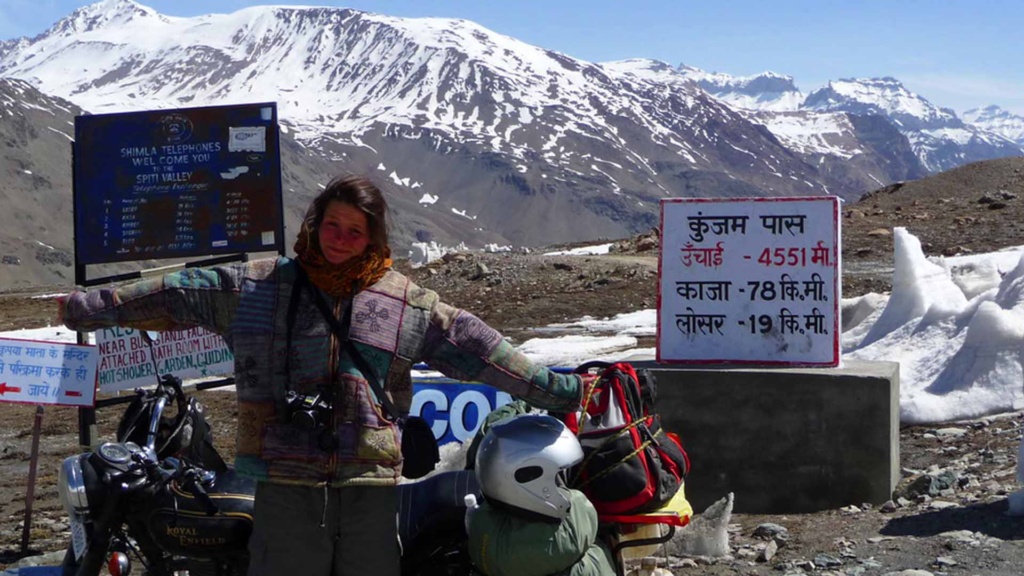
It was late June 2016, and Cecilia and I were riding from Kargyak to Padum on Royal Enfield Himalayans. The route was clear enough in our heads: Kargyak, Purne, the Phugtal turn-off, Ichar, Reru, Stongde, Padum. We did it in one day, though “one day” makes it sound tidier than it was. In truth, it was a chain of interruptions held together by heat, dust, fuel worry, tyre levers and the kind of help that arrives without announcement.
These were 2016 road conditions, and I want that stated early. This is not current route advice. Roads in Zanskar have changed significantly since then; BRO announced connectivity on the 298-km Nimmu–Padam–Darcha road in March 2024. What we rode was an older version of that corridor, rougher in the memory and much less forgiving in the moment.
The puncture came somewhere between Kargyak and Purne, just as the valley had begun to open and we were relaxing into the day. The rear tyre went soft, and with it went all the confidence we had packed that morning. We stopped where a little shade tried its best. Out came the tools, tube, patch kit and pump. Out came the vocabulary of inconvenience.
Cecilia wrapped her scarf against the glue smell and grinned. “Flat tyres are the Himalaya teaching patience with props,” she said.
The thorn was small enough to feel insulting. I pulled it out, checked the tube, roughed the rubber, spread the glue, waited, pressed. A man came down from a field with a willow basket on his back and barley dust on his hands. He watched for a moment, squatted beside us, and pointed at the shade.
“Shadow will move. Your patch won’t if you don’t hurry,” he said.
He offered a matchbox flame to warm the patch, and the smell of rubber and heat rose into the afternoon. We paid in biscuits and thanks. The tube held. The pump worked slowly enough to make each stroke feel like a negotiation. When the tyre took shape again, the day felt possible, but less casual.
We rode on more gently after that. Punctures do not only remove air. They remove some of the stupidity from your wrist.
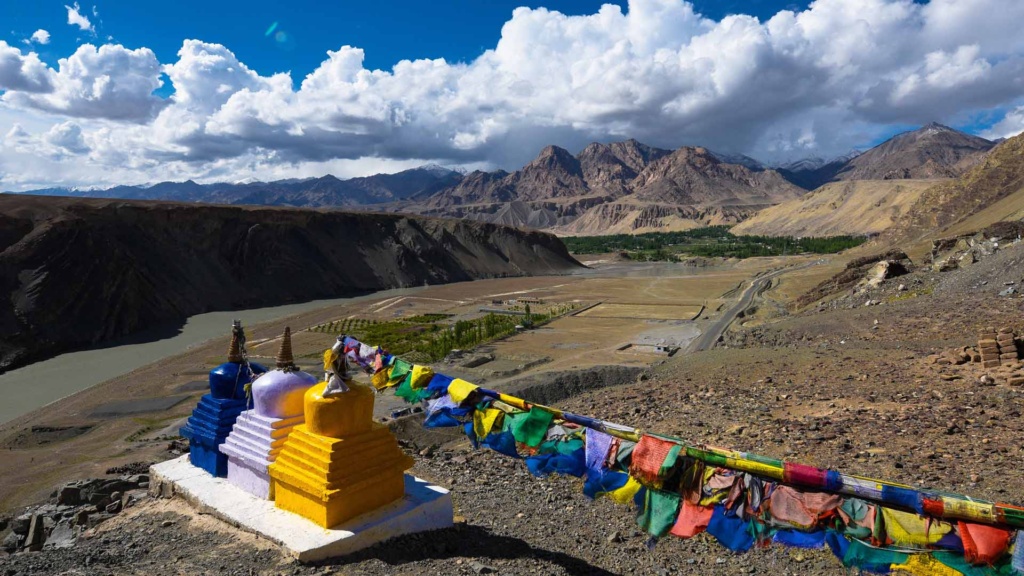
Somewhere In Zanskar
Purne and the turn we did not take
By Purne, fuel had become less a number and more a mood.
The track, headwind, idling during repairs and the slow grind of rough sections had burned more than our optimistic calculations allowed. We had jerrycans, but jerrycans have a strange habit: they look reassuring in the morning and inadequate by noon. I switched to reserve earlier than necessary, partly to know where I stood and partly because superstition sometimes wears the same clothes as planning.
At a tea shack near Purne, we stopped for salt tea and arithmetic. The woman there looked at our cans and did not pretend the situation was better than it was.
“Half-litre for each,” she said, taking down Coke bottles repurposed into fuel vessels.
The petrol looked too little and too important. I asked how much.
“Enough for tea next time,” she said.
We paid what we could, drank slowly, and let the shade do some of the work the morning had failed to do. Nearby, the track towards Phugtal pulled at the mind. In my preferred spelling, Phugtal. Ladakh administration describes Phugtal Gompa as a cave monastery in the Lungnak valley, and even then the name had the power to make a tired traveller consider foolish rearrangements of time.
We stopped at the turn-off and looked up the valley.
“Next time,” Cecilia said.
It was the right decision. Fuel, daylight and tyres were already asking enough from us. Some places stay in a journey precisely because you did not go. Phugtal became one of those: a monastery carried forward, not visited that day.
Heat, Ichar and Reru
The climb towards Ichar made the heat personal.
The road rose in rough switchbacks, lifting us away from the river and into a light that flattened distance. The engine began to cough — not a full breakdown, not fuel starvation yet, just the irritated misfire of a hot machine being asked to keep proving itself. We stopped in a patch of shade shared by goats and a shepherd who looked at our boots, our bikes and our faces with equal doubt.
“Strong shoes, weak plan,” he said.
He was not wrong.
We sat, drank water, let the engines cool and accepted the silence without trying to decorate it. Cecilia offered him mango candy, which he accepted with the solemnity of someone receiving something from a country he had no immediate need to visit. Then he returned to his goats, and we returned to the hill with more humility than before.
The Reru flats looked easier than they were. That is how flats, in both senses, get you. The surface appeared smooth enough to tempt the throttle, and the rear tyre punished the thought. Another puncture. This one had a nastier cut, the kind that makes a patch less a solution than an argument.
We pushed towards help, ridiculous and sweating. At Reru, the mechanic’s fire became the centre of the afternoon: a man in a watch cap, a boy on a stool, a coffee can of patches, a brick stove and a vulcanising plate already blackened by other people’s emergencies. He examined the tube, looked at us, then said only, “Fire.”
Chai arrived. The tube was warmed, pressed, held, checked, rejected, pressed again. The first attempt failed. The second held. Cecilia taught the boy to say “football” the Portuguese way, stretching the word until he laughed. The mechanic refused a photograph, which I respected. Work was work. It did not have to become proof.
When the wheel went back on, the repaired tyre rolled with the delicacy of a thing that had been persuaded rather than fixed.
Stongde and the last fuel
Somewhere near Stongde, the fuel needle stopped pretending.
The reserve had already been used. The extra petrol from Purne had become memory. The engine began to sound lean under throttle, that thin, questioning note every rider learns to fear. We stopped under a rock lip that gave barely enough shade to count as kindness.
I tilted the bike, trying to persuade whatever fuel remained in one corner of the tank to gather where the machine could drink it. Cecilia laughed so hard she nearly lost her balance.
“This is a samba,” she said, swaying the bike with me.
A truck came climbing slowly, first gear, dust, patience and weight. The driver stopped because some people understand the language of a tilted motorcycle without translation. He had petrol in a Coke bottle too. Not much, perhaps a few hundred millilitres, though I would remove the exact amount before publication unless a note confirms it. He poured it in with no performance.
“For your prayer,” he said.
We offered money. He refused, took an orange for his boy, and drove on. The engine started again with a sincerity that felt almost emotional, though it was only fuel and combustion doing their ordinary work.
By then Padum was not far, which is exactly when arrivals become dangerous. The last stretch rattled us through gravel, old broken surfaces and corrugations that turned wrists and knees into complaints. Stongde sat off to one side, dignified and distant. The light had begun to soften, but the road had not.
We rode standing where we had to, sitting where the wind and fatigue insisted. The kilometres reduced themselves slowly. Every sign that suggested Padum was near felt both encouraging and cruel.
Then the town began to gather: fields, dogs, the first shop, a lane, a wall, a guesthouse.
We parked the bikes and said very little.
Padum, hot water, repairs
The hot water bucket in Padum felt more important than achievement.
It arrived with the seriousness the day deserved. I washed road dust from my hair, glue from my fingers, sweat from my neck, and that particular smell of petrol and tube rubber that clings to a rider after a hard day. Dinner was dal-rice, and it tasted less like food than membership. We had made it. We said it softly because saying it loudly would have misunderstood the day.
Later, after the generator quietened and the plates had disappeared, Cecilia and I walked into the Padum night. There was a small drink, a careful toast, more relief than celebration. We did not toast bravery. We toasted punctures that held, fuel that arrived, and people whose names we had not properly learned but whose help had carried the day.
The next morning, the machinery of consequence began.
The bikes went to a yard. A mechanic with a backward cap listened, tightened, adjusted, corrected what we had pretended not to hear. A spoke was tightened. The rear brake was made less vague. Things rattled; things were told not to. We bought apricots, ate momos too hot for dignity, watched children empty out of school, and let Padum return us to ordinary movement.
This repair day belongs in the article because a hard road does not end at arrival. It ends when the machine is looked at honestly the next morning.
Then, when we later left Padum towards Rangdum, the rear tyre flirted with failure again.
A slow puncture. Not dramatic. Almost comic by then. We coasted to the first chai, found the mechanic’s fire again, and took our place in the queue of other needs: cement, salt, our tube, someone else’s repair, everyone’s patience. The boy from before had learned the word “football” properly enough to make Cecilia clap. The patch took on the first try this time.
That is where I would leave the story: not with a lesson, but with a wheel going back on, a tube holding air, and two riders who had become regulars in a small economy of fire, rubber and tea.
The road from Kargyak to Padum had not tested us in any grand heroic way. It had made us dependent, repeatedly and practically. On a patch. On a flame. On half a litre of petrol. On a truck driver’s bottle. On a mechanic’s thumb. On Cecilia’s ability to laugh exactly when the day needed puncturing more than the tyre did.
We rode lighter after that, though nothing on the bike had actually become lighter.
Ride soft. Make room. Say thank you with your hands.