A ride where a short hop from Padum became a day of drums, dust, cables and laughter
The detour before the drums
The drums reached us before the monastery did.
We were still outside Padum, still arguing with dust, still pretending the day was simple. Cecilia and I had planned a short ride to Sani in August 2016, just before the longer Zangla–Lamayuru journey that would later stretch our idea of distance beyond recognition. This was supposed to be a smaller day: Padum to Sani, the festival, maybe a loop above the village, perhaps Pibiting the next morning, then back to the larger road.
That was the plan, which is usually the first thing Zanskar improves.
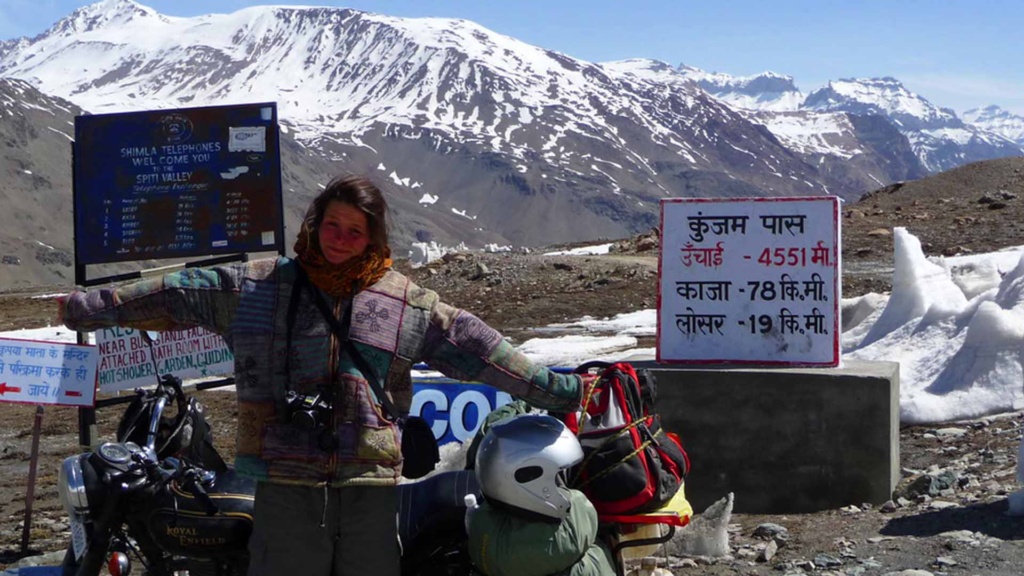
We were on the same Royal Enfield Himalayans, both already carrying the fatigue of earlier riding and the small mechanical suspicions that collect after rough roads. Chains checked. Cables checked. Fuel discussed with more seriousness than usual. Cecilia had the relaxed expression of someone who expects trouble and therefore is not surprised by it. I had the expression of someone trying to look prepared while privately hoping the motorcycle would cooperate out of affection.
Padum was already awake in fragments: apricots being sorted, children moving through lanes, mechanics handling tools in the half-light, tea appearing in metal cups before anyone had earned it. Someone had told us the Sani festival was on. In my notes, and in the way we spoke of it that day, it was Sani Gustor. Before publication, I would still verify the formal name, because public listings often record Sani’s August festival as Sani Naro-Nasjal or Sani Nasjal. But on that ride, the word in our mouths was Sani, and the sound ahead was enough.
The road out of Padum began politely and then changed its mind. Dust came first, then hardpack, then loose pebbles that made the front tyre feel as if it had developed opinions. We stood on the pegs where the surface demanded it and let the bikes move a little beneath us. Then Cecilia shouted, “Listen.”
At first I thought she meant the engine.
Then I heard it: drums, low and distant, not loud enough to be spectacle, but steady enough to pull the day forward.
Three kilometres or so before the Sani turn-off, the first detour arrived. A bridge had become uncertain about its role. It was not fully gone, but it had the look of something no motorcycle should trust casually. An older man in a red wool cap gave the universal mountain-road assessment: a flat hand tilted one way, then the other, then the expression that means you may try, but why make a fool of yourself before lunch?
A boy pointed us towards a sandy line through an old riverbed. A tractor had gone first and cut two useful trenches. We followed them badly but successfully. My rear wheel fishtailed with more theatre than danger. Cecilia rode through with the irritating calm of someone who understands sand better than I do.
On the far side, we stopped at a tea stall marked more by smoke than signage. The woman there gave us tea without asking whether we wanted advice with it. I asked about the festival.
“Dance-day,” she said, and looked at our tyres. “Leave hurry here.”
So we tried.
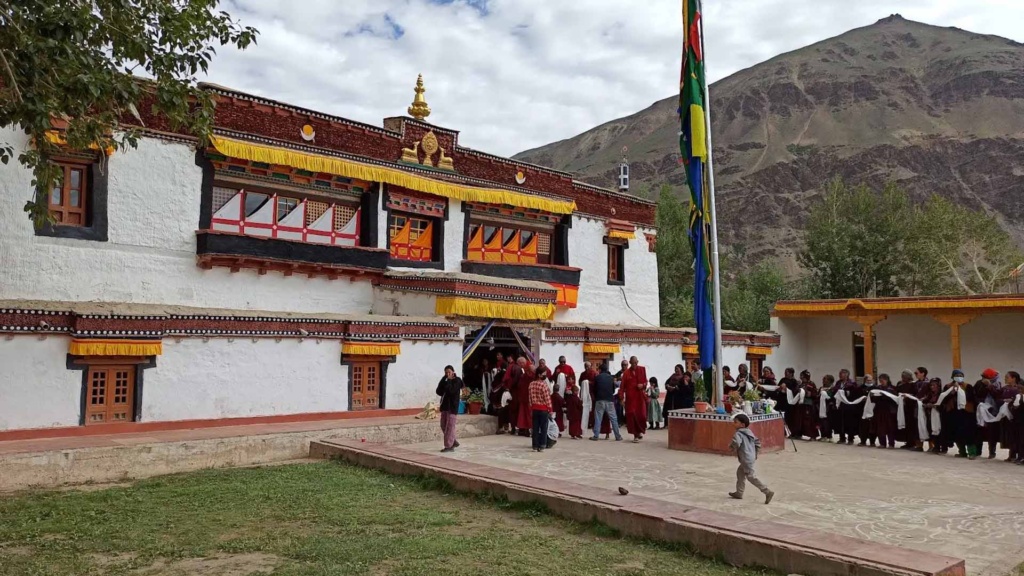
Sani Monastery
Sani yard
Sani did not announce itself like a monument.
It gathered around sound. Drums first, then horns, then the thinner cut of cymbals, then voices, engines, feet, goats, children and the layered murmur of a village day that had become public. We parked among tractors and motorcycles and entered the yard with the slight awkwardness of riders who have arrived with dust on their boots and no clear idea where to stand.
I am keeping the festival description observational because that is how I experienced it. I saw masked cham dancers, drums, dungchen horns, cymbals, butter lamps, the chorten, a thangka room and people moving between devotion, curiosity and ordinary errands. I did not understand everything I saw, and the article should not pretend otherwise.
The first dancer stepped into the courtyard and dust rose around the robes. The drums gave the movement a centre. Dungchen horns folded the air into a long, low sound that seemed to come from the ground as much as from the instruments. A late-arriving motorcycle revved too hard near the edge of the crowd, and for a second ritual and engine noise collided so perfectly that Cecilia and I both laughed.
That mix is what stayed with me: not festival as performance, but festival as a day that included everything. A child with a wooden top. A monk moving quickly with a practical errand. Women tending lamps. Visitors trying to frame photographs without blocking the view. A goat making its own judgement about the crowd. Dust turning the light visible.
We circled the chorten, stood near the lamps, looked only where it felt appropriate to look, and returned to the courtyard. I did not want to turn Sani into a spectacle for the page. The place was not waiting to become content. It was already busy being itself.
Then we made the mistake of thinking we had enough time for the upper loop.
The upper loop misbehaves
The first hairpins above Sani were easy enough to encourage foolishness.
The road climbed through dust and loose stone, giving quick views back towards the plain. We told ourselves we would ride a little higher, look down on Padum, return before the final dance and still have enough daylight for everything. This is the kind of sentence that sounds practical only before the first cough from the engine.
My bike began to stumble. Not a dramatic failure at first. A hesitation, then a fuel-starved stutter, then a cough through the carburettor. I stopped and opened the fuel cap. The hiss said enough. Dust had affected the vent, and the tank had begun creating its own little problem of pressure and refusal.
For a few bends, loosening the cap helped. Then the motorcycle coughed again and stalled. We found shade, investigated, muttered, laughed less confidently. Cecilia asked, “We go back?”
“We go sideways,” I said, pointing towards a track that looked as if it might rejoin the main route.
It did, but not before charging its fee.
A rock step looked smaller than it was. The rear hopped, my left foot searched for ground and found only air, and the Himalayan went down with the tired affection of a machine that had been waiting for me to stop pretending. It was not a serious fall. The lever, peg and mirror survived. My pride required more adjustment than the bike.
Cecilia put a hand on my shoulder and said, “We made our offering to Sani. Dust and a little ego.”
That line stays. It was accurate.
We righted the bike, checked for leaks, and continued with more care. Then the clutch cable began its own announcement: first a roughness at the lever, then a slackening, then the horrible feeling of a handgrip coming back too far without the resistance it should have. The outer sheath had frayed near the perch. It was not the kind of failure that ends a journey, but it was exactly the kind that makes a short detour feel longer.
We coasted down towards help.
The mechanic under the mulberry
The mechanic did not have a signboard.
He had shade.
A mulberry tree spread itself over a yard with a bench, a swinging bulb, a box of screws, the smell of chai and coal, and the kind of calm that only people with tools possess. The man who came out had a red tika and black half-moons under his nails. He saw the clutch cable and understood the situation before I had finished explaining it.
From a coffee can came a small brass cable nipple, wire, taped pliers, and the practical magic of making one more ride possible. Children gathered in twos and threes. Cecilia borrowed a kettle and began making tea as if she had been appointed logistics officer by the valley. I stood there feeling both useless and deeply grateful.
The repair was temporary and honest. The mechanic tightened, pinched, tested the lever and gave the kind of warning I respect more than reassurance.
“Only to Sani and back,” he said. “Buy new tomorrow. Faith is good; cable better.”
We paid him, added biscuits and whatever small thanks could be accepted without turning gratitude into embarrassment, and rode back to the monastery yard with a clutch that worked well enough to make me religious about gentle shifting.
The final cham had begun when we returned. We had missed some of what we came to see and arrived in time for what the day allowed. The drums were deeper now, or perhaps I was simply more ready to hear them. A child noticed the fresh wire near the clutch perch and gave me a thumbs-up with official seriousness. I returned it.
By the time we rode back to Padum, evening had softened the road. The detour that had felt rude in the morning now seemed almost generous. The patched clutch held. The dust came with us. Padum appeared ahead with small roofs, smoke and the promise of food.
Dinner tasted better than it had any right to. Sleep came quickly.
Switchbacks Become Stories: Five Days Between Zangla and Lamayuru
Pibiting, then the real repair
The next morning, we found a new clutch cable.
That should have been the whole day’s practical triumph, but we still had enough curiosity left to make a small side trip to Pibiting. The route was short, the chorten visible enough to pull us forward, and the bikes seemed to be behaving with the politeness of children after a scolding.
Halfway up, I felt the wobble.
The tyre looked fine at first, which is how slow leaks like to behave. Cecilia sprayed water near the bead and bubbles appeared with quiet malice. It was not a dramatic puncture, not even fully a flat. Just a reminder. We pumped enough air to give ourselves time, rode carefully, and stopped in the chorten’s shade to look back at Padum under late light.
There was also apricot oil, wrapped carefully in newspaper by a woman whose hands made even glass seem less fragile. Fuel from a drum into bottles happened too, part of the everyday arithmetic of riding in Zanskar then. None of this should be presented as current route advice. It was simply how that day worked.
Back in Padum, the tube was patched near a mechanic’s fire, and then came the job that should have been easy: replacing the clutch cable properly.
I struggled with it.
The cable found every awkward angle possible. The guide resisted. The lever refused to sit cleanly. Grease reached places where grease had no editorial purpose. Cecilia stood nearby, laughing with the complete freedom of someone who had earned the right.
“You and your faith,” she said.
“Cable better,” I muttered.
That is where the article should end: not with a lesson about detours, not with drums becoming destiny, but with my fingers blackened by grease, a new cable finally sliding into place, Cecilia still laughing, and the motorcycle ready for the road that would soon take us towards Zangla, Singge La, Sirsir La, Lamayuru and the five days we had not yet learned to respect.
Detours are not obstacles; they are the festival’s encore.