A ride through an unfinished line of mud, machines, ledgers and waiting
Where the road stopped
The road stopped at water first, then at stone.
We were somewhere around the Sansari–Sural side of Pangi in June 2016, Josephine French and I standing with our motorcycles beside a crossing that had stopped being a crossing and become a question. A stick-and-rope barrier leaned across the track with more hope than authority. A uniformed man had an old ledger open on his knee. Truck drivers waited nearby with the patience of people who knew that the mountain did not speed up for anyone’s schedule.
“If it rises, turn back,” the jawan said. “No shame.”
It had rained somewhere above us. We could not see the rain, but the nallah had brought the message down in its own language: more water, more force, more brown impatience. A Tata 407 went first when the level dropped. It rocked, hissed, pushed through, and climbed the far bank. Then it was our turn. Second gear, steady throttle, eyes across, not down. Halfway through, a stone kicked the rear tyre sideways and the bike twitched hard enough for my body to forget every clever thing I had ever said about riding.
Then the far bank took us.
A kilometre later, the road disappeared into a fresh landslide.
The rock still looked newly exposed, pale and raw, as if the hill had torn its own skin open. A road crew had already arrived. Flags. Whistles. Men moving with an efficiency that did not need drama. A dozer chewed at the slide, reversed, angled, pushed again. Negi was there, real and publishable, directing the work with the tired concentration of someone who had repeated the same argument with the mountain all season.
“We move the line every day,” he said. “The mountain moves it back.”
That line stayed because it was not a slogan. It was a work report.
We parked in the safest hollow we could find and waited. At some point waiting became participating. We moved small stones, carried water, shifted ourselves when the crew needed space, and learned the awkward humility of being travellers on a road other people were still making possible. We had come for a route. They were building one under our boots.
The rewrite of this article has to begin here because this is where the idea of the journey became honest. Pangi to Padum was not a clean line. It was a permission repeatedly requested from water, rock, labour and weather.
This is also a dated memory. I am writing about 2016 conditions. The road has changed since then. BRO announced connectivity on the 298-km Nimmu–Padam–Darcha road in March 2024, and official releases later described the Shinkun La tunnel project on the same road axis. What Josephine and I rode was an earlier, unfinished version of that landscape.
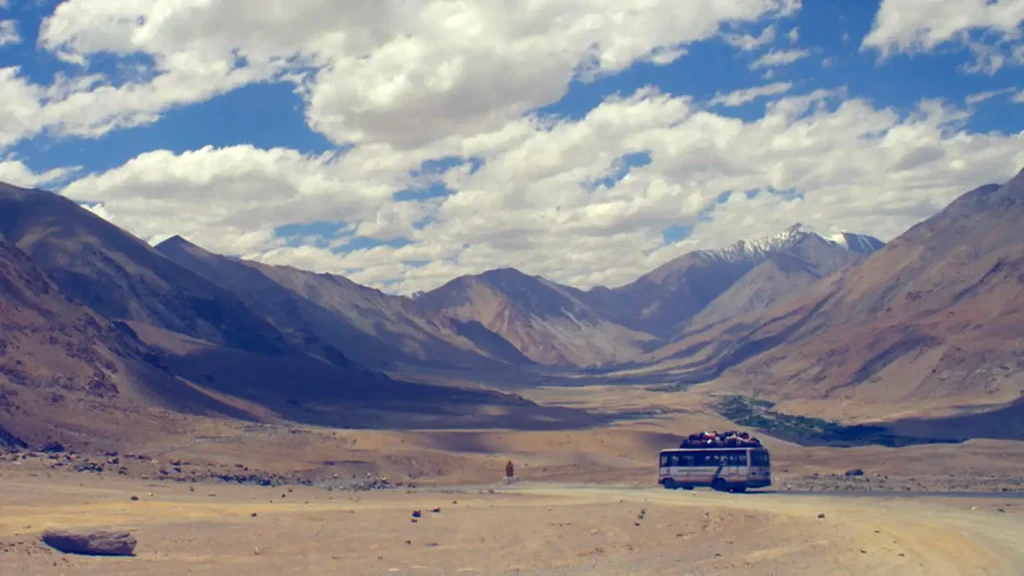
Zanskar
Manali to the Pangi edge
We had started in Manali with maps that looked more confident than we were.
Early summer there has its own damp theatre: jackets drying under eaves, engines idling in drizzle, riders comparing pass rumours over tea, someone always declaring a road open because one person had heard from another person whose cousin had seen a truck. I had my Himalayan, a softening paper map, and the usual list of things that seem excessive until they are needed: tools, biscuits, rope, spare patience.
Josephine arrived with the calm of someone who had already accepted uncertainty as part of the route. We compared notes in a café, the table crowded with tea, grease marks and lines drawn too cleanly for the mountains to respect.
“Padum?” she asked.
“Padum,” I said.
The first movement was familiar enough: Manali to Rohtang, then down towards Lahaul, Keylong and Tandi. Rohtang was grey and damp, the snow walls already slumped and dirty, traffic breathing in corners, buses stopping wherever certainty failed. Beyond it, Lahaul opened hard and clean. At Tandi, where fuel is treated with the seriousness it deserves, we filled up and turned towards Udaipur rather than staying with the more familiar Darcha logic. Pangi pulled at the map.
The road to Udaipur along the Chenab was already teaching its terms. Cliff on one side, river below, trucks arriving at blind corners with the authority of lived repetition. We rode close to the mountain where we could, not because it was always safer but because it felt more negotiable than the outer edge. In Udaipur we found a room, tea, and a wall map that belonged to another season.
The next day to Killar sharpened everything. The Chenab road is not scenic in the soft way. It is scenic because the body keeps measuring consequences. Rain loosens stone. Corners hold old debris. The road narrows without apology. At Tindi and beyond, the mud on workers’ boots told us more than any rider rumour.
At one stop, a BRO crew waved us in for tea. Negi pointed towards a shelf where the road ahead looked temporary, as if someone had sketched it and walked away before deciding whether to keep it. Men were rebuilding a culvert that the water had damaged. Their movements were practised: shovel, lift, drag, signal, wait.
“You ride for views,” Negi said later, not unkindly. “We ride to make views reachable.”
We reached Killar with dust in our teeth and ate dal-rice with the seriousness of people who had discovered how much attention a road could consume. By then we still believed we might push the Pangi logic forward. Sansari and Sural corrected us.
The long backtrack
The next morning the talk in Sural was practical and unanimous: the way ahead had slumped badly enough to make our plan foolish.
This was not a dramatic defeat. It was road information. A slope had gone. Water had risen. The crew had work to do. The sensible line to Padum was no longer the line through which we had entered. It was back: Sural to Killar, Killar to Udaipur, Udaipur to Tandi, then Darcha, then the unfinished approach towards Shingo La.
Josephine looked at the map and laughed with resignation. “We make a big circle to step across a puddle.”
It was more than a puddle, but she was right about the feeling. Backtracking has a way of bruising pride more than progress. The same corners we had ridden with uncertainty now returned as known dangers. The Chenab still roared, the cliffs still leaned, but something in us had changed. We were no longer trying to prove the route. We were trying to remain useful to it.
By Tandi, the bikes were dusted in layers. By Darcha, our names entered another ledger. The checkpost details were real, but I would keep them general in the published piece: date, names, route, the ordinary bureaucracy of remote roads. Ledgers are not romance. They are accountability, and in places like that they matter.
Above Darcha, the new work began again. Cut faces. Fresh rock. Bulldozers. Wind. The metallic smell of stone recently torn open. The road towards Shingo La felt less like a road and more like an agreement in progress. We rode through sections where the surface changed every few hundred metres: powder, loose rock, wet patches, hard-packed sections that made you trust them just before they ended.
That night we camped near a bridge skeleton in a temporary road-worker settlement. Tara was real and may remain. She lent us a pressure cooker with the look of someone who had already decided that incompetence could be managed if people were polite. Rice cooked faster than the moon rose. Workers ate, checked machines, spoke in short sentences, and let us sit at the edge of their evening without turning our presence into an event.
The bridge skeleton stood nearby, metal against dusk, not yet useful and already essential. I remember lying down that night to the distant bass of engines and the closer sounds of canvas, utensils, wind and someone coughing in the dark. It was not wilderness. It was work.
Across Shingo La
Morning at Shingo La looked unfinished in the best and hardest way.
I am using Shingo La because that is the name from my 2016 notes and memory. Current official material often uses Shinkun La in relation to the Nimmu–Padam–Darcha road and tunnel project, but this article should preserve the field language of that ride while noting the spelling difference in fact-check notes.
The climb began through fresh cuts, drill marks, loose talus and stone pushed into the rough discipline of a track. My Himalayan idled unevenly for a while, then settled. My lungs were less cooperative. Josephine rode quietly, economical with movement, choosing lines without wasting theatre on them.
Near the top, the wind became sharper. Snow held in shaded gullies. A dozer sat near the pass, yellow and indifferent, its bucket open as if resting its jaw. There was no grand signboard in my memory, no finished-road ceremony, no polished claim. Just machines, men, wind, rock and the sense of being allowed through a place still deciding its own shape.
We parked clear of the work and walked a little. Breath came shorter. Speech became practical. The pass was not a destination as much as a hinge. Behind us: the backtrack, Pangi, Sural, Killar, Udaipur, Manali. Ahead: Zanskar Sumdo, Kurgiakh, Purne, Reru, Padum.
The descent was harder. Slush caught the tyres in two sections, and we walked the bikes with engines off, clutch in, boots sliding, hands ready. There is nothing elegant about walking a loaded motorcycle through slush at altitude. It is all grunting, balance, embarrassment and sudden gratitude when the wheel finds firmer ground.
Lower down, the valley began to soften. Water appeared as thread rather than threat. The road was still rough, still provisional, but it had stopped feeling like a machine yard and begun to feel like a route. At Zanskar Sumdo we found a canvas dhaba and food that tasted more precise because everything before it had been uncertain.
Kurgiakh came with willow, barley, stone houses and the return of human scale. The spelling should remain Kurgiakhhere, as confirmed. We stayed in a homestay with one bulb, two quilts and gur-gur cha poured with the calm of repetition. A boy practised multiplication tables. A goat argued outside. After the pass, ordinary sounds felt newly valuable.
The next day took us towards Purne and Reru. The Phugtal thought hung to one side, but this is not the place to retell it fully. That belongs more naturally to the Kargyak–Padum ride elsewhere. Here, the emphasis stays on the road being made: temporary bridges, workers passing stones by hand, laughter on a ridge, a track that alternated between powder and paste.
At one damaged section, men were moving stone hand to hand. We joined briefly, badly but sincerely. The rhythm was not heroic. Pick, pass, stack, step aside. The body understands infrastructure differently once it has moved even a few stones for someone else’s road.
At Reru, children pulled us into a loose game with a bent bat and a ball that had survived more stone than leather should. We were terrible enough to be welcome. That evening, in a partially built guesthouse with cement bags stacked nearby, dinner was hot, simple and deserved. Someone spoke about roads changing winter, work and cost. I would keep the line if published because you confirmed the dialogue as verbatim, but I would keep it close to the room, not turn it into a thesis.
“When the road completes, winter will become the only honest season,” he said. “We will be reachable, and reachability is both blessing and bill.”
That was enough. The sentence did not need my decoration.
Padum, then Josephine riding out
The final approach to Padum in 2016 felt less like arrival and more like the road taking a breath.
The track continued to change under us: powder, ruts, gravel, half-made culverts, workers pointing out the safer line, machinery resting beside the day’s cut. Stongde appeared from its perch. Karsha gathered in the distance. Padum widened into view slowly, then suddenly, as high towns often do.
We rode into the main lane with the awkwardness of people who had spent too long inside helmets. A room was found. A mirror returned my face to me in two halves: sun on one side, dust on the other. I laughed because the alternative was to begin explaining the road to a mirror, which would have been unfair to both of us.
Food came first. Dal, rice, pickle, water in steel cups. Josephine and I lifted the cups and said almost together, “We made it.”
Then, just as quickly, we corrected ourselves.
“We didn’t.”
The road had not ended. It had only allowed us to stop. Beyond Padum, lines still continued towards Zangla, Rangdum, Lamayuru, Leh, and into other unfinished sentences we had no right to simplify.
We walked to Karsha that evening because the body, perversely, sometimes wants to move after a day of riding. The mani walls held the warmth of the day. The monastery remained a brief, observational stop: lamps, quiet movement, boys’ voices, dust in the light. I did not need to interpret it. I only needed to stand there without rushing.
The rest day in Padum should remain because it shows how a place continues after arrival. Josephine rode out at dawn to test the Rangdum line while I stayed back to have my carburettor cleaned. In the mechanic’s yard, the carb bowl held a small galaxy of fine silt. The man called the engine “beta” and explained jets with more story than formula. By then I had stopped needing everything to sound technical. If the bike ran better afterwards, the explanation had done its work.
I walked the bazaar. Apricots on a charpai. A post office operating at its own temperature. Shops selling batteries, biscuits and improbable combinations of necessity. An old man made tea and asked how the road was from Pangi.
“Confused,” I said.
“Good,” he replied. “Certainty makes bad travellers.”
You confirmed the dialogue, so I am leaving it. It fits because he did not sound like a sage. He sounded like a man making tea.
In the afternoon, Josephine came back with wind in her clothes and a story in her face: a washout, a dozer, trucks waiting, a woman at a roadside shack managing the queue with the authority of someone who had done it before. We sat with tea and compared what the day had given each of us.
The final scene is Josephine riding out.
Not because it was dramatic, but because it was exact. She tightened her luggage, checked the straps, kicked the stand back, and looked once towards the road before putting on her helmet. There was dust on the tank, mud in the lower frame, and the usual unreadable confidence of a rider about to become smaller in a valley.
We did not make a speech. We had already done the talking a road like that permits: at crossings, in ledgers, beside dozers, over rice, near mechanic’s tools, in the short language of hand signals and head nods.
She raised one hand.
Then Josephine rode out, and I stood in Padum watching her taillight become a red point in the dust, then nothing.
That is where the road ended for this article: not finished, not solved, only briefly visible before it went back to becoming itself.
Switchbacks Become Stories: Five Days Between Zangla and Lamayuru