A coast-hugging day by scooter and short walks along Phuket’s southern edge.
July 2024, and my passport had become a smudge of airports: Thailand first, Bali next, Malaysia later. I had come to the south end of Phuket to practise a slower kind of movement, though not an entirely heroic one. The scooter would carry me between the main points; my feet would do the edges — from parking areas to beaches, viewpoints, rocks, food stalls and the places where the road could no longer help.
The plan was simple enough to trust: start with dawn at Nai Harn, idle at Ao Sane until the sun made its point, ride towards the Windmill Viewpoint for shade and air, stop around Ya Nui, then reach Promthep Cape before dusk. The night before, I laid out the small kit of the day: filled bottle, rash guard, sunscreen, battered hat, soft towel, a tiny sins bag for plastic corners and stray fishing line, a pen, and a postcard to myself. I slept with the window open to Rawai’s low evening machinery — scooter notes, a gecko in the rafters, a late conversation in Thai whose vowels did more for me than the hotel playlist.
Before 5 a.m., my alarm made a small mistake. I was already awake.
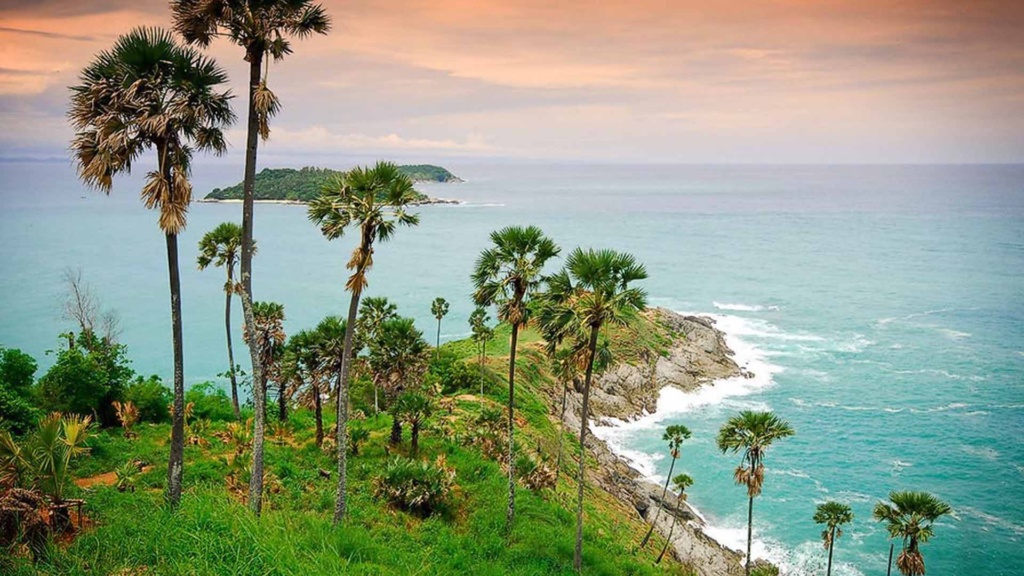
Promthep Cape
Nai Harn: a day invents itself
In the blue before morning, the lane to Nai Harn smelled faintly of jasmine and warm concrete. Casuarina trees combed the wind along the shore. Runners traced loops around the lake, the earliest and most devout, while the beach waited in a colour that was not yet silver and not yet blue. I parked, walked barefoot through sand that still held the night’s coolness, and sat where the shore agreed to be wet.
Dawn came slowly, then all at once: pewter, guava, saffron, then the warm gold that allows the day to ask more of you. A fisherman waded chest-deep with his net. Three elderly women stretched with the economy of people who had edited their mornings for years. A dog patrolled the wrack line with a seriousness that outperformed most security guards I have met.
I swam at the first lift of light, a short parallel line to the shore: five strokes, breath, six strokes, breath. No heroics. The Andaman does not care for declarations. On my back, I drifted until the water at my wrists reminded me to stop comparing oceans and be where I was.
By the time I towelled off, the beach had begun its daylight work. Vendors adjusted umbrellas, breakfast carts tested burners, and a monk in orange moved through the morning with a bowl that made no sound. I bought khai jiao over rice — egg fried wrong in all the right ways, edges furious, centre pleased with itself. The vendor reached for a plastic spoon, saw me hesitate, and produced a metal one without a word. Island hospitality is sometimes an intuition that arrives before your request.
Immigration at Midnight: Between Flights and Faces in Bangkok
Ao Sane: a small beach, a slower hour
The ride to Ao Sane was short enough to feel like a continuation rather than a new chapter. I parked and walked down through shade, past resort walls and gardeners already negotiating with bougainvillea. Ao Sane appeared as a pocket of sand, boulders and clear water, the kind of beach that lowers your voice without asking.
The tide had left small worlds on flat rock tables. I crouched and watched without naming too much. There was movement in the pools, the flicker of tiny bodies, shells shifting, dark shapes tucked into the safety of shadow. I did not lift rocks or rearrange anything. Some lives deserve their dark.
A child nearby announced each discovery to a patient father. “A star!” the child said, pointing at something that may or may not have deserved the name.
“Also a star,” the father replied, choosing wonder over accuracy.
When the sun rose harder, I slipped from the boulder into the water. The shallows were clear enough to make care feel obvious. I kept my feet quiet, hands tucked, breath loud in my ears. A longtail boat burred towards the headland and I stayed close to the rock until the churn settled.
Back on the boulders, I ate a banana from my pocket and read three pages of a book I am still pretending to finish. Ao Sane is a good place to fail at reading. Shade moved slowly. Two dive students practised mask clearing with theatrical sneezes. A woman laid out a towel with the seriousness of a treaty.
Wind on the shoulder
By late morning the boulders had begun storing heat. I rode back towards Nai Harn and took the road up, keeping to the side, waving impatience past. The hill towards the Windmill Viewpoint was more coax than demand on a scooter, though the final walking around still reminded the calves that the day had not outsourced everything.
Traffic had its own manners. Delivery bikes, a pickup carrying water, a tourist car remembering how to yield, and an uncle on a Honda Dream whose horn squeaked with more personality than authority. Halfway up, I stopped at a coconut stall in the shade. The vendor tapped open a green coconut and gave me cold, sweet water. I returned the cup as if it were a document.
At the viewpoint, the wind took a more active interest in the afternoon. It arrived in layers: a cool undercurrent travelling along the contour, a warmer shove over the ridge, a pause, then another push. Kitesurfers below made small inventions on the water. The turbine turned with the patience of something large enough not to hurry.
A wedding photographer arranged veil and horizon while cousins perfected the art of neither helping nor hindering. An ice-cream cart man rang his bell politely. I sat on a bench, opened my book, and achieved the kind of reading where the same paragraph keeps returning with better wind.
To be honest, the day could have ended there and I would have called it a success: skin salted but not scolded, body awake, mind quieter than arrival. But Promthep held the day’s last light, and the road curved forward.
Ya Nui to Promthep
From the Windmill side, the route gave me the coast in pieces: Nai Harn behind, Ya Nui below, the Andaman widening whenever the vegetation allowed it. The shrubs were thorny, the grasses coarse, the occasional tree heroic by refusing to advertise itself. I parked where I could, walked where walking made sense, and let the scooter wait out the parts built for engines.
Near the lower ridge, goats nipped at shrubs with the relaxed entitlement of people at a buffet. Their bells made a small, uneven music. A pickup of teenagers passed; one called out, “Where you go?”
“Promthep,” I said, pointing with my whole hand.
A chorus of thumbs-up returned. I love a place where thumbs-up remains acceptable punctuation.
At Promthep Cape, the crowd had already been decided by the hour. Sunset is a magnet. Arrive early, though, and you get to watch the cape remember itself before the ceremony begins. I bought water from a stall behind the parking area and walked towards the promontory, slow and loyal to my ankles.
There is a lower ledge, not secret and not entirely overrun, that rewards care more than ambition. I went down slowly. From there, the view widened and loosened. The cape reached into the sea, the sea accepted the gesture, and I found a rock with the right angle for waiting.
Gold is a tired word until you are asked to name what spills from sky to water and back again at Promthep. The light changed everything without hurrying it. Boats beyond the headland became silhouettes. The grasses showed their silver undersides. Faces upridge softened into versions more forgiving of their own stories.
Thirty metres to my left, two children argued about the superiority of mango sticky rice versus roti banana, a debate clearly older and more important than whatever the sun was doing. The auntie who had sold me water came down with pineapple in plastic, then produced a bin from nowhere and tied the bag herself, anticipating my question before I had the chance to become earnest.
There is a rumour called the green flash, that tiny prism at the last second when light does a party trick on the horizon. Did I see it? I will say this: the last light had a clean edge, and then it did not. My breath took an extra step before remembering how. Good enough.
Night earns its soft noise
I did not rush the return. Sunsets do not need chasing after they end. I lifted a hand, stepped aside on narrow bits, and let the evening traffic find its own rhythm. At Ya Nui, I stopped near a little freshwater trickle to rinse sand from my feet. A tiny crab skittered away and returned immediately to judge me.
Nai Harn’s restaurants were turning on their neon one by one, like a sentence being emphasised too much. I took the quieter edge by the lake, where the morning runners had surrendered the track to moths and one couple quietly arguing about dinner. At the beach, the last towels were folded like flags after a parade.
Rawai welcomed me back with squid lamps offshore and the smell of dinner close to the road. I bought pad kaprao with a fried egg at a corner stall that had strong opinions about garlic and chillies. The cook asked, “Phet mai?” Spicy?
I gave a middle-aged reply and was rewarded with the perfect burn.
At the guesthouse, I handed over the sins bag and asked for the correct bin. The receptionist nodded like a judge accepting evidence and said, “Khop khun ka,” with a smile that made me want to be a better neighbour to all things.
Back in the room, I took the bucket bath I have learned to prefer: two kettles into cool water, a mug over the shoulder, soap where labour had earned it. On the balcony, I wrote the postcard to myself: “From Nai Harn dawn to Promthep dusk.” The title and the truth.
I put the hat on a chair and told it it would be needed after sleep. Outside, Rawai kept its polite party going: glass clink, scooter hum, a laugh blown sideways by the night. I slept like someone who had followed a coastline without asking it to become more than a day.