A winter walk on the Zanskar’s glass spine and the body learning slower than the ice changed
The first correction
I fell because I tried to walk as if the ice were a floor.
It was a small fall, which is the most embarrassing kind. No heroic crack, no dramatic plunge, no rescue story. My gumboot slid forward, the other foot tried to negotiate too late, and I landed sideways with my pack twisting my shoulder and my pride arriving last. The Chadar held. My dignity did not. Somewhere behind me, one of the crew laughed softly, not unkindly, the way people laugh when they know a man has just been corrected by physics.
This was January 2017, on my second deep winter return to Ladakh after the Ladakh Marathon had first planted the idea of the Chadar in me. The full journey that year lasted about twenty-one days, but the frozen-river section itself was ten days of walking, slipping, waiting, watching and slowly becoming less useless. I had already learnt, in theory, that the Chadar was not a trail in the normal sense. It was the frozen skin of the Zanskar, changing by the hour, used by locals as a winter artery and borrowed by people like me under conditions we only partly understood.
The fall made that theory personal. Dorje and Rigzin, both real men with the calm economy of people who had done this work before, did not turn it into drama. They adjusted the line, checked the surface and kept moving. That was the first lesson: on the Chadar, advice often arrived without a speech. It came as pace, posture, a shifted route, a hand pointing to the safer edge, or a laugh that told you to stand up and stop performing.
I stood, brushed ice from my sleeve, and tried again. Smaller steps. Softer knees. Less ego in the heel.
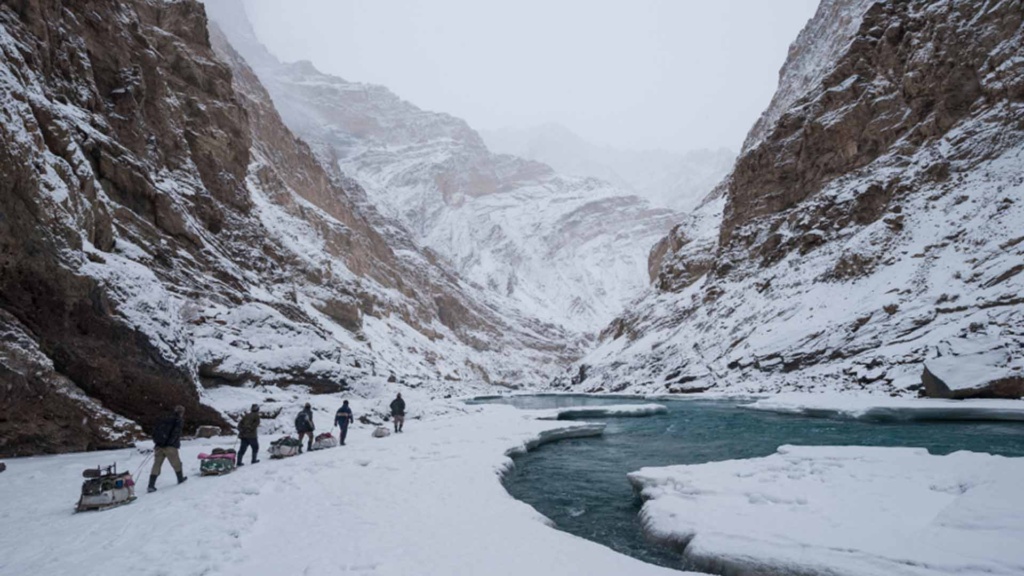
Walking across the thin sheet of ice.
After the finish line
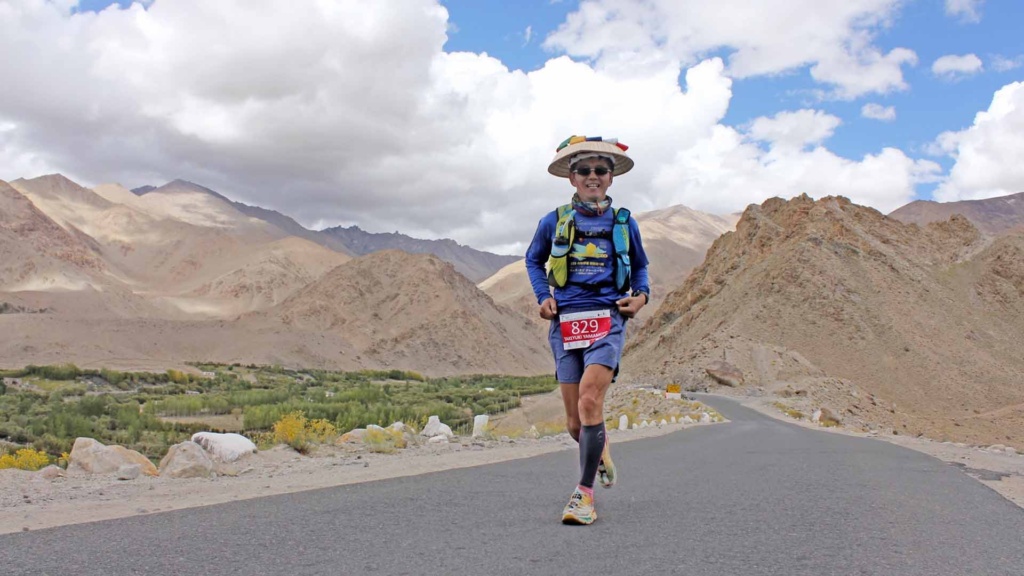
The Chadar had entered my life after the 2014 Ladakh Marathon. At the finish line in Leh, when my lungs were still bargaining with the altitude and my legs had become unreliable citizens, I heard people talking about walking on the frozen Zanskar in winter. I had seen the river before in summer near Nimmu, all silt and force, moving with the impatience of meltwater. The idea that the same river could become a road lodged somewhere in me.
When I returned in 2017, the vow had lost some romance and gained weight. Leh in winter made even simple errands feel deliberate. Boots stiffened near doors. Breath appeared in rooms before words did. The market moved at a reduced volume. I stayed, arranged the trek privately, checked gear and tried to pretend I was calmer than I was. The Chadar does not reward a traveller for looking prepared, but preparation at least gives fear something useful to do.
The kit was practical rather than glamorous: gumboots, warm liners, microspikes, layers, gloves inside bigger gloves, sleeping bag, thermos, dry bags and sticks that would become extensions of my nervous system. I had enough experience by then to know I was still inexperienced. That is a useful condition if you respect it. It keeps your mouth shut when the guide is reading ice.
We drove towards the start with the usual mixture of anticipation and dread. I remember the transition from road to river more than the exact logistics: packs unloaded, sledges arranged, kerosene and food checked, straps tightened, people quietly becoming the work they were there to do. Tashi, our cook, had the unshowy authority of a man whose job would become more important every evening. Stanzin handled loads with a patience that made my own movements look noisy. The crew checked their gear and ours, and we checked again. Cold is not a forgiving editor.
When the boots finally stepped onto the Chadar, the marathon felt very far away. Running had taught me to endure discomfort in a straight line. The frozen river required something less dramatic and more difficult: adjustment.
Learning to move
The first few days changed my walking before they changed my thinking. The body is stubborn that way. It prefers to learn through consequences. A boot placed too confidently on polished ice slid. A step taken too wide exposed the hips. A pause in the wrong place made cold climb into the toes. The correct movement was smaller, flatter, less proud. Gumboots do not make a man graceful, but they teach him to negotiate.
Dorje and Rigzin read the ice with a patience I did not yet possess. They looked at colour, surface, sound and position in the bend, but never as isolated clues. A dark stretch could be strong or simply frictionless. A white patch could hold or hide weakness. Ice near the inside curve of the river often behaved differently from ice where current pressed hard against the outside. I knew enough to be curious and not enough to be correct, which meant the safest thing I could do was follow the feet in front of me.
The wind was another lesson. At first I treated it as discomfort something that hit the face, stole warmth, made conversation brief. The crew treated it as information. Wind polished some surfaces, loaded others with snow, erased tracks, changed the feel of a bend. A place that looked familiar on the return could behave differently because the wind had worked on it while we were elsewhere. I began to watch not only the ice underfoot but the loose snow moving across it, the way spindrift collected near a rock, the way a gust carried sound along the gorge.
There were open-water detours where the river simply refused to be a road. In those places, no one argued. We climbed out, crossed loose frozen earth, used hands where boots were not enough, and came back to the ice later. The bypasses were often more tiring than the river itself. My thighs complained. My breathing shortened. The pack pulled backwards. But those detours taught the most important distinction of the trek: difficulty is not the same as danger, and convenience is not the same as safety.
One day we had to crawl across a section where standing felt like too much faith. There was no dignity in it, only method. Gloves on ice, knees lowered, pack shifted, movement slow enough to feel foolish and useful at the same time. I remember the cold smell of the surface close to my face and the scrape of fabric behind me. If anyone had taken a photograph, I would have hated it then and treasured it now.
Cold Work
Cold on the Chadar was not one thing. It had schedules and moods. Morning cold made buckles clumsy. Evening cold entered the fingers when you stopped moving. Night cold turned breath into frost and made a sleeping bag feel less like equipment than a small argument with the universe. I learnt that warmth was not a state you achieved; it was work you maintained.
Camp routine became the most reliable part of the day. Tents in some places, caves or overhangs in others, and village houses at Nyerak and Zangla, where walls and a stove felt almost luxurious. The moment we stopped, everyone had jobs. Loads came off. Stoves were managed. Water had to be melted or boiled. Socks had to be dealt with before they became boards. Gloves had to be kept dry or admitted as wet and managed accordingly. Tashi’s food did more than fill the stomach. It returned language to tired faces.
I learnt to watch the crew at camp as closely as I watched them on the ice. How they set things down. What they kept close. How quickly they changed layers. How little they wasted movement. The trek had stripped away decorative competence. Either a habit worked in the cold or it did not. Either you found your headlamp before dark or you fumbled for it while your hands became useless. Either your bottle slept where it would not freeze solid or you woke to an object with no immediate purpose.
We ate after the porters and crew, not because I want to dress that as virtue, but because hunger clarified hierarchy. They had done the heavier labour and would do it again the next morning. We checked gear, including theirs, with more seriousness as the days passed. A broken strap or inadequate glove was not a private inconvenience in that gorge. It could slow everyone. It could become risk.
Waste also became less abstract. We packed out what we brought in. The river did not need our wrappers, batteries, tape, packaging or laziness. The cold made even small bits of rubbish visible, indecent against the blue-white surface. Asking before photographs became part of the same discipline. The Chadar was not a stage, and people moving on it were not proof of my adventure. Some were working, travelling, carrying supplies, going somewhere that mattered more than my frame.
The Winter Artery
By the time we were past the early embarrassment, I began to see the Chadar less as a trek and more as a corridor with its own traffic. Locals moved differently on it. They did not waste drama on what the river required. Some carried loads, some moved with sledges, some passed us with the contained efficiency of people for whom winter travel is not an identity but a necessity. Watching them changed my sense of what we were doing.
For us, the Chadar was a chosen hardship. For people from Zanskar, it had long been one of the ways winter connected home to the outside. That difference matters. It affected how I walked, how I moved aside, how I used the camera, how I listened when the crew changed the line. We were not discovering a secret. We were borrowing a working route for a short time.
At Nyerak, staying in a village house gave that understanding a room to sit in. The warmth was domestic, smoky, ordinary and therefore powerful. The Chadar outside was already becoming part of the next day’s calculation, but inside there were socks, tea, tired shoulders, small talk, the logistics of staying warm. It is easy in writing to turn such rooms into symbols. At the time, I was mostly grateful for walls.
Zangla gave the journey its far edge, but I do not want to retell that arrival in detail here. That belongs more naturally to the route story. What matters for this piece is what had changed by then. I was no longer looking at the ice only as an obstacle between places. I was seeing it as a surface of decisions. Each crossing, bypass, wade, pause and fall had corrected the way I used my body. Each local traveller had corrected the way I understood the route.
The wade remains vivid. Water above the boot line is a simple fact that produces immediate seriousness. We moved quickly, not gracefully, and came out stamping heat back into our feet. Afterwards, the body remembers the lesson more cleanly than the mind: keep dry if you can, act fast if you cannot, and do not make the crew spend more energy rescuing your carelessness than the river already demands.
What Changed On The Walk Back
The return was where I realised familiarity could become dangerous. Sections I recognised were not necessarily the same sections. The river had continued working while we were away. Cold had strengthened some places. Sun had weakened others. Wind had smoothed tracks or covered small warnings. A bend that had felt straightforward earlier now required a pause. Another stretch that had looked doubtful held cleanly under the staff.
I walked differently on the way back. Not bravely. Better. My steps shortened without needing instruction. I watched Dorje and Rigzin’s shoulders as much as their feet. I noticed when Stanzin altered the sledge line before I understood why. I drank before thirst became a problem. I kept gloves managed with less drama. I stopped pretending that discomfort was information by itself. The useful question was always: what does this discomfort require me to do?
The fall that had embarrassed me at the beginning became almost tender in memory. It had been a clean correction. Later mistakes had higher prices. A crawl over doubtful ice, a bypass above open water, a wade that reminded me how quickly cold could enter these were not lessons in the abstract. They were adjustments stored in the muscles. The Chadar did not make me wise. It made me less casual.
When we finally left the ice and found dirt and road again, the ground felt blunt underfoot. A vehicle waited with the ugly comfort of an engine. The sound should have been reassuring; instead it felt too easy, as if the world had suddenly removed the need for judgement. I looked back at the gorge for a moment, but not in search of a grand conclusion. Mostly I was checking, as I had been trained to check, what the surface was doing.
Back in Leh, indoors, warmth arrived too quickly and made me clumsy. I washed my hands and watched grey water run from my fingers into the basin. Later, in the city, I would catch myself stepping around a puddle as if it might answer under my weight. The Chadar had changed nothing dramatic in me. It had only altered the angle of my foot, the timing of my caution, and the small delay before I trusted a surface that looked solid.