A spring recce through orchards, water channels and homes at the far end of Nubra
The road was still deciding
Spring had not fully arrived in Ladakh when we left Leh for Turtuk.
It was 2013, and I was travelling with a small team on a commercial recce for a company I worked with. That matters because we were not only wandering. We were scouting whether future travellers could be brought here responsibly, what the road allowed, where people could stay, how long the journey took, and what kind of questions a place like Turtuk would ask of us before we asked anything of it.
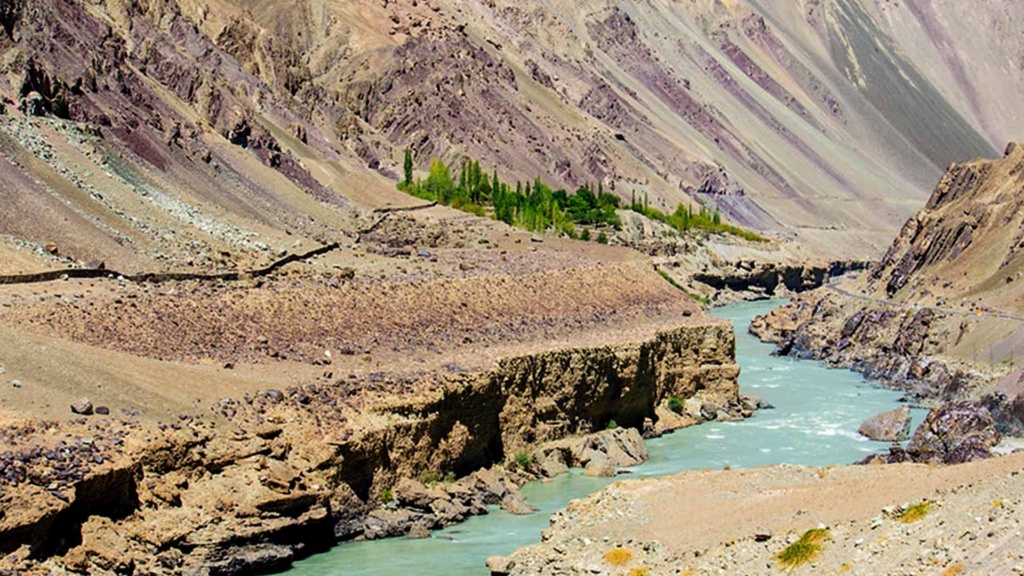
The route ran from Leh over Khardung La, down through Diskit and Hunder, then along the Shyok side through Bogdang towards Turtuk. Spring made everything provisional. Old snow held in shaded folds. Some patches of road carried meltwater and ice. Khardung La behaved like a pass with a memory of bad weather and no interest in our schedule. In Hunder, Bactrian camels sat folded into themselves on damp sand, looking less like tourist attractions and more like old residents waiting for the cold to lift.
Beyond the usual Nubra turnings, the road changed its tone. The Shyok came closer. The valley narrowed and widened by mood. We were careful with cameras, careful with questions, careful with the easy excitement that border places can produce in visitors who do not have to live with the consequences of being interesting.
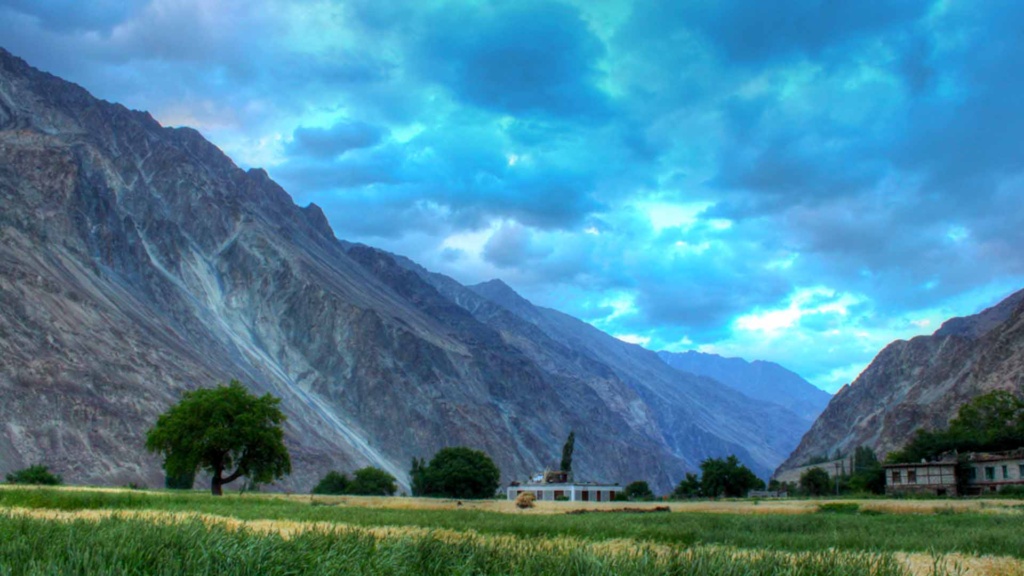
Turtuk revealed itself slowly: fields, poplars, water channels, wood balconies, stone houses, apricot branches still not ready to bloom. The village did not arrive as a headline. It arrived as work. A woman carrying something. A child crossing a bridge. Water running faster than my eyes could follow. A dog pretending not to adopt us and then doing exactly that.
When I first saw the orchards, I understood why apricots appeared in every description of the village. But in spring, the trees were still holding back. Buds sat tight on the branches, waiting. The restraint suited the place. Turtuk was not going to spend itself on first impressions.
Turtuk
Amina’s kitchen
Our homestay was with Amina, whose name I am keeping because it can be published and because the story would lose something without her.
She poured tea before asking too many questions. It was kahwa, warm with cardamom and almond, the kind of drink that makes a cold arrival feel less like an inconvenience. The room was low, carpeted, practical, and warmer than the road had been. Outside, the Shyok kept moving. Inside, someone adjusted a stove, someone moved cups, someone made space for travellers who had arrived early in the season and probably looked as if they needed to be told where to sit.
“You have come early,” Amina said.
She was right. The village was not yet in the apricot abundance visitors like to imagine. No heavy fruit in bowls, no branches bending under sweetness. The trees were still preparing themselves. Amina laughed at my disappointment and said, “Come back when the snow gets shy, and you will eat until you think apricots invented sweetness.”
Over five nights in and around Turtuk, we walked through Youl and Farol, followed water channels, crossed small bridges, stood near orchards, and watched how much of the village’s life moved through narrow threads of water. The channels were not decorative. They were schedule, memory, irrigation, argument and relief. A village can look quiet to a visitor while being busy in ways the visitor does not yet know how to read.
Amina showed us an apricot tree her family treated like a relative. She pressed her palm to the bark and said, “This is my great-grandmother.” From a timber joist near the eaves, she took down a small clay lamp and told us it had been lit with apricot oil when her daughter was born, as her mother had done when she herself was born. She did not dramatise this. She simply showed us the object and returned it to its place.
Food carried the same plain authority. We ate thukpa, roti, tangy salad, khambir, dal, churma with dried apricot, and a stew where apricot kernels gave a quiet richness I still remember more clearly than some famous views. It was not “border cuisine” served for narrative effect. It was dinner, and it tasted of enough.
One afternoon, Noor pointed at my camera, then at himself, then towards the road. “Other side,” he said.
I tried to be clever and asked which side he meant. He did not laugh. He meant the side that leaves. The side that arrives, points, records, and goes. I put the camera away for a while. It was a small correction, and a useful one.
1971 at the table
Turtuk’s history did not arrive through a monument. It arrived at the table, between tea and weather.
Amina explained Balti identity to us the way people explain something when they are used to outsiders getting it slightly wrong. She spoke of language, food, prayer, relatives, and the difference between being placed on a map and belonging to a valley. Official Leh material describes Turtuk as a Balti village in Nubra, with Noorbakshia Muslim residents who speak Balti; in Amina’s room, those categories were not abstractions but the texture of daily life.
The political history had to be handled carefully. Before 1971, Turtuk and nearby villages were under Pakistan’s administration; after the 1971 Indo-Pak war, Turtuk, Thang, Tyakshi and neighbouring villages came under Indian administration. A defence studies source notes that the area remained out of bounds for public access for decades and was opened for public visits only in 2010.
In 2013, that was still recent enough to feel present. Tourism had arrived, but cautiously. People were curious about visitors, but not helplessly pleased by them. There were homestays, local stories, apricot oil, museum rooms, permissions, cautions, and the constant need to remember that a border is not a sightseeing feature for the people who live beside it.
Karim told us about an uncle across the line whom he had not seen in decades. He did not tell it like a tragedy prepared for visitors. It came up because we were speaking of relatives, roads and what distance does when politics hardens around it. “We send apricots,” he said, “with soldiers.” Then he grinned. “They don’t mind extra weight.”
The joke landed because the sadness under it did not ask to be admired. That was often how Turtuk worked on me. It resisted the obvious emotion. It returned instead to practicalities: food, kinship, water, rooms, snow, the road, whether someone had eaten, whether a bridge would hold, whether the fruit would come well that year.
We visited the Royal House of Yabgo, the private museum that holds old photographs, household objects and pieces of local memory. I am keeping that section brief because rooms like that are easily turned into exotic inventory. What stayed with me was not a single artefact but the feeling of history being looked after at household scale. It was not state history first. It was family history, village history, fragile history, history that had to be dusted and explained by people with other work waiting.
Prayer, play and the edge
We visited Thang, but I do not want to turn that visit into a performance of proximity.
There were checks, permissions and places where cameras had no business coming out. That is enough to say. The point of going was not to stand at an edge and feel dramatic. It was to understand, even slightly, how close geography and biography can become in a place where family stories, administrative lines and military caution share the same road.
The village life around Turtuk did not pause for this knowledge. It absorbed it. People still swept thresholds, moved through lanes, opened shops, carried wood, corrected children, poured tea. That ordinary continuity made the history more powerful, not less. The border did not make life stop. It made certain forms of movement more difficult and certain memories heavier.
One evening, we stood outside the wooden mosque while the azan was happening. I had not entered; I was outside, close enough to hear and far enough to remain a visitor. The wood, the light and the sound belonged to the place without needing to become mine. Amina had explained enough for me to understand that prayer here was not separate from the village’s Balti and Noorbakshia life. Still, understanding is not ownership. I stood quietly and kept my hands out of my pockets because that is what the body does when it is trying to behave better than the mind.
Another evening, we were invited to sit in on a zikr as visitors. We stayed at the edge. The room was low, carpeted, attentive. No one performed for us. No one explained more than necessary. The recitation moved through the room with the discipline of something practised, not staged.
Later, elsewhere in the village, the night had a different sound: cards, dice, laughter, someone asking for more tea, someone teasing someone else with the confidence of old familiarity. That contrast mattered. Border stories are often told in the language of loss, flags and separation. Turtuk had all of that, but it also had jokes, games, children, small irritations, kitchen smoke, animals, and people who had no intention of becoming metaphors just because outsiders arrived with notebooks.
The snow came in a brief flurry one afternoon, as if spring had forgotten its own argument. The village put winter back on without complaint. Roofs held white at the edges. The orchards waited. The dog that had adopted us followed for a while, then abandoned us for better prospects. Near Hunder on the return side of memory, the Bactrian camels would still be there, probably unimpressed by all human weather.
The apricot pit in Leh
Leaving Turtuk did not feel like finishing a place.
It felt like leaving in the middle of a sentence someone else would continue properly after we had gone. We returned through the same valley, past the same cold edges of spring, along the Shyok, through Bogdang, towards Diskit and Hunder, then back over the high road to Leh. The bends looked different because they now had names attached to them: Amina, Karim, Noor, Thang, Youl, Farol, the wooden mosque, the museum room, the apricot tree, the lamp.
We had gone to scout. That was the plain, slightly ugly word for it. A recce asks practical questions: road time, homestays, permissions, food, safety, where future travellers might sleep, how much a place can receive before receiving becomes a burden. The trip answered some of those questions, but it also made the larger one harder: not whether people could be brought to Turtuk, but how they should arrive.
This first visit shaped the returns that came later. I did return in other seasons. I ate apricots when they were no longer promises. I crossed bridges with more familiarity and less confidence. We left books for the school and returned photographs in envelopes, small gestures that did not repay anything fully but at least refused to let the journey be only extraction.
Back in Leh after that first trip, I sat at a desk and wrote until the pen began to go blunt. An apricot pit from Amina’s courtyard lay beside the notebook. I rolled it between finger and thumb while I wrote names carefully, because names were easier to damage than scenery. I wrote Turtuk. I wrote Amina. I wrote Karim. I wrote Noor. I wrote apricot, water, mosque, Thang, snow, road.
Then I stopped writing and listened to the small hard sound of the apricot pit against the wooden desk.
That was where the article should have ended all along.