A note on arriving too fast, walking too soon, and learning that Leh does not reward hurry
The first staircase
The first warning came before I had seen anything properly.
Not at a monastery. Not on a high pass. Not beside some dramatic valley edge. It came on a staircase in Leh, in 2014, with my bag cutting into my shoulder and my lungs behaving as if someone had quietly reduced their working hours.
I had flown in from Delhi that morning. The descent into Leh was beautiful in the way altitude often is from a window: jagged, clean, unreal, and safely separated from the body by glass. The runway appeared suddenly, stitched into a dry bowl of mountains. I remember touching my forehead to the cold window and thinking the landscape looked too close, as if the mountains had leaned in to inspect the aircraft.
Then the doors opened.
The air was bright, dry and thin. I took a step, then another, and felt breath become work. Not panic. Not illness in any dramatic sense. Just the immediate, slightly embarrassing discovery that my body had arrived from Delhi faster than it could understand.
At the guesthouse, which I am keeping unnamed here, Stanzin checked me in and placed tea before me with a gentleness that made me feel even more foolish for wanting to rush. He was real, and so was the line that stayed with me.
“Small sips,” he said. “Slowly, slowly.”
He was speaking about the tea, about water, about the day, perhaps about all of Leh. I did not know that yet. I nodded with the confidence of a man who was about to ignore good advice.
The room was simple: a bed, a quilt, a table where my notebook landed before my bag did, and a window that gave me more mountain than I had earned. I should have slept. I should have unpacked slowly, eaten lightly, and allowed the first day to remain small.
Instead, I decided to walk.
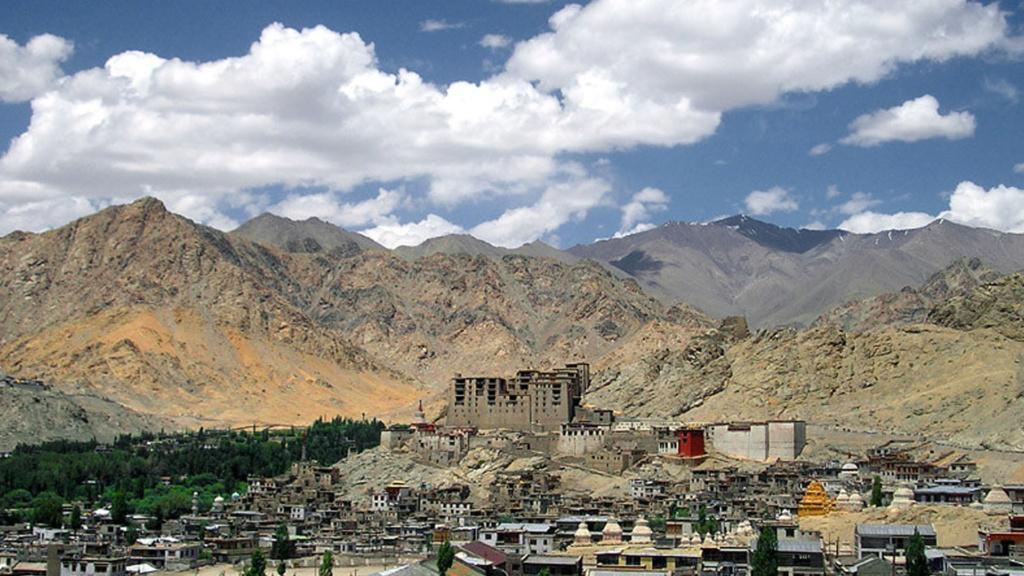
Leh City
Walking like the plains
The mistake was not walking. The mistake was walking as if I were still in the plains.
Old Leh pulled me out because old towns have always done that to me. A lane turns, a doorway leans, a wall holds light, someone rearranges apricots on a stall, and suddenly I have convinced myself that fatigue is only poor discipline. That afternoon, I walked too fast, skipped proper rest, and tried to make a first day do the work of a week.
The lanes were narrow and sunlit. Mud walls held the heat. Children ran past with the easy cruelty of the well-acclimatised. I stopped often, pretending to study doorframes or sketch a lintel when I was really giving my lungs time to catch up with my ambition.
Ten steps could be enough. A slight incline became an argument. My heart beat too loudly inside my ears. The notebook helped me hide. I bent over it and wrote things that sounded like observation but were mostly cover for heavy breathing.
At the bazaar, Leh widened into colour and movement: shawls folded in careful towers, copper pots catching light, apricots piled in baskets, shop shutters in old blues, soldiers passing, vendors speaking softly, dust rising from under shoes. I sat on the steps near the Jama Masjid and tried to look like someone making notes rather than someone being taught by oxygen.
The headache began there, faint at first, a pressure at the back of the skull. I did not name it. I did not want to give it authority. I bought time with tea, then with stillness, then with the old traveller’s lie: I’m fine.
I was not in danger. I was simply not ready.
That distinction matters. The CDC describes headache as the cardinal symptom of acute mountain sickness when accompanied by other symptoms such as dizziness, fatigue, nausea or loss of appetite, and the final article should avoid pretending a personal memory is medical advice. In my case, I had heavy breathing and a headache that improved with rest, fluids and food; I did not consult a doctor, use oxygen or take altitude medicine.
Night one
By evening, the mountains had changed colour and my confidence had changed shape.
The courtyard was quieter. Prayer flags moved in a dry wind. Someone laughed in a room nearby. From a kitchen came the practical sounds of dinner: ladle, bowl, stove, footsteps. I remember wanting to be more present than I was. Leh was there in all its texture — light, dust, stone, voice — and my body kept pulling the attention back to breath.
Dinner was thukpa. A simple bowl, steam rising, noodles tangled in broth, warmth doing the work that scenery could not. I ate slowly because chewing too quickly felt like another kind of exertion. Every spoonful was useful. Every pause was necessary.
That night, under the quilt, sleep refused to arrive cleanly. My breathing was not dramatic, but it was noticeable. I could hear my pulse. I could feel the day’s stupidity inside the body: the fast walking, the missed rest, the unnecessary bazaar loop, the little pride of wanting to behave like a seasoned traveller on the very first day.
I sipped water slowly. I listened to dogs outside and to some distant chant or song I could not place. The room seemed larger in the dark. My notebook lay beside the bed, open to a page where I had written only three words:
Too fast today.
That was the first honest sentence of the trip.
Official Ladakh advisories now tell travellers arriving in Leh to take at least 48 hours of acclimatisation before moving to higher-altitude areas; Leh district guidance also advises air travellers to rest after sudden altitude gain. That advice is not the article’s main subject, but it explains why my first-day overconfidence looks so obvious in hindsight.
Day two, slower
Morning did not make me new, but it made me more careful.
My tongue was dry. The headache remained, though less sharp than the previous evening. Brushing my teeth still left me oddly aware of breath. I moved around the room with a seriousness usually reserved for bad knees and fragile crockery.
I went out again, but slower. That was the difference.
At Sankar Gompa, the whitewashed walls held the morning light cleanly. I remember entering with less curiosity than usual because most of my attention was still inside the body. The monk I met there was real. I told him, awkwardly, that the altitude was making me breathe heavily.
He smiled and said, “You breathe too fast. The mountain will teach you slowness.”
It is a line that could become too neat if mishandled. I do not want to turn him into a sage placed conveniently in my path. He was simply a person I met on a difficult morning, and he said something useful. That was enough.
The rest of the day became an exercise in reducing scale. I looked at courtyards, old doorways, chortens, prayer wheels, and the bazaar again, but I stopped pretending I could cover ground like an assignment. I sat more. I drank slowly. I ate momos because steam and garlic seemed more persuasive than willpower. I let children outrun me without taking it personally.
The headache came and went, but by afternoon it had lost some authority. The heavy breathing remained if I hurried, so I stopped hurrying. This sounds simple until you arrive in a place you have wanted to see for years. The first instinct is to collect. The wiser one is to stay alive enough to notice.
I did less that day and saw more of what I did.
Putting away the notebook
By the second night, the headache had improved.
That was the first small victory. Not a pass crossed, not a monastery reached, not a photograph taken from a higher ridge. Just a dulling behind the eyes, a slower pulse, a body beginning to understand where it had been delivered.
I sat in the room with tea and the notebook open. The pages from the first 48 hours were uneven: half observations, half excuses to stop walking. Old Leh walls. Apricot baskets. Jama Masjid steps. Sankar Gompa. Thukpa. Momos. “Small sips.” “Too fast today.” “Breathe slower.”
I had mapped very little of Leh in those two days. That used to bother me. Now I think it was the point. The first 48 hours were not there to make me productive. They were there to make me honest.
Arrival is not readiness.
I put the notebook away before sleeping. That is the scene I remember most clearly: closing the cover, sliding it under my bag, turning off the light, and lying down without trying to turn discomfort into a lesson too quickly. Outside, Leh continued without needing me to understand it. Dogs barked. A vehicle passed. Wind moved through the courtyard.
For the first time since landing, I did not count every breath.
I slept.
“The mountain will teach you slowness.”
The words sink into me heavier than stones.