Children, lessons, and laughter in the cold the quiet courage of teachers who stay.
The classroom door was already half open when I reached it.
A line of shoes sat near the entrance. Inside, a metal bukhari ticked with heat and a teacher bent over a notebook without looking up immediately. Children occupied the warmer part of the room. On the blackboard, someone had begun writing in English.
I had come to Zangla from Padum in the middle of winter, shortly after travelling the frozen Zanskar on the Chadar. My hands were still rough from those days on the ice and my boots carried the residue of the journey.
I had expected the cold to dominate whatever I found here.
Instead, somebody was trying to spell January.
The word had been written carefully across the board. A child sounded it out. Another interrupted. Somebody laughed. The teacher corrected them and moved on.
I stood near the stove longer than dignity required.
Frozen Runway – Riding the Chadar in Its Last Season
Outside, Zangla was buried in the muted colours of a Zanskar winter — snow along walls and roofs, bare poplars, hard ground and light that seemed bright without giving much warmth. The old palace or fort stood above the village, broken at the edges and visible from below.
Inside, none of that appeared to require commentary.
There was a lesson to finish.
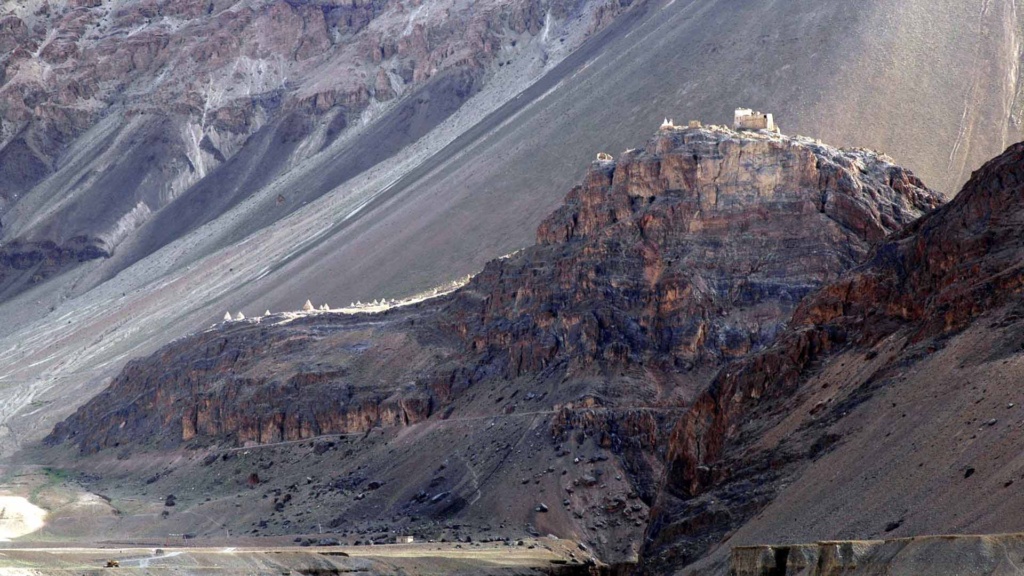
Zangla Fort
January on the blackboard
The room was small enough for the bukhari to matter.
Children shifted closer to it when they could. Gloves came off when pencils needed holding properly and went back on during pauses. A few rubbed their hands together beneath the desk.
The teacher divided the morning between English and arithmetic.
My original account names three teachers Stanzin Angmo, Sonam Dorje and Rigzin Dolma and assigns each of them a neat role. Until I can confirm those names and roles from my notes, I would rather remember the room without turning its adults into characters more polished than they probably were.
What I remember clearly is how continuously somebody had to manage things.
One person corrected notebooks while another dealt with the stove. Chalk was found. Pencils were sharpened. A child who had stopped paying attention was brought back into the lesson. The fire needed checking again.
Then came multiplication.
Numbers filled the board in rows. A few children answered quickly enough to annoy the others. Someone miscounted and the room broke into laughter.
One boy’s pencil had been chewed badly at the end. His eraser had almost disappeared.
He worked through part of the seven-times table, whispering the answers before writing them down.
I knew 7 × 8 because, thankfully, the Indian education system had prepared me for at least one useful contribution to winter life in Zanskar.
Fifty-six.
This earned me temporary credibility.
It did not survive handwriting.
When I tried writing alongside the children later, what appeared on my page looked significantly less confident. Someone corrected me. Another child inspected the result with the seriousness of a customs officer and apparently found it unsatisfactory.
That was closer to the classroom I remember than the one I originally wrote about.
Children got answers wrong.
They watched one another.
They tried to finish before their friends.
They were distracted.
They laughed when an adult made a worse attempt than they did.
The cold was present, certainly. It just wasn’t interesting every minute.
At tea break, mugs went around.
The butter tea was hot and salty. I held mine with both hands mostly because it felt good.
One child noticed my notebook and wanted to see what I had been writing. My original version gives him a name and has him carefully writing mine in Uchen script. That may have happened, but I would want the field notes in front of me before publishing either the name or the detail as precisely as I once did.
What I can remember without assistance is the children being interested in the notebook because it was there.
My romantic ideas about remote education did not interest them nearly as much.
What it took to keep the day ordinary
The stove divided the room into climates.
Close to it, hands loosened and children could work comfortably. Farther away, coats stayed fastened. As the morning sunlight moved through the windows, places that had been less desirable became useful.
The teachers noticed these shifts without discussing them.
That was one of the things I had missed when I first wrote the story.
I wanted the people in the room to explain winter to me.
They were busy managing it.
Fuel had to be brought in and fed into the bukhari. The room needed warming before certain activities became practical. Light changed through the day. Children arrived bundled in layers that had to accommodate both the walk outside and sitting indoors.
None of this made them heroic.
It made the classroom labour-intensive.
Later official records from Ladakh make clear that heating remains an administrative concern in schools across Zanskar. In 2021, for example, the district administration was discussing passive solar heating, insulation and other winter heating arrangements for government schools in Zanskar and Drass.
That is useful context now.
It does not, however, tell me exactly what institution I visited on this earlier journey.
The source article calls it a winter school and implies that regular schooling elsewhere had stopped. I cannot responsibly retain that larger claim without establishing the year and programme.
Winter education in Zangla has taken different forms at different times. There have been community and outside-supported initiatives, and current official records document a free winter tuition programme operating in Zangla in the 2020s.
Those later programmes cannot be projected backwards onto my visit.
So I am left with what I actually saw.
There was a class.
Adults were teaching it.
Children had books, pencils and exercises.
A stove had to remain lit.
And lunchtime still arrived at lunchtime.
Food came in steel containers. The source remembers thukpa with potatoes, carrots and noodles. Steam rose when the lid came off.
The room quietened in the efficient way classrooms do when everyone has started eating.
There was no revelation hidden in the bowl.
I was hungry.
So were they.
We ate.
Outside the door
Recess briefly defeated whatever order the teachers had established.
The children went outside into the snow.
A rope appeared. Stones became part of a game. Someone had a carrom striker with no carrom board and found another use for it. Snowballs followed.
One teacher issued the obvious rule about faces.
The rule was tested almost immediately.
This is one of the scenes I trust most in the original because nobody behaves symbolically.
Children in a remote Himalayan village, given snow and a few minutes without arithmetic, behaved much as children with snow tend to behave.
A goat had found a patch of sun near a wall and refused to participate.
Behind all this, the old Zangla Khar stood above the village.
I had initially given the fort far too much work in the story. It watched, remembered, instructed and represented history.
The building was more interesting once I stopped doing that to it.
It was simply there — a partly ruined former palace on the hill, pale against the winter ground.
Its history is complicated enough without embellishment. Current Ladakh administration refers to it as Zangla Palace or Khar, and archaeological work has documented both the structure and efforts to conserve it. Sources differ on exactly how old it is, which is a good reason not to give it a convenient century in a personal essay.
From the school, what mattered was scale.
The fort was visible.
The classroom was warm.
The children wanted to get back inside once the break stopped being fun.
They returned carrying snow on shoes and cuffs.
Lessons resumed.
There were books in a wooden cupboard — some well used, some worn at the edges. Exercise books waited in piles. The original describes science comics, Ladakhi texts, Hindi readers and an uncharged Kindle attached to a story about a broken solar panel. I am leaving most of that out until I can confirm it.
The cupboard itself I remember.
It was not a grand library.
It held things people read.
That is sufficient.
The later afternoon moved towards writing.
Letters appeared in lines on the board. Children copied them, erased them and tried again. A younger boy had developed the habit of bringing his pencil to his mouth between attempts. Another child was better at sharpening pencils and apparently aware of this status.
The teachers moved between them.
A wrist was corrected.
A page was turned around.
Someone was told to do a line again.
Outside, winter remained exactly where we had left it.
Inside, handwriting improved by fractions.
Before tomorrow
The light began leaving the room before the school day felt finished.
The bukhari still gave heat, though less aggressively than it had earlier. Books went back into bags. Caps appeared. Gloves were found beneath things they had apparently had no business being beneath.
Children started putting their shoes on.
The room became noisy in the way classrooms everywhere become noisy once everyone understands that lessons are over.
Goodbyes came in several directions at once.
A few children ran outside.
Others waited for friends.
One called something back through the doorway and produced another round of laughter that I did not understand.
I prefer not understanding it.
The original version of this article ends by giving Zangla a syllabus about courage, hope, endurance and the meaning of education.
I think I was trying too hard.
What impressed me now, looking back, was much less dramatic.
Someone had opened the room that morning.
Someone had made it warm enough to use.
Lessons had been prepared. Children had arrived. Multiplication had gone better for some than others. Pencils needed sharpening. Lunch had been eaten. There had been snowballs.
Then everyone went home.
Before I left, I saw fuel being put aside near the building for the next day.
That is the image that stayed.
The fort was turning blue in the late light above Zangla. Snow remained hard along the lane. I put my boots back on and started walking away.
Behind me, the classroom door closed.
The wood for tomorrow was already there.
“A river can teach you to walk; a village can teach you why.”