
The message that stopped the day
The road did not close with drama. It closed through a small phone.
I remember the object first: a keypad phone passed between hands, its screen too small for the size of the news it was carrying. This was during the September 2014 Jammu and Kashmir floods, the year water rearranged confidence across the region. Official updates from that month recorded flood damage, landslides, washed-out road sections and large-scale rescue and relief work across Jammu and Kashmir. Road connectivity was not a background detail then; it was the story.
I was somewhere in that old Zanskar rhythm of waiting, listening, asking again, not fully trusting my own impatience. By then I had learnt that a road update in the mountains does not arrive like a city notification. It travels through a broadcast, a driver, a dhaba, a checkpost, a relative in another town, a postmaster, a phone handed across a counter, a sentence repeated until everyone has understood the practical meaning: not now.
The update changed the day because it removed negotiation. There would be no clever timing, no heroic push, no “let us just see a little further.” We waited. The decision felt frustrating for the first ten minutes, then sensible, then obvious. Outside, the road had the dull patience of a thing that did not care about my plan. Inside, people adjusted around the news with less fuss than I expected. Tea was poured. Bags were left tied. Drivers compared what they had heard. Someone repeated the latest update from Aakashvani, not as entertainment but as a working instruction.
That was the first time I fully understood radio as road infrastructure. It was not romance. It was not nostalgia. It was a way for information to survive distance, weather and uncertainty. In remote places, the voice that says wait can be as useful as a bridge.
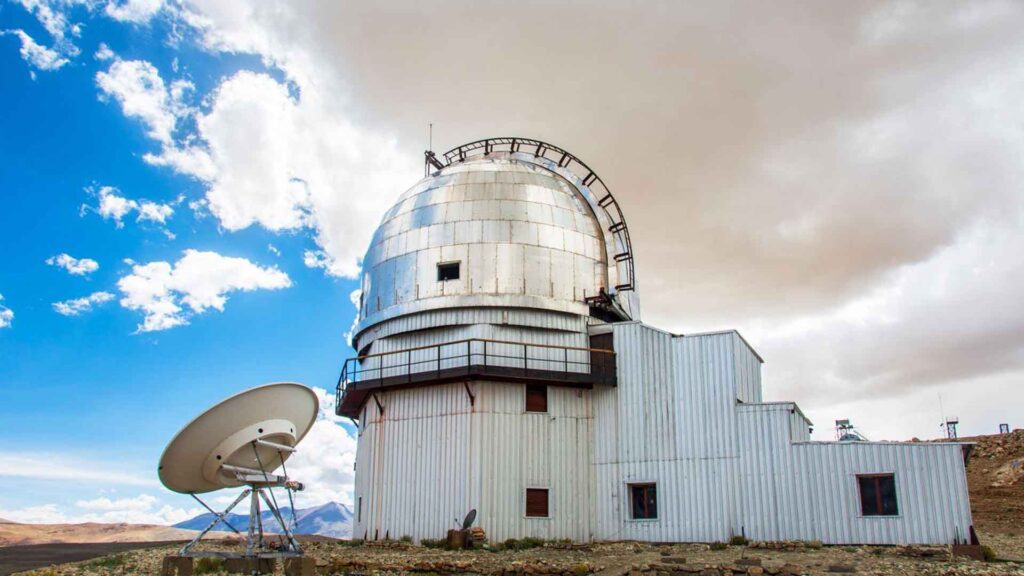
Hanle Observatory
Learning to listen
My earliest Zanskar journeys had already been training me for that lesson.
In 2012, when I first entered the region in June, the road still carried the mood of a rumour. The Kargil–Zanskar road through Pensi La was never just a line on a map. It was weather, snowmelt, timing, repair work, driver memory and local caution. I reached places like Darcha, Rangdum and Padum still believing, in the naive way travellers do, that a road being “open” meant it was available to me in a simple sense. The mountains corrected that quickly.
At dhabas and small halts, radios sat in windows or near kitchens with the importance of a stove. Sometimes the update came clearly. Sometimes it arrived after static, repetition and interpretation. Aakashvani was the name I heard most often in those years, and it mattered that this was not just a private message chain. Akashvani’s own current listings include Leh and Kargil among Ladakh broadcasts, with Ladakhi and Hindi programming shown on its live radio page.
I did not always know which station or frequency I was hearing. That uncertainty is part of the truth. A traveller in a smoky room is rarely conducting a media study. I knew only that people listened at particular times, that road information moved from radio to mouth to road, and that the sentence changed behaviour. A driver who had been confident would wait. A group that had been restless would soften. A plan would become a question.
The most useful thing I learnt was not technical. It was social. The radio did not work alone. It worked because people respected the chain around it: the announcer, the local listener, the driver who understood what the words meant on that specific road, the shopkeeper who knew which warning was serious, the person who repeated it slowly for those who had missed it. Information became safety only after it had passed through judgement.
That is why the radio stayed with me more than many views did. A glacier can astonish you once. A road bulletin can keep you alive.
Cold, classrooms and repairs
In 2015, on the Chadar, the idea of listening became even more physical.
The frozen Zanskar was its own road, and a poor one to argue with. Batteries suffered. Devices behaved badly in the cold. Voices, when they arrived, felt warmer than they should. I remember reaching settlements after days of ice and hearing radio again as a form of return: not a grand moment, just a familiar human sound after a landscape that had made the body careful.
In Zangla, Stanzin Angmo remains in my memory not because she delivered a perfect line, but because she treated information as part of the school day. Weather, road conditions, family movement, truck movement, winter routine — all of it was connected. Children did not listen to updates as abstract news. They listened because roads were attached to fathers, mothers, supplies, exams, letters and the next possible journey. In that setting, a broadcast was not background sound. It was a timetable with consequences.
Monasteries held the same truth differently. At Karsha or Stongde, a small radio could sit at low volume in a room where other forms of attention were already present: lamps, pages, recitation, footsteps. The point was not that radio had become sacred. The point was simpler and better. A shared sound had to learn manners. It could inform without occupying the whole room.
Photoksar gave me the repair version of the same lesson. Namgial, who fixed radios and small devices, belonged to a kind of mountain economy I admire deeply: repair before replacement, patience before complaint, a willingness to coax one more season out of an object. The solar-panel detail stayed with me because it felt so ordinary there and so miraculous outside. A small panel, a stubborn wire, a receiver that still had work to do. He did not need to make a speech about resilience. The repaired sound was enough.
These scenes were not all from the same trip, and the article should be honest about that. Between 2012 and 2023, I learnt radio in fragments: a kitchen in winter, a dhaba in rain, a schoolroom, a truck cab, a monastery corridor, a road halt where nobody wanted to be patient but everyone knew patience was the only adult in the room.
Drivers know when a warning has weight
Drivers taught me how to hear road news properly.
I had notebooks full of things I thought mattered: distances, pass names, fuel notes, where the road improved, where the road became loose, where a stream crossing might rise by afternoon. Drivers carried the same knowledge differently. They attached information to timing. A warning before breakfast meant one thing. The same warning after noon meant something else. A cloud over a pass had a different weight depending on who had just come down from it.
Gurvinder, a driver I remember from those road years, had that practical intelligence. His advice did not need polishing. He would listen, wait, ask someone coming from the other side, then decide. If the update said delay, he delayed. If the road looked wrong despite optimistic talk, he trusted the road over the rumour. What I admired was not caution in the abstract. It was caution with a method.
The Pensi La turnaround stayed with me for that reason. I use the spelling Pensi La here, though one sees variants in use. On that day, the message was clear enough: weather and road conditions would worsen after a certain point in the afternoon. We were close enough to argue with it and sensible enough not to. At 13:50, we turned around.
The exact minute matters because it shows how reluctant good decisions can be. Ten minutes more and the ego would have felt satisfied. Ten minutes less and the story would have been cleaner. But travel does not care about narrative neatness. We turned when the combination of radio update, driver judgement and road mood made the answer obvious.
Nobody won that afternoon. That is what I liked about it later. The trucks that stayed were not cowards. The vehicle that turned was not wise in any heroic sense. Everyone was simply placed differently inside the same information. On remote roads, safety is rarely a slogan. It is a set of unequal decisions made from shared warnings.
What changed, what stayed
The roads have changed since many of these journeys.
By 2024, BRO announced that the Nimmu–Padum–Darcha road had been connected, a development that will continue to alter how Zanskar is reached, supplied, imagined and travelled. I am glad for easier access where it helps residents, patients, students, families, goods and winter movement. I am also cautious about the way travellers translate a new line on a map into certainty. A connected road is not the same thing as a simple road. Weather, repair, traffic, landslides, water and local advice still matter.
That is why I do not want this essay to become a nostalgic complaint about modernity. Phones improved. Roads improved. Signals reached places that once relied on slower chains of information. Homestays advertised solar hot water. Drivers checked updates in more ways than before. But the old discipline remained useful: listen locally, date the information, do not turn a warning into content, do not share yesterday’s road rumour as today’s permission.
The radio taught me that. Or perhaps the people around the radio did.
When I think back now, I do not hear one grand voice speaking for the Himalaya. I hear many small sounds: static before clarity, a host reading slowly, a keypad phone buzzing on a wooden counter, a driver asking for the update to be repeated, a teacher pausing before making a decision, a repairman testing a receiver, a dhaba owner turning the volume down because someone older was sleeping nearby. These are not dramatic sounds. They are the sounds by which movement becomes responsible.
The best road update I ever received was not the one that opened a pass. It was the one that closed a day before I had the chance to make it dangerous.
So I learnt to carry a small form of surrender with my gloves and papers. Not surrender to fear, but to information. To the local person who has heard the morning bulletin more carefully than I have. To the driver who knows when a stream changes mood. To the broadcast that says wait without caring what my itinerary says. To the road that does not speak, but is often spoken for by people who know it better.
At the end of one such day, after the decision had been made and the journey had shrunk to a room, I turned the phone face down on the table and listened to the radio continue somewhere near the kitchen. Outside, the road remained closed or difficult or undecided; I no longer remember which. What I remember is the relief of not moving. Gloves drying by the stove, boots near the door, tea cooling in a steel cup, and the voice in the next room carrying the valley forward until the road could.