
A drive from Kargil towards Padum, when the road kept changing under us.
The message that stopped the day
From the window of a guesthouse in Kargil, the river looked like the only thing that knew where it was going.
It was June 2017, and we had given ourselves ten slow days for the road to Padum and back. The journey was self-funded: a hired Scorpio, a driver who knew the value of not speaking too early, Jamie in the other seat, and me with a paper map that still believed in lines. I had met Jamie in Leh. She was travelling alone, wanted to continue deeper into Zanskar, and had the cheerful confidence of someone who understood that shared discomfort is one of the quickest ways to become friends.
On the map, the route looked almost polite: Kargil to Sankoo, Parkachik, Rangdum, Pensi La, Padum, and then onward into a longer Zanskar journey. The road followed the Suru for a while, bent towards Rangdum, rose towards the pass, and then dropped into the wide interior that had been pulling me east for years. I sipped tea and traced it with a finger as if touch could make a line more obedient.
By the time we folded the map and tied the spare jerrycan to the rear rack, the road had already begun to argue. Not on paper. Under the tyres.
June was not winter, but winter had not left cleanly. In the shadows, ice held. By noon, meltwater began to cross the track with confidence. By afternoon, dust rose from whatever had survived water. This was not a drive on a road so much as a drive through the day’s negotiations: ice at six, water at eleven, dust after three, and somewhere between them, men with shovels and machines trying to persuade rock to behave.
I did not call that impermanence at the time. That word came later, far from the valley, when I had the luxury of making sense. In the Scorpio, in June 2017, it felt simpler and less elegant: excitement first, amusement often, fear when the wheels slipped, and mechanical frustration whenever the vehicle reminded us that the mountains were not the only things capable of mood.
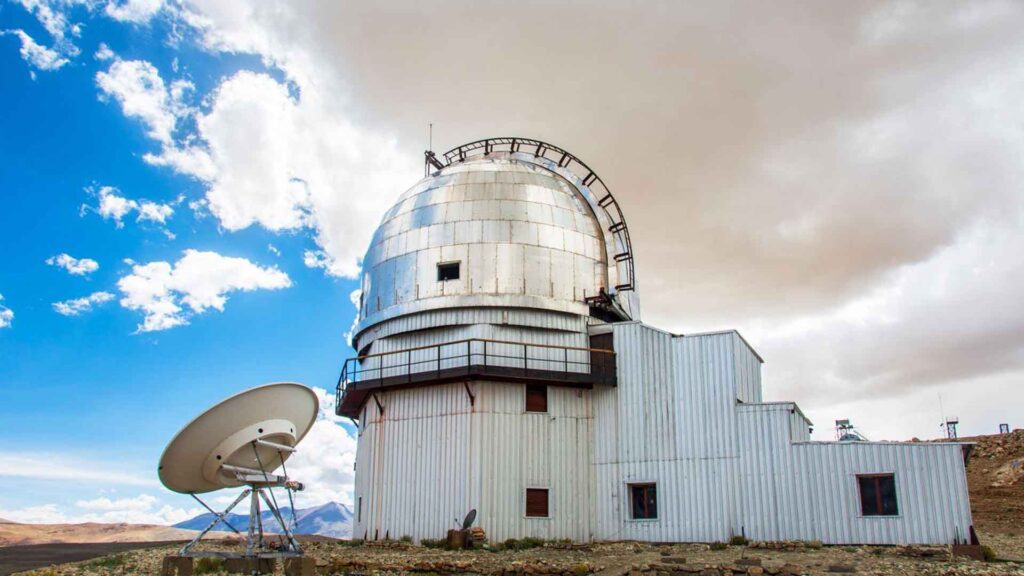
Hanle Observatory
Ice before water
The last reliable tar ended without ceremony. Tarmac thinned, broke, and gave way to a surface that looked as if the road had been made and unmade many times by people who had stopped expecting applause. By Sankoo, the valley had widened: poplars, early barley, irrigation channels, warning boards, trucks painted with instructions, jokes and small prayers. A sign announced SHOOTING STONES with the calm of a weather report.
At the first broken section near a culvert, the stream had found daylight under the concrete and taken part of the track with it. Tyre marks dipped into the riverbed and climbed out again, proof that someone had solved this problem before breakfast. Our driver stopped, looked once, then again, and waited for a truck to crawl through first. Waiting, I would learn, was not indecision here. It was information-gathering.
A small road camp stood ahead: a yellow dozer, men with tea, tools laid out on a tarp, faces turned towards the road the way farmers read a sky. The dozer operator touched the bonnet of the Scorpio, perhaps feeling the engine, perhaps just making the morning more human.
“Where you go?” he asked.
“Padum,” I said.
He gave the kind of shrug that meant the answer was possible but not guaranteed. Then he tapped his ear and the ground.
“Drive by listening,” he said. “Stone talks today.”
It would have sounded too neat in most places. There, with the track already broken and the water beginning to run, it sounded like practical advice dressed as poetry by accident.
Near Parkachik, the air changed. The glacier sat above the valley, black and white and old-looking in a way that made our rented vehicle seem temporarily foolish. We stopped long enough to stand in the cold coming off it. Ravens moved above the ice. Somewhere inside the glacier there was a low creak, then a silence that felt larger because of it.
A little later, an invisible seep had frozen across the track. I got out to walk the sheet first. My boots slid a few centimetres, corrected, slid again. The ice had the colour of old glass bottles. Sand had been thrown across the edge, probably by someone who had done the same calculation the previous evening and understood that a handful of grit could change someone’s morning.
The driver took the Scorpio across slowly. I watched the front wheels search for grip and felt my jaw clench. Only when we were past did I realise my mouth tasted faintly metallic.
“I wish I could press pause on this exact temperature in my head,” Jamie said. “So later, when we’re boiling in dust, I can replay this.”
“You’ll get the chance,” I said.
I meant it as a joke. The valley took it seriously.
When the road became water
By late morning, the road had warmed into a different creature. Snowfields that had looked solid earlier were turning chalky. Rivulets appeared across the track as if they had been waiting for permission. The first nalla did not look dangerous, which is often how danger introduces itself politely.
A trucker had stopped to arrange stones into a causeway. He waved us towards the line he trusted. I walked it first, water biting at my ankles, the bottom shifting under my boots. There were two possible routes: one shallow but slick, the other deeper but firmer. I returned to the Scorpio with wet socks and the inflated seriousness of a man who had contributed perhaps fifteen percent to the survival of the vehicle.
Jamie leaned forward as the driver prepared the crossing.
“Committed throttle,” she said. “No heroics, no fear.”
The Scorpio entered with a low growl. Water pushed against the tyres. A stone knocked somewhere under the chassis with a sound that made all three of us become quiet. Then the vehicle lifted out of the flow and onto gravel. My palms, which had been damp for reasons unrelated to water, slowly became respectable again.
We stopped later for Maggi from a roadside shack. The cook, Mustafa, told us what the afternoon held as if he were listing items to be collected before dark.
“One more nalla, big; one landslide if wind thinks; one snow patch hiding stone.”
He counted them on his fingers. I remember laughing because the list was absurdly casual. I also remember not laughing for very long.
Beyond Rangdum, the road and river began to share more than was comfortable. The bank had collapsed into shingle. Prayer flags marked a ford, not as decoration but as evidence that humans had agreed to this line before us. We got out, walked upstream and downstream, and tested the current with a stick. The water was glacier-cold and insistent. It pushed against my legs without anger, which somehow made it more persuasive.
The far bank had two exits. One was shorter and steeper. The other was longer and softer. The driver chose the longer line. We trusted him because he had been quieter than all of us.
In the middle of the crossing, the Scorpio swayed. For a second, the river felt less like scenery and more like an argument we might lose. A rock hit the underside with a deep knock. Jamie stopped speaking. I stopped pretending my excitement was uncomplicated. Then the tyres found the far shingle, the vehicle climbed, and a man from the road crew clapped once from the bank.
“Badiya,” he said. Then, pointing downstream: “People come fast, then sit. Go with the old line, not the obvious one.”
I have forgotten many grander travel sentences. I remember that one because it was about road, water, and a certain kind of human foolishness, all at once.
When the Radio Speaks for the Road
Roadwork and waiting
The landslide announced itself first as dust.
We saw a pale rise around a bend, then the fresh wound on the slope, then the vehicles waiting. A boulder sat on the track with the authority of something that had not asked to be moved. Scrape marks showed where a dozer had already tried to correct the hill’s mood. We parked behind a few vehicles and joined the small roadside democracy that forms wherever a mountain interrupts traffic.
There was tea. There is almost always tea.
A stove hissed inside a rough tent. Parle-G appeared from a tin. Nobody seemed surprised by delay. That, more than the boulder, taught me the scale of the place. We had been thinking in hours. The road workers seemed to think in returns: return after tea, return after the dozer, return after the slope finishes dropping what it wants to drop.
A dozer rolled forward, blade low, engine steady. The operator did not attack the boulder. He tested it, nudged it, waited, nudged again. The rock shifted, rolled, and settled downslope. Then the blade scraped loose debris away from the track with the patience of someone cleaning a wound that would not stay clean.
When the road opened, it did not become safe in any triumphant sense. It became passable. That is a smaller word and a more honest one.
At another crossing later in the journey, a tidy convoy of tourists tried to improve a difficult turn by cutting into the bank with shovels. The dozer operator stood with his hands on his hips and said nothing. The silence worked better than a lecture. The men stopped, looked at the bank, looked at the slope above it, and put back as much earth as they could. They took the harder line. No one applauded. The road did not become moral. It simply remained less damaged than it might have been.
The radio came in and out through the day. I am not keeping the exact announcement from my old draft because the route wording no longer feels reliable to me, but I remember the role it played: static, local voices, warnings, songs, useful fragments. In a valley where a road could change after lunch, the calm of a broadcast felt like infrastructure. Sometimes we acted on it. Sometimes we only listened because listening made us feel less alone.
That night, or one of the nights on that slow ten-day movement, the Scorpio began to acquire small complaints. In the morning, the driver checked what water and dust had done: air filter, brake pads, bonnet latch, fuel line, tyres, socks drying wherever sun could reach them. A mechanic called Asgar, travelling with a convoy of fruit trucks, worked faster than any of us and smiled at our arrangement of bungee cords and hope. The vehicle was hired, but by then its problems felt partly ours. Fear, I discovered, is not always dramatic. Sometimes it is the sound of a small mechanical hesitation in a place where the next workshop is only a rumour.
At a shack later, I bought kerosene in a reused bottle. The man behind the counter tested it with a small sniff and said, “Good. For stove. For lamp. For that thing you believe will save you tonight.”
I laughed because he was funny. I also laughed because he was not wrong.
Pensi La and the far side
Higher up, winter showed what it had left behind.
Snowdrifts held against rocks. Old avalanche blocks lay dirtied by sun and dust. A snow bridge crossed a gully, blue in its underside, soft at its edges. We did not treat it like a test of courage. We treated it like a problem none of us wanted to make worse. I walked only where it made sense to walk, tapped lightly with a pole, and came back with less confidence than I had hoped to display.
The driver kept the Scorpio to the old line. Nobody made a speech. The tyres compressed snow with a soft, unsettling sound. On the far side, I realised I had been holding my breath again.
Near an overhanging cornice, we stopped closer than I liked, though not as recklessly as my older draft made it sound. Jamie looked up and said, “Five minutes,” in a tone that contained both humour and prayer. We took the five minutes seriously. Thin air does not reward lingering for the sake of drama.
Pensi La did not arrive with the self-importance I had expected. No grand declaration, no cinematic reveal that arranged itself for us. Just a slow opening into cloud, light on snow, a cold wind, and the knowledge that we were on the high point of the road we had been following for days. The pass felt less like a destination than a hinge. Behind us were ice, water, rockfall and the Suru Valley. Ahead lay Padum, dust, and the deeper journey we had been moving towards.
Fuel, Faith, and Flat Tyres: Kargyak to Padum the Hard Way
Descending into Zanskar, green returned in pieces. Willow, barley, low houses, children with a ball, a dog exactly where he would not be a problem. The Scorpio wore the route on its body: mud, scratches, grass caught underneath, dust in places dust had no business entering. We reached Padum with the relief of people who had not conquered anything but had been permitted to continue.
Later, in the plain near town, wind turned the road towards Stongde into a low brown theatre. Dust lifted, swallowed the edge of things, and softened the world into silhouettes. After days of white and grey, the dust felt almost warm. It was not gentler than ice. It was only another way for the road to disappear.
The same road, changed
Returning over the same route should have made things easier.
It did not.
The river we had crossed earlier had moved its stones. A dozer had cut one bend deeper. A melt channel had widened. The ice near Parkachik was smaller but more treacherous, a thin lens over rock instead of the broad sheet we remembered. The road was familiar only in the way a person is familiar after an argument: recognisable, but not the same.
At the landslide bend, the cut was neater. The dozer idled nearby. Men waved us through with the relaxed authority of people who knew exactly how temporary their success was. At one nalla, we watched a bus descend with an unwilling dignity, children inside shouting as if the whole thing were entertainment rather than engineering, judgement and luck.
I was still excited. That is the honest truth. Even after fear, even after mechanical frustration, even after cold water in my socks and dust in my teeth, a part of me loved the absurdity of it all. Jamie did too. She had a way of laughing at the point where worry might otherwise become unpleasant. It helped. So did the driver’s refusal to perform bravery. He made the most difficult choices look unromantic, which is probably the only responsible way to make them.
Back in Sankoo, late afternoon light made the poplars look newly washed. The same valley we had passed through on the way out now seemed to be holding back its own commentary. By the time Kargil came close, the road began to accept tar again. Blacktop felt almost rude after everything else: too smooth, too certain, too eager to pretend the previous days had been an inconvenience rather than the point.
At the guesthouse, the owner asked whether the road was good.
“Good,” I said.
He smiled as if he understood exactly how much had been hidden inside that one word.
That night, Jamie and I sat outside under the Kargil stars. I do not remember what started the laughter. Maybe the way we looked: sunburnt, dusty, overtired, still half-rocking from imaginary water crossings. Maybe the uselessness of explaining ten days of road in ordinary sentences. Maybe the fact that the map, folded beside us, still looked so confident.
We laughed quietly because the guesthouse had other sleeping people, and because the river below us was doing its own talking. Above, the stars were sharp and indifferent. The road to Padum lay somewhere behind us, already changing in the dark.
I had gone looking for a line on a map. I came back with the memory of a road that kept becoming something else.