Riding towards a pass I wanted too badly, and turning around two bends from the top.
The rear tyre lost grip two bends below Umling La.
It did not happen like a dramatic crash, the kind that gives a story an obvious before and after. It began as a small betrayal under the wheel gravel, ice, old snow, whatever mixture the road had made for itself that morning and then the motorcycle snapped sideways hard enough for the tank to slap my thigh. The Royal Enfield Himalayan went right while my body tried to remember everything it had ever learnt about balance. My hands tightened, the front corrected, the rear kept moving, and somehow the bike came back under me without falling.
I stopped a little ahead, not because I had planned to, but because my body had stopped negotiating. My breathing was heavy. My shoulders were locked. The air felt too thin for pride and too sharp for pretending. It was August 2018, and I was close enough to the top to make turning back feel ridiculous. That was the danger of it. Close is one of the most dishonest measurements in the mountains.
The road ahead climbed into shadow. Snow had gathered in places where the sun had not done enough work. Wind moved loose powder across the track in quick, impatient strokes. I could see the next bend, maybe the one after that, and beyond it the place I had been carrying in my head for days: Umling La. At the time, the name still felt half-rumour to me, passed between riders, mechanics and tea stalls with the special charge that high places acquire before they become neatly packaged bragging rights.
Later, official claims and records around the road would become clearer. In 2018, I was still chasing something less tidy altitude, curiosity and the old mistake of wanting to know if I could. I sat there with the engine ticking below me, listening to my own breath turn rough inside the helmet. The top was not far. The evidence was closer.
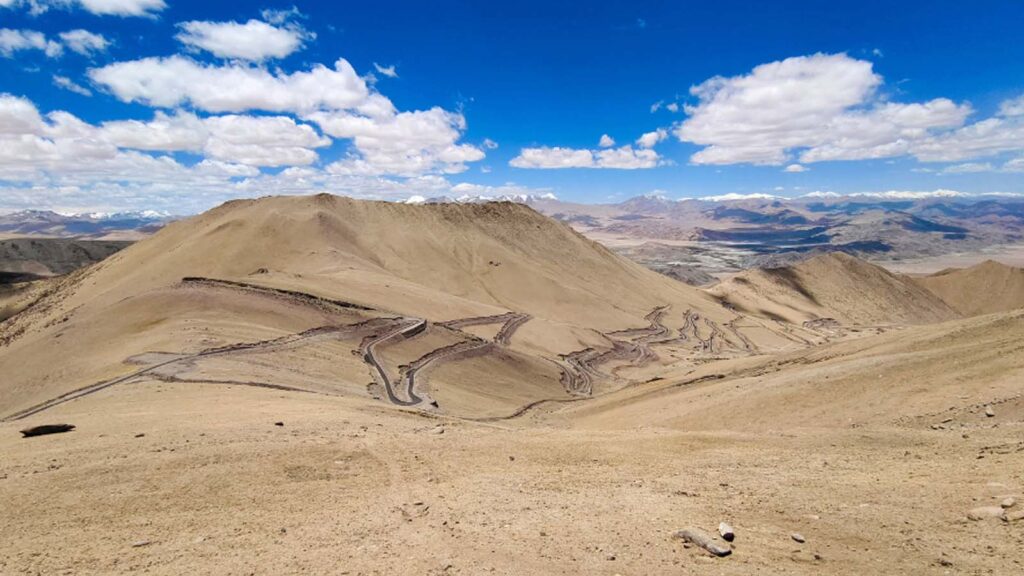
Two bends below Umling La, August 2018 — the point where the road, wind and fatigue made the decision clearer than the ambition.
The road that led to Hanle
I had started from Leh with an Inner Line Permit arranged in town, the usual bundle of paper confidence that makes a traveller feel briefly organised. The route took me towards Pangong, then along the long edge of the lake towards Chusul, over Tsaka La and onward to Hanle. I had left Leh solo, but I met Stacy at Pangong, and from there the ride stopped being a private dare. She rode along for the rest of the route, which changed the rhythm of the journey. There was another head reading the sky, another motorcycle in the distance, another person to whom a bad decision would not remain entirely private.
That stretch east of Pangong always feels as though the map has begun to speak more quietly. The lake thins behind you, the settlements grow more spaced out, and the land opens into a kind of sternness. It is not empty no lived landscape is empty but it asks you to pay attention. The road surface changed often enough to keep confidence from settling. There were sections of decent track, then gravel, then wind-packed flats, then sudden broken patches where the motorcycle had to be guided rather than ridden.
At Chusul, the paper ritual mattered. This is not a part of Ladakh where one should casually improvise a route. I showed the permit, answered the necessary questions, and tried not to mistake access for entitlement. In my memory, the exchanges were courteous and practical rather than dramatic. Men who worked those posts had seen enough riders arrive with too much confidence and too little weather sense. I was trying not to become one of them, though ambition has a way of disguising itself as readiness.
Tsaka La came with its own slow work: loose surface, thin air, the ordinary fatigue of riding where every correction feels slightly more expensive than it should. The Himalayan was built for bad roads, but even a capable motorcycle does not cancel altitude, weather or judgement. It only gives you a better chance of making decent decisions if you are still calm enough to make them.
By the time we reached Hanle, the day had already become larger than the plan. The village sat under that immense Changthang sky, quiet in a way that makes even engine noise feel temporary. Tsering, whose place I stayed at on a self-funded basis, gave me a room and the kind of ordinary hospitality that travellers often romanticise only because they arrive tired. I remember warmth, a bed, food, and the relief of being indoors after a day of exposure.
I also remember the question that came easily once she knew where I meant to go.
Umling?
I must have answered with some version of “if the road allows”. That phrasing sounds wise now. At the time it was probably still half-performance. I wanted the pass. I wanted to stand there and know I had made it. Want is not always loud. Sometimes it sits quietly at dinner and waits for morning.
Watch the sky
I left Hanle early, before the day had fully decided what kind of day it would be. The first kilometres did not immediately announce trouble. That is another way mountains deceive you: they let the beginning feel manageable. The Himalayan felt cold but willing. The plain opened ahead, and the road gradually became less road and more suggestion track, stone, dust, patches where previous tyres had chosen a line and left the rest to judgement.
The altitude made itself known without needing a number. My breath became work. Not panic, not sickness, just work. I was tired from the previous days of riding, and fatigue at that height does not behave like ordinary tiredness. It sits inside the arms and slows decisions. It makes the bike feel heavier when you need it to feel light. It turns small corrections into labour.
There was a checkpoint on the way. I do not remember the exact words cleanly enough to put them in quotation marks, but I remember the warning. A soldier told me to keep watching the sky; the wind, he suggested, would give me enough reasons to turn back if the day was not right. It was not a poetic line in the moment. It was practical advice from someone whose work required noticing what visitors like me often reduce to scenery.
I looked up after that more than I would have otherwise. The sky did not collapse. It changed by increments. Cloud pushed in. Light flattened. The wind grew less playful and more directional. Snow from the previous night, or from higher drifts being carried across the road, began to matter in shaded corners. I could still ride, and that was the problem. Nothing had yet made the decision for me.
The track climbed and tightened. I remember riding in short sections, each bend negotiated on its own terms. I was not racing anything except my own impatience. The surface became mixed and unreliable: hard patches, loose stone, traces of ice where shadow still held the night. My breathing grew louder. My shoulders started doing the work my judgement should have done sooner.
When the tyre slid, it did not introduce a new fact. It simply made visible what the road had been saying for some time. I was exhausted. I was not riding badly yet, but I was close to the place where fatigue begins to spend from tomorrow’s luck.
Two bends short
After the slide, I tried to continue for a little while. This is not the part of the story I am proud of, but it is the part I trust most. Turning back rarely arrives as one clean decision. It arrives through bargaining. One more bend. One more clear stretch. Let me see what it looks like after that rise. Let me not turn around this close.
Two bends from the top, a Gypsy came down from ahead. Again, I remember the substance more than the exact phrasing. The people inside warned me to keep one eye on the road and the other on the sky. It was the same message the soldier had given earlier, now delivered from the direction I wanted to go. The road had given me a second witness.
I looked at the track ahead, then at the sky. The pass was close enough to feel almost offensive. But the facts had collected themselves: snow and ice in shadow, wind rising, heavy breathing, tired hands, a recent skid, no good margin if the bike went down badly, and a summit that would give me nothing useful in exchange for ignoring all of that. The calculation was not heroic. It was plain. Continuing had become indefensible.
So I turned the motorcycle around.
It was awkward. The ground was uneven, and even the act of pivoting the bike demanded care. There was no cinematic moment, no noble acceptance, no sudden wisdom. There was only the slow work of getting the Himalayan pointed back down without dropping it. When the front wheel finally faced Hanle, something in me loosened and sank at the same time. I was relieved. I was disappointed. Both feelings were true.
The descent required more attention than the climb because now I had to live with the decision while still riding the same road that had forced it. I went slowly. The wind kept moving. The bike felt steadier once the altitude began to release its grip, but my body did not immediately forgive me. At intervals I stopped, drank water, flexed my hands and looked back. The pass stayed where it was. It did not need me.
Hanle again
I returned to Hanle the same day. That detail matters because disappointment changes shape once the body is fed and warm. On the road, I had been full of unfinished wanting. Back in the village, with the bike quiet and the worst of the cold leaving my hands, the day became easier to read. I had not failed to arrive at the top. I had arrived at the limit of the evidence available to me and made the only decent decision left.
That did not make it painless. When people ask about a pass, they usually ask whether you made it. There is no easy, clean answer for a day like this. “Almost” sounds like an excuse. “No” sounds incomplete. The truth is heavier and less dramatic: I got to within two bends of the top, the bike tank-slapped and skidded right, I brought it back, read the weather badly for too long, then finally read it well enough to turn around.
At Tsering’s place, the evening moved at the ordinary pace of Hanle kettle, food, tired limbs, the sky going dark with its usual extravagance. Stacy was there on the route with me, and the return did not need to be explained into a moral. The facts were enough. I had wanted a summit and came back with the bike upright. At that altitude, on that surface, on that day, upright was not a small thing.
The next day we rode back by Loma Bend, towards Upshi and then Leh. The route home had none of the glamour of the attempt, which is perhaps why I remember it with more affection now. Junctions, dust, tea, the gradual return of roads that behaved more like roads, the body slowly leaving the high, tight place it had occupied the day before. Leh received me without ceremony. The guesthouse gate opened, the engine went quiet, and I sat for a while before unloading anything, one hand still resting on the tank where the bike had slapped me back to attention two bends below the top.
“The bravest thing I did on that road was not arrive.
It was decide I would like to another day.”