When the sky broke and strangers became company.
In May 2014, I went up to Shanti Stupa because the air in Leh was too clear to waste indoors. Spring had the valley in that high-altitude brightness where everything looked rinsed and slightly overexposed: the white of the stupa, the brown folds of the hills, the town below still carrying the day’s dust. You can almost believe, if you are not careful, that the weather will behave as well as the horizon.
I should have known better. Ladakh is a place where the sky has moods.
The plan was small: climb the stairs slowly, circle the dome, leave a few quiet questions at the feet of the Buddha, make a couple of formal work-related heritage notes, and come down before the evening wind stiffened. What I did not plan for was the storm that arrived like a decision, and how, in the unannounced ceremony of rain and thunder, a handful of strangers became exactly the company I needed.
I started in the late afternoon, pockets full of the ordinary gear a meticulous traveller mistakes for talisman: a notebook, two pens, a half-filled bottle of water I had promised myself to sip rather than gulp, a packet of glucose biscuits, and a light shawl whose ambition exceeded its warmth. The climb from the parking area to the base of the stupa is not long, but at altitude small efforts ring louder. The staircase was mostly mine: stone worn by thousands of feet, white railings catching sunlight like small drifts of snow. Below, Leh spread out in familiar squares and rectangles — mud-brick houses, flat roofs punctuated by prayer flags, the bazaar soldered together by sound, spice and diesel, the distant river a metallic thread.
At the first landing, a street dog joined me. Not the wary, rib-mapped kind, but a thick-coated caramel fellow with one ear permanently rakish. He gave me the look I had sometimes received from children in Ladakh: I know this place better than you, but you may pass. I named him Captain in my head and offered a biscuit. He accepted, then trotted ahead, tail set to half-mast optimism.
I paused often. Not because the steps were steep — they are polite, as steps go — but because breath at 11,000 feet is a negotiation. I sipped water and let my lungs catch up with my eyes, which were always running ahead: to a line of poplars, a corrugated shadow fanned across a ridge, the long white curve of the stupa’s dome holding the sky like a bowl.
Shanti Stupa is both literal and theatrical. It is a white punctuation mark on a brown page, an exclamation that somehow does not shout. Built to commemorate 2,500 years of Buddhism and to promote peace, it does a quieter work from day to day: it invites, gathers, and gives you an excuse to climb higher and look back without apology. Up close, the dome is taller than your doubt, and the terrace around it offers a belt of views: the spread of Leh, the palace like a fossilised wave, and the roads running out towards Indus and Nubra.
I did what everyone does. I circumambulated clockwise, a prayer-hum in my head even if my lips stayed closed in the wind. On my first round, I counted flags. On my second, I noticed hairline cracks in the plaster, which I noted for maintenance. On my third, I watched the people around me, because sometimes the quickest route to a place’s mood is through the people witnessing it with you.
There was a young couple in matching windbreakers, cheeks still apple-red from the drive up; a Ladakhi grandmother in a goncha the shade of deep tea, silver amulets stitching years into her chest; two bikers with Bengaluru accents and jackets carrying the embroidered confidence of long miles; a nun in maroon whose eyes softened everything she looked at; a boy selling tea from a plastic crate; an off-duty army jawan with a round, ready laugh; a Czech backpacker with limbs like exclamation points; and Captain, who had claimed the one rectangle of sun that belonged to no one else.
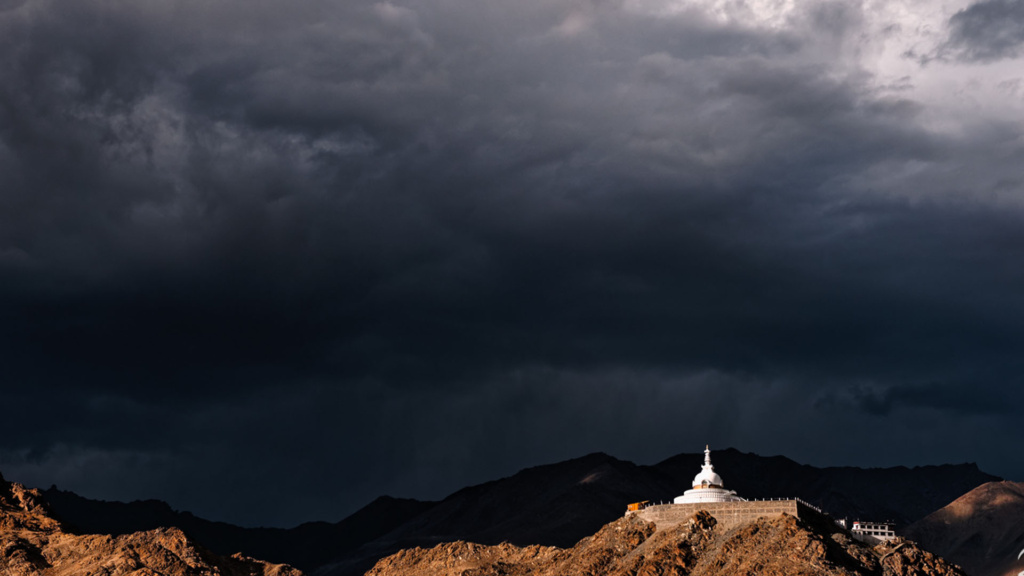
Storms over Shanti Stupa
The sky was clean enough to defeat suspicion. A blue so persuasive it felt like a promise. Yet on my fourth round, I noticed a lid pulled tight over the western edge, something thickening where the light should have loosened. Clouds in the Himalaya do not always announce themselves. Sometimes they gather like a rumour and then suddenly own the room. One minute the flags were carefree. The next, their tails stiffened. The first push came as a question, a curious wind lifting the hem of my shawl. Then it became an insistence, snapping the flags into furious semaphore. A raven scissored the sky as if it knew things about pressure I did not.
I saw the nun turn her face upward. The jawan checked his phone for a network that had no interest in our worry. The tea boy poured faster. The grandmother tightened her shawl and said something in Ladakhi with the tone older people use when weather changes: come in, come close.
And then, because mountains do not argue, the sky broke.
It did not begin with rain but with a sound: thunder folding itself across the valley, then unfolding. A cold rush of wind drove across the terrace. Everyone did the maths of shelter quickly. The covered corridor around the dome, with its shallow arches and painted panels from the Buddha’s life, became the nearest room available.
We moved without choreography and yet almost as if rehearsed. Someone shifted to make room on the low parapet. Someone pulled the tea boy’s crate closer to the wall. The bikers shouldered their backpacks into a tight wedge. The couple zipped each other higher into their matching shells. The nun lifted the edge of her robe and tucked my little shawl more firmly around my neck, as if to say: this is not ceremony, this is practical compassion. Captain installed himself under the bench, a warm punctuation mark against my ankles.
The first raindrops were big enough to have opinions. They landed with the plop of something that may have started as ice. Within minutes, rain became hail — small glass pebbles rattling across the white tiles, a sound precise enough to count and then too many to bother. The terrace transformed from a place of vistas into a room of weather. The mountains receded behind sheets of motion. Thunder rolled again, the kind of bass note that tells you what your ribs are for. Lightning stitched two ridges together and unstitched them before we could name them.
“Upar se aa raha,” the tea boy said, tilting his chin towards the west, as if the storm were a person whose direction mattered. “From above.”
He poured with one hand, the other steadying the rattling crate. Someone thrust him a note and told him to keep the rest, because there are economies you do not count in a storm.
When the power cut, it felt almost ceremonial. The string of bulbs along the corridor went dark in sequence, a run of notes reversed. The stupa, white in every weather, took on a ghostly insistence against the blackening sky. We could still see each other in the civil light left by hail and cloud. Faces at the edge of drama are easy to read: the couple’s surprise becoming worry; the bikers’ bravado looking for somewhere dry to stand; the grandmother’s calm, as if weather were merely a relative visiting with familiar complaints; the nun’s attention fixed on us, not the dome; the jawan turning his shoulder so the wind’s edge hit him first. The Czech, who had been photographing everything, lowered her camera and took a breath that looked like surrender.
I found myself counting: seconds between lightning and thunder, between breath and the next one, between one burst of hail and another. Counting is what the mind does when it wants a handhold.
It is a simple thing to become company: proximity, a shared problem, a willingness to let your edges blur. But it still amazes me how quickly it happens in a place like Leh. Perhaps altitude makes us more honest. Perhaps the knowledge that distance can widen with one bad decision makes our decisions kinder. Whatever the reason, by the time the first clatter of hail had rushed past our ankles and into the drains, we had become a small, temporary collective.
“Biscuit?” one of the bikers offered, tapping the packet as if it were a drum that could summon courage. “Marks,” he added, unnecessarily, as if the brand mattered to worried teeth. I took one and let the sweetness distract my jaw from clenching.
“You from Delhi?” the jawan asked, pitching his voice to cut through the drumming without shouting.
I nodded.
“First time?”
“Not the first,” I said, “but every time feels like an introduction I haven’t perfected.”
He laughed the way people do when the truth of your sentence is echoing around them in weather.
The tea boy, sixteen at most and wearing a sweater mended more times than made, handed cups down the row as if distributing something steadier than tea. “Butter tea?” he asked the Czech, who hesitated and then accepted. “It’s salty,” he warned, as if the sky had not already tutored us in salt and surprise. She sipped, made a face, and then smiled — the kind of smile that says the mouth has not understood yet, but it is willing.
The nun looked at the tiles trembling with hail. “Wind is a fast teacher,” she said in English that carried the rhythm of Ladakhi. “Rain is a patient one. Thunder is the one who wakes up the foolish.”
“And lightning?” I asked, because when you are gifted three teachers you might as well ask for the faculty list.
“Lightning is the exam,” she said, and her laugh loosened our shoulders.
Captain pressed closer as the wind found a new angle. He had the flexibility of a creature skilled at fitting his body into the negative spaces of others. The grandmother scratched him as if scratching a thought and told the tea boy to keep the kettle on the leeward side. “You don’t fight the sky,” she said to nobody and everybody. “You wait while it finishes speaking.”
In the pause before the next outburst, the couple looked at each other in that way couples do when the mask slides. It was not fear, exactly, but the recognition that their itinerary had not included hail.
“We wanted a sunset,” the woman said, to the air, to herself, to us.
“We will get a story instead,” the grandmother replied, which was probably the only useful itinerary left.
The storm found its second wind. The hail grew smaller but more insistent, rain threading itself between stones. The wind turned the corridor into an instrument, singing through gaps and banging the metal railings into a music that was not quite tune and not merely noise. We drew closer. Someone’s shoulder overlapped mine. The nun again lifted the hem of her robe to cover my knees without looking at me, which is the kind of help that does not need the theatre of permission.
We legislated kindness quickly. The jawan gave his spare wool cap to the tea boy, who pretended not to notice the sting it left on the soldier’s ears. The Czech produced a chocolate bar from a pocket and broke it into absurdly tiny squares, as if dividing a treasure map. One biker found a roll of gaffer tape — why he had it, only the gods of panniers know — and used it to secure a loosened corner of tarp that threatened to become a sail. The grandmother, unimpressed by tape as a category, supervised like a foreman who had built roofs with worse tools.
Somewhere in that hour, and it must have been close to an hour because the kettle was emptied twice, the rain changed pitch. It softened. The thunder began to travel farther between notes. Lightning tired of stitching. The flags, which had spent the hour shouting their invisible syllables, slackened into a tremor.
“Dekho,” the tea boy said unnecessarily, because we were already lifting our faces.
The air had that perfume that comes only when dust has been told to sit down: ozone, wet stone, something almost mint-like if mint grew in granite. The valley, washed and shocked, looked newly minted. The white dome shone as if scrubbed. Water beaded on the painted panels, turning the lapis blues, saffron robes and steady greens deeper than before.
The couple held hands in a way that was not for show. The bikers grinned in that sheepish key that follows an adrenaline high replaced by relief. The Czech took no pictures for a while, as if the camera’s appetite could wait until her own had finished. The grandmother patted her shawl smooth and said a few quiet syllables that may have been gratitude or gossip. The jawan stretched his arms, rolled his shoulders and looked across the valley with the fondness of somebody who has been cold in many places and chooses to be here. The nun pressed her palms together and bowed lightly towards the storm’s departure.
Captain shook himself. If you look at a dog right after rain, water beads arc like a small rainbow. He accepted another biscuit like a medal.
The tea boy counted his cups. Someone pressed money into his palm. Someone else added a note: for the next time the sky lectures us. He shrugged the way teenagers do when adults insist on proving to themselves that they are generous, but gratitude showed in the set of his mouth.
We drifted out from the corridor, careful at first, then with more confidence. The terrace was a geometry of puddles. Water had gathered in the low places and then remembered it knew how to leave. I walked the circumference again, slower than I had planned. My notebook was damp at the corners; my pen had decided to work only if cajoled. So I made notes in my head and underlined them with my eyes.
The simple truth was this: a storm came, the sky broke, we sheltered, it passed. Under that was another truth: we were strangers who became company because the weather asked us to be. No one exchanged cards. Hardly any names were offered. What we offered were usable things — space on a bench, a cup, a shawl edge, tape, a biscuit, a laugh when the thunder pretended to be larger than it was.
On my final lap, I stopped at one of the painted panels showing the Buddha touching the earth, calling the ground to witness. Rain had shifted the colours into another register, like a musician retuning between songs. There was a small chip near the base I had meant to photograph for the maintenance notes. It would need a careful hand, compatible repair, and a day without weather. We think of heritage as stone, paint, and a catalogue of approximated eternities. But sometimes it is also the agreements that happen around it: when to shelter, whom to let in, what to share when the sky is greedy.
The couple hovered nearby, still linked at the fingers.
“We thought we’d come for sunset,” the woman said with the dazed candour people have when plans have survived a small violence. “We got… all this.”
“All this,” I agreed, which was the best we could do.
The nun passed behind us, her soles already dry while the rest of us squeaked. “When the sky breaks, the inside mends,” she said, without slowing. I wanted to ask her to repeat it, to give me a grammar, to tell me which inside. But some sentences do not benefit from interrogation. They prefer to live in the room they have just made.
The bikers were squatting by their bags, redistributing weight as men do when they have recently lifted something heavier than their understanding. “We’ll ride slow,” one said to the other, in a tone that suggested an old joke at a new speed. The jawan clapped each of them on the shoulder in the universal idiom of men who have both misjudged storms and learned from them.
“Photograph?” the Czech asked finally, but she raised the camera lightly, as if it were a flute and not an instrument of proof. She took three: one of the stupa, one of the valley newly rinsed, one of Captain blinking at a puddle. Then she put the camera away.
“For remembering,” she said, more to herself than to us.
As often happens when danger underperforms doom, a second weather followed the first: jokes, loosened ribs, plans being made out loud as if the sky were now a committee member. We drifted towards the railing. The Indus lay a thinner coin of light than it had at noon. The palace wore its ruins like jewellery. Beyond everything, the mountains, which had not moved, pretended indifference.
“Chalo,” the grandmother said to nobody and everyone at once, which in the mountains means both let’s go and let’s carry the lesson only as far as our feet will manage. She stepped onto the wet stone with the confidence of someone who had been doing this longer than most storms had been practising. The tea boy gathered his crate and received more applause than he could pocket. The bikers shouldered luggage that had learned its place. The couple took one last look that had less to do with Instagram and more to do with the tiny archive humans carry behind the eyes. The nun did not say goodbye; she nodded as if we had been properly introduced to something larger than each other. The jawan saluted the stupa in a playful way the wind seemed to approve.
I lingered, as I often do, an overzealous custodian of moments. I checked the drain spouts, ran a hand along the parapet to feel for loosened tiles, freed the edge of a flag from a snag, and told myself these were the reasons I had come, even as my mind replayed the hour in the corridor: the chorus of hail, the small engineering of bodies into warmth, the sentences exchanged like bread.
The sky, having spent itself, found the decency to pull apart into filaments of blue. Between two clouds there was the kind of light I have learned not to name too quickly. People call it holy or cinematic or simply beautiful. For me, it was the light that follows honest weather: a white dome scrubbed sharper than it had been, flags heavy with rain beginning to lift, footprints losing their edges, the dog yawning a small apology for having done nothing but be excellent, and a group of people walking down the stairs no longer quite strangers.
On the way down, I found myself matching pace with the jawan. He asked about the mapping work, and I realised how ridiculous it might sound to say I was interested in cracks and paint formulas when the valley had just demonstrated a larger durability. But work is also a kind of listening. I told him that sometimes the best a note can do is hold a room open for the next person.
“What will you write?” he asked.
“Something about weather,” I said, “and what it asks us to be.”
“And what is that?”
“Useful,” I said, surprising myself with the bluntness of it.
He nodded the way soldiers sometimes nod when a civilian accidentally says something that works in both languages.
Captain escorted me to the final flight as if he had been paid in biscuits to ensure my good behaviour. At the bottom, he veered towards a vendor who had just begun setting pakoras on a tray, because some promises are embedded in smell. I bought two papers’ worth and sent the jawan off with one. The vendor, pleased to have customers in post-storm clearness, told me a story about the last time the sky had scolded everyone worse than this.
“It threw stones,” he said, meaning hail the size of walnuts. “We threw stories back.”
He smiled the proud smile of a man whose inventory included recipes for chaos.
Back in town, the wetness had turned dust to paste and then back again. The bazaar was already rehearsing the next hour’s noise. I walked past Jama Masjid, where a boy was washing the front step with a bucket. Shops reopened themselves to the evening. A woman shook rainwater from a plastic sheet and folded it with the efficiency of someone who had other work waiting. It is a Ladakhi skill to let the dramatic become background to the practical without disrespecting either.
In my room, I hung the shawl near the window so the late sun could pull the damp from it. I emptied my pockets, where storms leave their receipts: a crumpled tea cup, a broken biscuit, a pen that would never live again, a small hailstone that had survived long enough in a fold to become merely water. I opened my notebook and wrote the day into a line I could trust:
Shanti Stupa today: the sky broke and we didn’t. We made room.
The rest of the entry took its time. I wrote about the nun and her faculty of weather, about the grandmother who treated the wind like a niece prone to dramatics, about the bikers who found a use for tape in a place that usually prefers prayer, about the Czech who put the camera away when it was not the right instrument, about the jawan whose laugh rewired the storm’s bass, about the tea boy whose industry stitched us into a temporary community. I wrote about Captain because every story needs a witness who cannot repeat it. I wrote about the paint chip and the repair note because if memory is to matter, it must be maintained.
Night came clean. The stars took back the sky with a punctuality that almost made me forgive them for their earlier absence. Somewhere, an army convoy gave itself away with the small chatter of diesel. Somewhere else, a dog announced a philosophy to the night and other dogs argued the counterpoint. The air had that after-rain rigour, cool enough to file your thoughts, quiet enough to render them audible. I lay under the quilt and listened to my breath, not because it was in trouble but because the storm had briefly made me aware of it.
The next morning I climbed again, because that is what we do when a place has made a new room for us. We return to check the furniture.
The tiles were dry where they liked to be. The stupa wore the untroubled face monuments practise in front of the faithful. The paint chip I had worried over had not widened. The corridor showed no sign of having been our small country and every sign of being ready to convene another.
There were new people: a man with a tripod, a woman who had braided her hair with thin blue ribbons, a group of schoolchildren in uniforms that made them look like exported enthusiasm. I tried to point my eye towards the critical — cracks, drains, edges — and found it wandering back, as loyally as a homing bird, to the human. A boy with a scar at his eyebrow carrying two cups carefully as a waiter on his first shift. A mother pressing her lips together in prayer and then kissing the top of her daughter’s head, as if the two devotions could be one. A monk in the side room wiping condensation from a window for the fifth time because clear glass might be a form of piety.
On my last circuit, I met the nun again. She carried a small cloth bag that clinked faintly, the sound of cups or perhaps bells. She recognised me the way anyone who has sheltered with you recognises you: a brief brightening, not possession.
“You wrote?” she asked, because monks can spot a notebook long before it is opened.
“I did,” I said. “But the writing is smaller than the weather.”
“Then it is the right size,” she said, smiling.
“What will you remember?” I asked.
“That my robe dries faster when I am laughing,” she said. “And that people hold each other up without being told to. Also that your dog” — she nodded towards Captain, who had chosen a place in the sun as if auditioning warmth — “is a good monk.”
“Without vows,” I said.
“Dogs are born vowed,” she replied, and drifted away, the clink of her bag a little metronome in the morning air.
I thought of finding each person from the corridor: the couple, the bikers, the tea boy, the jawan. But some company is a season, and it is ungracious to drag a season through a calendar. Better to let the sky schedule your reunions. Better to trust that the next time a white dome and a black cloud agree to interrupt you, the right strangers will again be at your side.
On the way down, I met a sign I had not noticed the day before, perhaps washed clean into legibility: Silence is also a prayer. The irony was not lost on me. Our hour in the corridor had been anything but silent. But the storm had proved there are many kinds of prayer, and one of them is the noise we make when we are getting good at being together.
Back in the bazaar, I bought a coil of butter, a bag of barley flour I was not sure how to use, and a length of cheap prayer flags whose dye would not survive the first summer. I wanted to take the storm with me in a way that would not embarrass the sky. These would do: objects that would wear out honestly.
That afternoon, across the river, another patch of clouds assembled: smaller, undecided, polite. I smiled in their direction, as one nods to a teacher seen outside the classroom, and walked into town to buy more biscuits.