A 2018 notebook from Dah–Hanu, where a borrowed object taught me more about returning than taking
At 05:11, Dah was already awake in ways I was not.
I had come to Dah–Hanu in 2018 during the same self-funded stay that later gave me the apricot-oil courtyard memory. This piece belongs to the edges of that visit: the dawn water-turn, the awkward pleasure of being allowed into a household rhythm, the moment Padma let me wear the flowered headgear indoors, and the later discomfort of looking at photographs with another traveller and realising that a good composition is not always a complete truth.
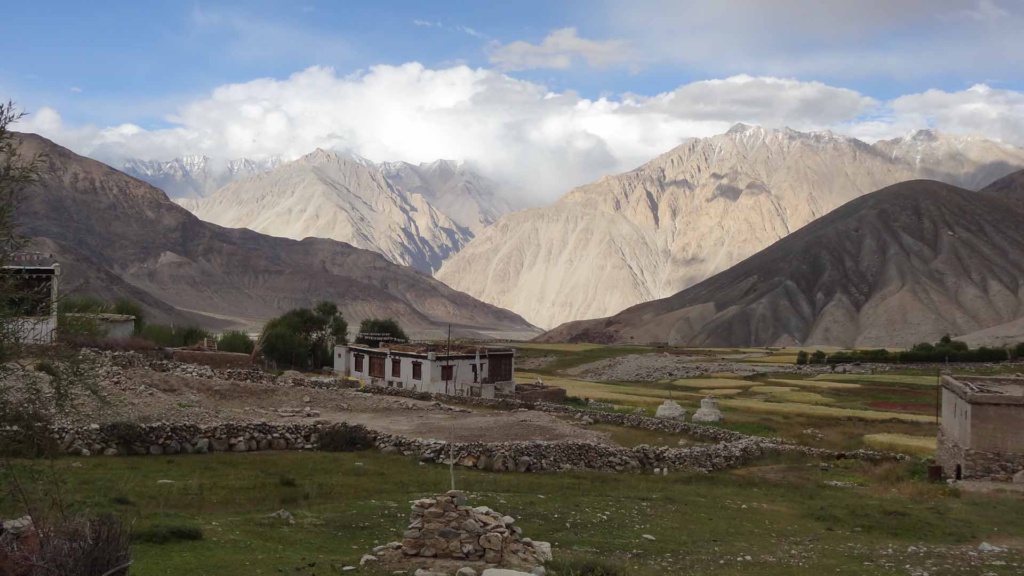
Rigzin took me out before the day had properly declared itself. The khul ran beside the path, narrow and quick, carrying water with the seriousness of a message. Men gathered at the head gate. A plank was lifted, adjusted, argued with by hand and experience, and the water changed lanes. The upper terraces received what the lower terraces had held through the night. Nobody treated this as picturesque. It was work, timing, fairness and memory in motion.
I reached for my notebook too early. Rigzin stopped me gently, not with scolding but with a look that said watching was also labour. The phrase I wrote later was “watch with pockets, not pen,” and whether those were his exact words or my translation of the moment, the correction was real. I put the notebook away and kept my hands still.
The first light came slowly along the poplars. A woman closed a small breach in the channel with a spade. Two boys ran ahead, then came back when told. A neighbour pressed gur-gur cha into our hands, the salt and butter waking my mouth before my language did. I had arrived thinking field notes meant writing quickly. The morning suggested otherwise. Sometimes the note is what you refuse to take while the thing is happening.

Brokpka Women
Apricot stones at noon
By noon, the courtyard had changed its sound.
A sack of apricot stones was opened, and the day became smaller, more precise. Chomo Rigzin’s mother worked with the easy rhythm of someone who had done this long before my curiosity arrived. Bari to one side, goos to another: bitter kernels for oil, sweet ones for eating. The terms stayed in my notes because they belonged to use, not decoration.
Nawang supervised my incompetence with admirable restraint. I cracked the first stone badly. The kernel broke, the room noticed, and laughter moved around the courtyard without cruelty. The correction was practical: lighter wrist, better angle, do not crush what can be opened. On the next attempt, the kernel came out almost whole. This was treated as progress but not achievement, which felt fair.
I am keeping the apricot scene short here because another article carries the full oil-press story. What matters in this notebook is not the complete process but the way the work placed me properly inside the room. I was not there only to observe. I was allowed, briefly and clumsily, to help. That made the welcome feel less ornamental and more demanding.
There was khambir, salt tea, apricot jam, kernels passed between hands, and the smell of oil from earlier pressing. A bottle of apricot oil sat in the light like something that had already survived a long argument with wood, heat and pressure. Later I would buy oil and carry it away carefully. At noon, I was still learning how much labour a small bottle can hide.
The borrowed headdress
The headdress waited near the doorway.
I had seen versions of it before in photographs and in the tourism shorthand that has done so much damage to Dah–Hanu: the exotic face, the flowered profile, the lazy “Aryan” label that reduces living people to a traveller’s theory. I knew enough by then to be wary of that gaze, but knowing better in principle is easier than behaving better in a room. Academic work on the Brokpa of Dah–Hanu notes their Dardic language context and describes the “pure Aryan” image as a tourism-perpetuated impression rather than a simple fact. That later reading sharpened something the room had already begun teaching me.
Padma saw me looking and asked if I wanted to try it. The question carried conditions before they were spoken. Inside only. No lanes. No performance. Listen first. I remember the relief of clear rules. Curiosity becomes less dangerous when someone gives it boundaries.
The headdress was not light. Coins, flowers, felt, thread, pins, memory, occasion: all of it gathered above the head and changed the body’s behaviour immediately. Padma helped place it properly. My neck lengthened because it had to. My shoulders stopped making casual decisions. I looked in a small mirror and did not see transformation so much as correction. The object did not make me part of the culture. It made me aware of how quickly I had wanted access to something that was not mine.
The walk was short: a few steps inside, a turn, a return. That was enough. The briefness mattered. A borrowed thing should not be made to serve a traveller’s appetite for too long. When Padma lifted it away, I felt both relief and embarrassment. My body had enjoyed the dignity of the weight; my mind knew the dignity was not mine to keep.
She did not give me a lecture. That is important. No one in the room behaved like a cultural guide hired to improve me. People laughed, corrected, pinned, adjusted, carried on. The lesson was not performed. It lived in the rules of the borrowing and the fact that the headdress returned to its place.
Compositions after dark
The photography question arrived later, not as a dramatic refusal, but as a quieter discomfort.
At night, another traveller and I compared compositions. On the surface, it was ordinary: frames, light, doorway, profile, petals, the sort of technical conversation travellers have when cameras have made them feel competent. But the day had already complicated the act of looking. After the khul, the apricot work and the headdress, every photograph seemed to ask a second question: what is outside the frame, and who pays the cost of making this look beautiful?
A strong composition can lie by omission. It can make a household look timeless when it was busy. It can make a headdress look like costume when it was governed by permission. It can make petals look like culture while cutting out the hands that gathered, pinned, swept or returned them. I do not mean that photography is wrong. I mean that in Dah, on that night, I began to distrust my own neatness.
We talked about angle and light, but I remember thinking more about context. Had I photographed the work or only the ornament? Had I waited long enough before raising the camera? Had I understood the difference between being allowed to take a picture and being entitled to use it as proof of intimacy? These questions did not make the camera useless. They made it heavier.
The Indus was audible in the rafters that night, not loudly, but steadily enough to enter sleep. Dinner was thukpa with greens, bread, apricot oil brightening the surface, and the familiar comfort of hot food after a day of being corrected in small ways. The generator gave the room an hour of modern noise, then withdrew. In the quieter dark, the day arranged itself into four notes: water turned by hand, stones opened by patience, a headdress borrowed briefly, and photographs made less innocent by what they could not hold.
Riding out
Morning returned the house to work before it returned me to the road.
There was tea, sweeping, low conversation, the small economy of a household beginning again. The khul had its own appointment. The oil had been stored. The headgear rested where it belonged. The apricot stones had not become symbols overnight; they were still material for labour. I liked that. The house refused to become the story I wanted too easily.
I packed the oil carefully. The bottle went into my bag wrapped against leakage and regret. A few kernels followed, sweet and bitter kept apart because that distinction had become practical enough to respect. My notebook, for once, felt less important than the objects. Oil has weight. Kernels have use. Notes only have value if they behave.
At the edge of the village, before riding out, I checked the bag again. The motorcycle waited with its usual impatience, dust already finding the places where straps would sit. Dah did not wave itself into sentiment. Someone returned to work. Someone called from inside. Water moved where it had been directed. The road along the Indus was ready in the indifferent way roads are ready: it would take me away whether I had understood the visit or not.
I started the bike and felt the bag shift slightly with the bottle of oil inside it. That was the ending I trusted most. Not a lesson, not a claim of understanding, but the physical fact of carrying something bought, something given, something borrowed and returned, and riding away with less certainty than I had brought in.