A summer 2017 morning in Maan, where the lake changed colour before the village fully woke
I woke before the blue.
The room in Maan was still dark, and the quilt had become heavier in the hour before dawn, as if the cold had climbed in quietly and taken its place beside me. I had arrived late the previous afternoon after the long road from Leh over Chang La, past Spangmik, and towards the villages of Maan and Merak on Pangong’s shore. The lake had been grey then — steel, slate, graphite — nothing like the impossible blue I had carried in my head from photographs and careless conversations.
That was my first correction. Pangong does not turn blue on command.
I was travelling alone, staying in a homestay in Maan. Before sleeping, Tsering, the homestay owner’s father, had placed salty tea in my hands and told me, “Five o’clock. The colour begins before prayer.”
So I dressed badly but thoroughly: thermals, fleece, jacket, cap, gloves, socks that were not warm enough, and the stubborn optimism of someone who thinks one more layer will solve altitude. Outside, the village had not yet become a village. A dog watched me from the lane, decided I was uninteresting, and returned to whatever responsibility dogs carry at that hour.
The path to the lake was pale underfoot. Pebbles clicked and shifted. Frost sat on stones and made them sound sharper. My breath showed in front of me, a small white proof that the cold was not only in my imagination. Somewhere behind me a stove came alive. Somewhere farther off, a vehicle changed gears carefully. The shore was not silent. It was only quiet enough to reveal how many small sounds had always been there.
Pangong appeared first as a long, dark plate.
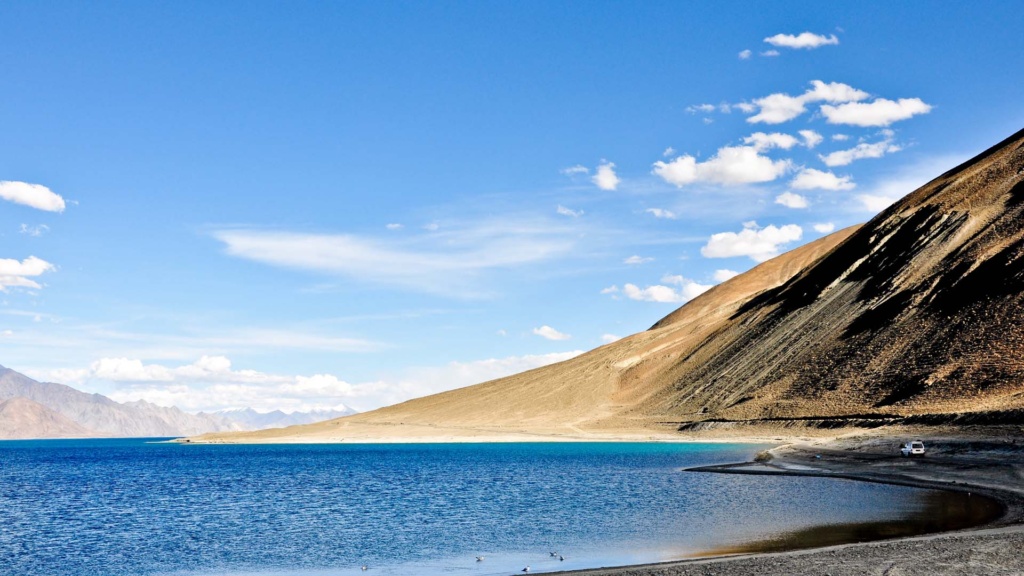
Official Ladakh sources describe Pangong as a high-altitude lake known for changing colours with the light, and note that it extends across the India–China boundary; for this piece, that is all the geography I need. The lake’s border context was present in the background, but my morning was shaped by cold, villagers, prayer sounds, stones, animals and water.
Pangong
The first colour
Before colour, there was a deep grey that seemed to contain all the colours in reserve.
The water moved from black to slate, then to something closer to pewter. The far mountains were still only edges. The sky had opened slightly in the east, but the sun had not yet announced itself. I stood near the shore with my camera hanging uselessly for a while. I had come to photograph the lake, but the first minutes did not feel like something to take. They felt like something to wait through.
A man stood some distance away, hands in pockets. A dog sat near the stones with the seriousness of a guard posted by no one. A monk’s horn sounded somewhere above the village — low, long, and practical. Another sound answered, then a drum. Maan Deram Chenmo had not yet become public movement, but the day had begun gathering itself.
Tsering arrived with a thermos as if the lake had asked him to be there.
He poured tea into a steel cap and handed it to me. The metal warmed my fingers before the tea reached my mouth.
“This lake,” he said, looking at the surface, “never shows the same face twice.”
A small bay near the shore changed first. The grey thinned, and a patch of turquoise opened in the water so quietly that I almost missed the beginning. Then the patch widened. Teal arrived next, then a blue that seemed to gather depth from underneath rather than from the sky. A thin wind crossed the surface and made little ripples that disappeared almost as soon as they formed.
“Today she chooses kindness,” Tsering said.
“What about when she doesn’t?” I asked.
“Then she teaches.”
I am wary of lines that sound too complete, but this one was his, and it belonged to that cold morning. He was not performing wisdom. He was pouring tea and watching a lake he had known longer than I had known the desire to see it.
By then the blue had become impossible to call one thing. Near the shore it held green. Farther out, it deepened towards sapphire. Under a passing cloud, it returned briefly to slate. The camera finally came up. I took photographs, then lowered it again because the screen made the lake seem smaller than it was.
A village morning, not an empty lake
The most useful thing Pangong gave me that morning was not silence. It was company.
The popular image of Pangong often arrives through cinema, road-trip photos and the idea of a vast, empty blue. I had also written separately about looking beyond the film-set version of the lake, and this dawn confirmed why that mattered. Pangong was not empty. It was shared.
Tsering was there with tea. A monk crossed the slope above the water. A few villagers moved between home, shore and prayer. Women carried buckets. A child appeared and disappeared around a dog. Later, soldiers came near the edge briefly, part of the ordinary presence of this region, and then moved on. The lake did not become less beautiful because people used it, crossed near it, prayed beside it, worked around it or guarded its roads. It became more exact.
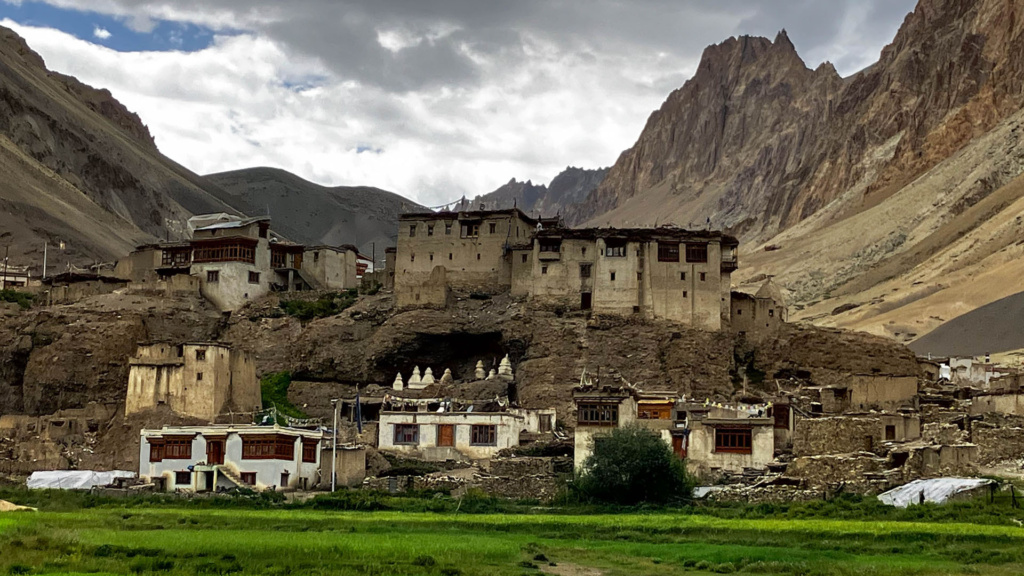
Maan Deram Chenmo shaped the morning without needing to take over the lake. I witnessed the village gathering: drums, horns, butter lamps, juniper smoke, khapse, gur-gur cha, dresil, chhang, archery, procession, thangka, masks and laughter. A community account of the festival describes it as a long-running celebration at Maan village on Pangong’s shore; before publication, I would still verify the exact 2017 date against your notes because public accounts often frame it as a spring festival while your memory places this visit in summer.
What I saw that morning was physical before it became symbolic. A butter lamp cupped against wind. A tray carried carefully. A drum set down on a low wall. A child’s sweater being pulled tighter. Juniper smoke crossing the cold air. Khapse passed from hand to hand. Tea doing what tea always does in Ladakh: becoming warmth, hospitality and conversation at once.
Some of the meanings came to me later, through memory and explanation, and I do not want to pretend I understood everything while standing there with cold toes. At the time, I mostly understood sound, light and the fact that the lake did not need to be alone to be still.
There were birds too: a gull cutting low, a crane seen in the distance, bar-headed geese, and the smaller life at the edge that I noticed only when I stopped looking for spectacle. A yak bell carried faintly from somewhere behind the village. Dogs came and went with better knowledge of the shoreline than any traveller. Even the brine shrimp near the shallows seemed like a reminder that this colour was not sterile. The lake was severe, but not empty.
At one point, Tsering said, “Today you will see the dance. Tomorrow you will remember the blue.”
He was right, though not completely. I remember the blue, but I also remember the thermos, the frost, the awkward warmth of the steel cap, and the way a village morning entered the water without disturbing it.
The khata and the road along the lake
Later, after the first blue had become ordinary daylight, I carried a khata down to the shore.
The gesture was real, though I want to write it carefully. I touched the water with the white cloth, then touched my forehead. The fabric darkened at one corner, heavier with lake water. I tied it later to a willow, knowing it would not last forever and not needing it to. Some gestures are not made because they are permanent. They are made because the body needs a way to say thank you.
By then the day had turned brighter and more practical. The lake that had been slate, then turquoise, then sapphire began to glare in places. Wind moved over it with more confidence. The village was fully awake. Maan Deram Chenmo moved into its later shape — food, archery, jokes, duties, drums, masks, the careful work of celebration.
I walked along the shore for a while, then returned to the homestay for food and warmth. The morning had already done enough. I did not want to stretch it into a lesson while it was still happening.
When I later travelled along the water towards Merak, Pangong lengthened beside the road in fragments: blue visible between curves, then hidden by dust, then suddenly returned. Official tourism material notes the route towards the lake through Chang La, Durbuk, Tangtse, Lukung, Spangmik, Maan and Merak, but in the moment I was not thinking in route names. I was thinking in colours and stopping points.
The lake kept changing after dawn, but dawn had already fixed the scale of the day. Noon made it brighter. Afternoon made it busier. The festival gave it sound. The road gave it distance. But the first hour had taught me where to stand: not outside the scene, waiting for an empty frame, but inside a living shore where people, animals, prayer, cold and work all had claims on the same blue.
Shanti Stupa after Pangong
The final scene belongs in Leh.
Later in the journey, I walked up to Shanti Stupa in the evening. It would be easy to make this too neat — Pangong’s blue carried back to Leh, silence becoming wisdom, the lake answering from far away. I do not want that. What I remember is simpler: steps, breath, city lamps, the body still holding the habit of waiting.
Leh was below me, busy with its own evening. The bazaar had returned to steam, shop lights, traffic, voices and small negotiations. From Shanti Stupa, the city looked contained for a moment, though I knew it was not. The sky over the mountains carried a faint colour that reminded me of the lake before it had turned fully blue.
I stood there longer than I needed to.
Not because I had understood Pangong. I had not. Not because the morning had made me better. It had not done that either. It had only slowed me down enough to notice the order in which things happened: dark room, cold path, slate water, thermos, horn, first turquoise, villagers, festival, khata, road.
That was enough to carry back.
At Shanti Stupa, I did not take out the camera immediately. I let the evening settle, then finally raised it for one photograph. The city lights had begun to appear. My hands were no longer cold, but they remembered the steel cap of tea. My shoes no longer held Pangong’s shore, but the morning still seemed to be caught somewhere in them.
Silence had not turned blue because the lake was empty.
It had turned blue because I had waited long enough to see who else was there.