A motorcycle ride past the image I had carried of the lake
The first sight of Pangong did not remove the film from my head.
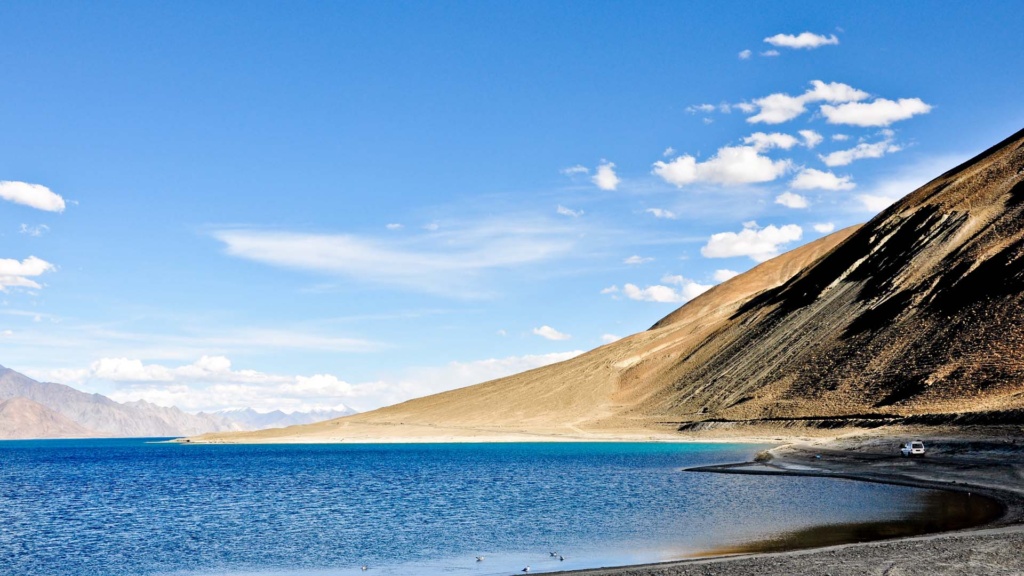
It arrived through the visor in pieces: a slice of blue after Chang La, a hard turn of wind near Tangtse, the road dropping towards Lukung, and then the lake opening with the confidence of something already over-photographed and still impossible to dismiss. I was on a motorcycle in September 2020, riding from Leh over Chang La, through Tangtse, then towards Lukung, Spangmik and Maan. I had three nights by the lake ahead of me and one very famous image already lodged in my mind.
That was the inconvenience. I wanted to pretend I had come clean, without expectation, without the cinema, without the memory of a lake made famous by other people’s frames. But I had not. I had seen the pictures. I knew the colour before I met the water. I knew the joke before I met the shore.
At Lukung and Spangmik, the familiar props were there: the 3 Idiots-inspired scooter, chairs, signs, and the cheerful machinery of proof. I did not know which pieces were original and which were later recreations. By then, the distinction almost did not matter. They were doing the work props are meant to do: giving people a quick way to stand inside a picture they already loved.
I had thought I would feel above it.
That was the first small embarrassment of the trip.
The lake was still there behind everything: wind-bent, cold, restless, blue in a way that made all language overconfident. But the shore was not empty, and pretending it should be empty felt dishonest. Pangong had become a place where the famous image, the village economy, traveller desire, tea stalls, homestays, motorcycles, dust, plastic, prayer flags and real water all stood beside one another. The question was not how to find the untouched lake. The question was how to stop reducing it to the picture I had arrived with.
Pangong
At the familiar shore
A boy waved me towards the prop area with the practical optimism of someone who knew exactly why visitors stopped there.
“Photo?” he asked.
It was a fair question. The whole arrangement existed because enough of us had wanted that photograph. I had no moral height from which to refuse him. I had travelled to Pangong too, camera packed, memory hungry, already rehearsing what the first sight might mean. The only difference was that once I reached the props, I did not want to sit inside the image anymore.
I said no to the photograph and yes to tea.
That changed the scene immediately. We moved from pose to pause. The boy told me who had repainted one of the signs and which parts the wind kept damaging. He laughed at how many people sat on the scooter and tried to look as if they had invented the idea. I asked stupid questions, which is one way of earning better ones. He told me the best light came when most people were either arriving in a hurry or leaving in one.
“Tomorrow, my uncle takes the boat for ropes. Come see,” he said.
I did not go. The lake would have other plans for me. But the invitation mattered because it shifted the prop from an object of mockery to a small part of someone’s working day. Film tourism was not only a performance. It was also income, maintenance, repainting, tea, repairs, jokes and boys who understood visitors better than visitors understood themselves.
I still avoided photographing the props. Not because they were false, but because they were too complete. They left nothing for me to discover except my own expression. I walked instead towards the water, where the wind made the lake difficult to look at for too long. Pangong did not become more real because I moved away from the film set. It simply became less available to the version of me that wanted a ready-made frame.
Maan after the crowd
I stayed at Maan with Padma, whose name I can use and whose homestay was part shelter, part kitchen, part weather station.
The room was stone, simple and cold at the edges. Solar panels leaned outside. Dung cakes dried for later use. Water was boiled before drinking. This sounds like a rustic inventory until you are the person waiting for the water to boil, counting how much you have already used, and realising that convenience is usually someone else doing invisible work.
“Bucket bath at five, before the line at the tap,” Padma said. “Greywater to the willow.”
She gave instructions without making them sound like virtue. A household has systems because it has to survive the season, not because it wants to educate travellers. I learned where to keep my boots, where to leave the mug, when hot water was available, how not to behave like a man whose city bathroom had spoiled his sense of scale.
“Shower is performance,” she said. “Bucket is content.”
I laughed because she was enjoying the line, and because she was right.
Dinner was thukpa with turnip greens, khambir, apricot oil, salt tea and butter. The food did not arrive as “local cuisine”. It arrived as dinner, which is better. We ate near the bukhari while the lake outside turned from blue to metal to something darker than colour. Inside, the room had its own weather: steam, wool, stove heat, metal bowls, the small patience of people eating after a long day.
Padma’s grandfather appeared in the article of my memory the way certain older men do in Ladakh: not as a sage, but as someone who had earned the right to be amused. He sold walnuts by weight and words by whim. He was firm about doors.
“Close gently,” he said, “so the place believes you were raised by a house.”
That line has followed me longer than some landscapes.
What the lake collected
The rubbish at Pangong did not look dramatic enough for outrage.
That was what made it difficult. Plastic bottles near the shore. Snack wrappers flattened into dust. Cigarette butts tucked between stones. Foil flashing briefly in the wind. Food waste left where animals, birds or weather could find it. None of it looked like a disaster in isolation. Together, it felt like a habit.
I carried my own micro-litter back with me. The torn corners of packets, small pieces of foil, wrapper fragments, whatever my own pockets produced and whatever I could pick without turning the act into theatre. I did not see a neat wet-dry waste system at the homestay, so I did not pretend there was one. I collected mine and took it back.
The lake made this feel less heroic than obvious. Wind moved everything. A wrapper did not stay where it was dropped. It travelled, snagged, lifted, disappeared, returned. The shore was too open for the comforting lie that small waste remains small.
There were birds on the water and along the edges, gulls and cranes in the distance, and marmots busy with their own nervous errands. Dogs moved through the village with the authority of unpaid officials. Somewhere farther off, yak bells carried in thin sound. I did not need a lecture on ecology to understand that my foil had no business in that arrangement.
One evening, a group arrived with a portable speaker and began singing near the homestay. They were not villains. They were happy, cold, excited and slightly too confident in the generosity of shared air. The song rose over the courtyard and met the lake badly.
Padma came out holding a ladle.
She did not shout. She stood there. The song lowered itself into embarrassment and then stopped. It was one of the most efficient negotiations I have seen.
Later, at the shore, I tied a ribbon and made a small stone mani. At the time, I thought I was being reverent. I had asked enough, I thought, and my intention was quiet. Looking back, I am less certain. Intention is not the same as understanding. A gesture can feel respectful to the person making it and still belong to a practice he does not fully know. I leave the memory in the article because the point is not to present a cleaner version of myself. I was learning the difference between adding meaning and adding myself.
The lake did not correct me. Places rarely do. They wait for memory to become less flattering.
Before Chang La
After three nights, I packed the motorcycle at Maan with less ceremony than I had arrived.
The famous blue was still there, but it no longer felt like the main fact. The lake had become heavier with smaller things: boiled water, a bucket bath timed around a tap, thukpa steam, a boy who knew the economics of a film prop, Padma’s ladle, cigarette butts between stones, the awkwardness of a ribbon I was not sure I should have tied, and a bag of micro-litter that made a faint sound whenever the pannier moved.
I rode back through Spangmik and Lukung, then towards Tangtse and the climb before Chang La. The road gathered dust and cold as it rose. Before the pass, I stopped at a nomad camp for tea. The motorcycle clicked beside me as the engine cooled. My hands had that post-ride stiffness where fingers remember the throttle before they remember the cup.
The tea was hot enough to make me slow down.
Behind me, Pangong had already disappeared from sight. In the bag, the small rubbish I had carried out waited for Leh. I did not feel improved. I felt more answerable, which is less pleasant and probably more useful.
I finished the tea, tightened the straps on the motorcycle, and checked the pocket where the micro-litter bag sat folded into itself.
Then I started for Chang La.