An August 2018 walk through dust, wind, monastery walls and the pale remains of old water
First view from the road
I first saw Lamayuru from a bend in the road west of Leh, where the land seemed to lose its skin.
One moment there were familiar Ladakhi slopes, dry and severe, holding the road in their usual way. Then the valley opened and the ground changed colour. Hills turned pale. Ridges softened. The surface dropped into folds and gullies, as if someone had pressed a thumb repeatedly into wet clay and left it to harden under a high sun.
The driver tapped his horn twice, out of habit more than need, and pointed with his chin.
“Moonland.”
It is a tired nickname and still difficult to avoid. Leh district’s official tourism page also describes Lamayuru as the “Moonland of Ladakh,” but the word can flatten the place if you let it. Leh Municipal Council The moon has no village paths, no donkeys complaining near walls, no kitchen smoke, no monastery bell, no thukpa waiting after a walk. Lamayuru looked lunar from the road, yes, but once I stepped into it, it became far more earthly: powder on the palm, wind in the ear, dust at the ankle, stone underfoot.
This was August 2018. I was travelling solo, part of a longer journey through Ladakh, but I had come to Lamayuru for itself. I stayed two nights in a homestay and gave the place the one thing it seemed to ask for: time on foot.
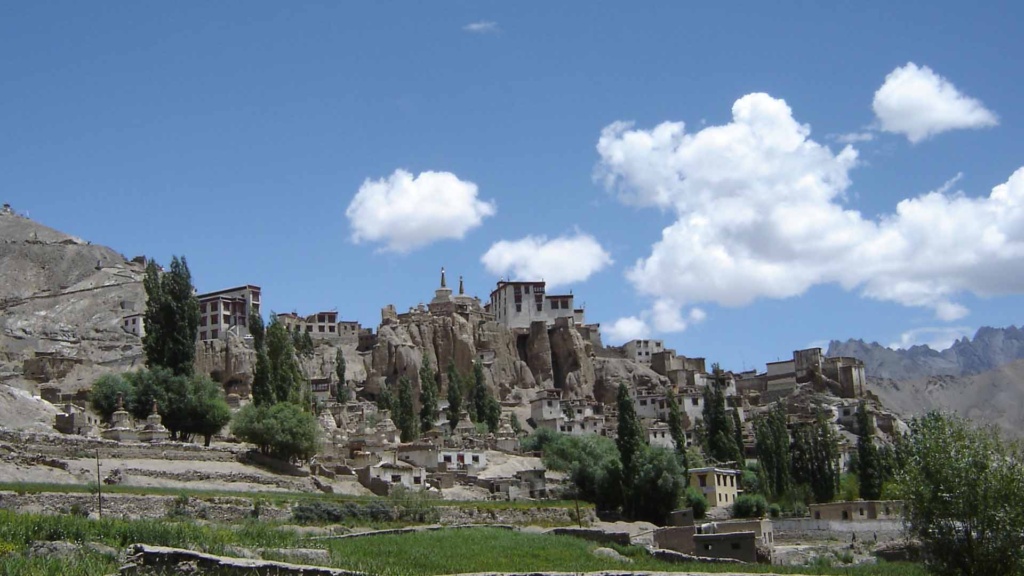
From the viewpoint, Lamayuru Gompa sat above the pale land with the confidence of something that had watched many travellers misname the valley and move on. A raven crossed the view, not hurried, not impressed. Below, the badlands folded towards the village in muted gold and ash.
I did not understand what I was looking at yet. That helped.
Switchbacks Become Stories: Five Days Between Zangla and Lamayuru
Moonscapes of Lamayuru
Walking the pale ground
The host at the homestay gave me tea and told me to go when the light softened.
“The ground shows you its face then,” she said.
So I waited until late afternoon, when the sun had lost its glare but not its warmth. I stepped out with water, apricot kernels, a notebook, and the familiar ambition to understand too quickly. The village path began between walls, fields and small practical noises: metal bowl, donkey, door latch, someone calling across a courtyard. Then the settlement thinned and the pale ground took over.
The first thing I noticed was how soft it sounded.
Each step released a small cough of dust. The slopes were not hard rock in the way I expected. They looked carved, but the carving felt fragile. My boot pressed into powder, slipped on fine sediment, found a stone, corrected. Walking here was less about distance than negotiation.
At one point I picked up a small rounded pebble. It was smooth in a way the surrounding slopes were not, and for a moment I wanted to keep it. Then the absurdity of pocketing a piece of a place because it had pleased me became clear. I put it back.
Some thefts are too small to be excused.
I followed the village path onto a ridge. From there the folds of Lamayuru opened wider: pale gullies, scalloped walls, soft spires and broken ridgelines. The wind had room to work. It crossed the slopes in small visible movements, lifting dust from one edge and laying it down elsewhere. A beetle pushed itself along the ground with more conviction than I had. Below, sheep moved across a slope, their line held together by a shepherd’s whistle.
“Careful,” he called. “The ground is polite until it isn’t.”
That was good advice. The path narrowed in places, and the crumbly surface had a way of looking firm until the heel proved otherwise. I slowed down. Lamayuru is not a place that rewards the city habit of walking as if the ground is merely service.
A monk sat on a stone near the ridge, maroon sleeves pulled close against the wind. He asked where I had come from, and after a little conversation he pointed towards the pale land.
“Old sea,” he said. “First, water. Then wind. Now we sit.”
I asked if I should keep walking.
“Walk,” he said. “But also sit. Wind explains more when you are not moving.”
I am usually suspicious of sentences that arrive too perfectly. But this one came from a real person, on a real stone, in real wind. I sat.
For a while nothing happened except the place becoming clearer. Shadow settled inside the gullies and made their shapes sharper. The ridge changed from pale yellow to a muted gold. The monastery walls caught light. A dog barked once in the village and then reconsidered its argument. The wind did not explain anything in words, which was kind of it. It only kept moving dust from one surface to another, and after some time that was enough.
Monastery, kitchen, moonlight
The next morning was clear and cold.
I walked higher towards the Fotu La side, not far enough to make it a march, only enough to see Lamayuru from a longer angle. The road appeared as a thin, practical line. Trucks moved slowly. The village held itself between pale land and darker rock. From above, the monastery and settlement did not look separate from the badlands. They looked like the human part of the same slope.
Later, I visited Lamayuru Gompa properly.
The official monastery website says Lamayuru Monastery belongs to the Drikung Kagyu tradition and houses about 150 monks; Incredible India also notes its Dukhang and Gonkhang interiors. lamayuru.com I did not know all of that as I walked in. What I knew was the immediate texture: butter lamps, old wood, wall colours that had survived dry air, a child monk trying to look solemn and failing in the most human way.
From the balcony, the badlands lay below like a map that refused to become flat. The road, the village, the slopes, the fields and the far horizon all held together for a moment. That view changed how I saw the monastery. It was not above the landscape in some abstract spiritual sense. It was built into the same argument with wind, weather and time.
Back at the homestay, the host taught me to eat tsampa properly: tea poured into barley flour, fold, press, roll, try not to make a mess. I made a mess anyway, though less than expected.
“You walk better if you eat like this,” she said. “Wind takes less then.”
The little boy in the house watched my technique with the calm cruelty of children who know adults are slow learners. Dinner was thukpa, hot enough to restore the body after a day of dust. Outside, the cold came quickly once the light left.
That night, the moon found the badlands and sharpened them.
All afternoon the hills had looked soft, almost edible in their pale folds. Under moonlight they became stricter. Edges appeared where I had not seen them before. Shadows turned narrow and dark. The monastery held a faint glow. A dog followed me part of the way to the lookout and accepted a biscuit as if this had always been the arrangement.
Stars came out with the dry clarity Ladakh gives when the sky is in a generous mood. I stood there longer than I had planned, hands in pockets, dust still in the seams of my shoes, the cold working carefully through my jacket.
Moonland was better at night, not because it looked more lunar, but because it stopped trying to be picturesque. It became outline, cold, silence and wind.
What the old water left
The title says “ancient sea,” and I am keeping it because that is how the place entered me: as the sensation of walking through old water turned to dust.
But the article needs precision. The old-water story first came to me through locals in Lamayuru — the monk, the host, the ordinary way people spoke of the land as something water had once made and wind had later revised. I did not arrive with geological certainty. I arrived with curiosity.
Later, I learned that researchers describe the Lamayuru badlands as having developed in lacustrine sediments of a former lake, sometimes referred to as the Lamayuru paleolake. One geomorphological study places that former lake at around 35,000–40,000 years before present, formed in relation to a catastrophic landslide and tectonic activity in the Indus Suture Zone; another paper discusses Lamayuru’s lacustrine sedimentation in a semi-arid alpine setting. gfdq.glaciologia.it
That does not make every slope a simple “ancient sea shore.” It makes the walking more interesting. What I saw under my feet — soft layers, powdery slopes, gullies, fine sediment, rounded stones, wind-cut shapes — belonged to a deeper story than my eye could read alone.
So in the rewrite, I would let “ancient sea” remain as a title and felt metaphor, while the body says what can be said honestly: locals spoke of old water; the land looked and felt sedimentary; later reading pointed me towards former lake deposits and long erosion.
That distinction matters because wonder becomes stronger when it stops pretending to be expertise.
On my second late-afternoon walk, I returned to the ridge without a plan. I had already photographed enough. The better work was looking. Donkeys moved near the village. A raven settled on a dead branch and behaved like it owned the valley. Sheep rearranged themselves on a slope. The beetle from the previous day, or another equally determined beetle, crossed a patch of dust with the seriousness of a pilgrim.
The wind had strengthened. It pressed my jacket flat against my ribs, then shifted and lifted dust from the ridge in a thin, transparent sheet. For a few seconds the ground seemed to move sideways. Then the dust settled and the slope returned to being still, as if nothing had happened.
That was Lamayuru’s method: change so slowly you mistake it for permanence, then show you the machinery for one second.
Leaving over Fotu La
On the morning I left, the light was clean.
Breakfast was simple, warm and sufficient. I said goodbye to the host, to the little boy, to the kitchen that had taught me more about walking than my shoes had. The driver loaded my bag and gave me the courtesy of silence until we were on the road.
We climbed towards Fotu La. Lamayuru began to fold behind us.
From the window, the badlands smoothed into a single pale sheet, then broke again into ridges. The monastery shrank first to a shape, then to a mark, then to something the eye could lose if it blinked at the wrong time. The road curved. Wind pushed dust across the shoulder. A truck moved ahead of us, slow and exact.
I kept looking back until the valley disappeared.
After some time, the driver glanced at me in the mirror.
“What did you do there?” he asked.
It was not small talk. It sounded like an assessment.
“Walked,” I said. “Sat. Listened.”
He smiled without taking his eyes off the road.
“Good,” he said. “Moonland is for ears.”
That was the right ending. Not a conclusion, not a lesson, not a claim that I had understood Lamayuru. Just the road over Fotu La, dust on the window, the valley gone behind us, and one sentence that made the walking feel complete.