Threads of mountain wind turned into warmth.
The first handful of pashmina I touched in Leh did not look expensive.
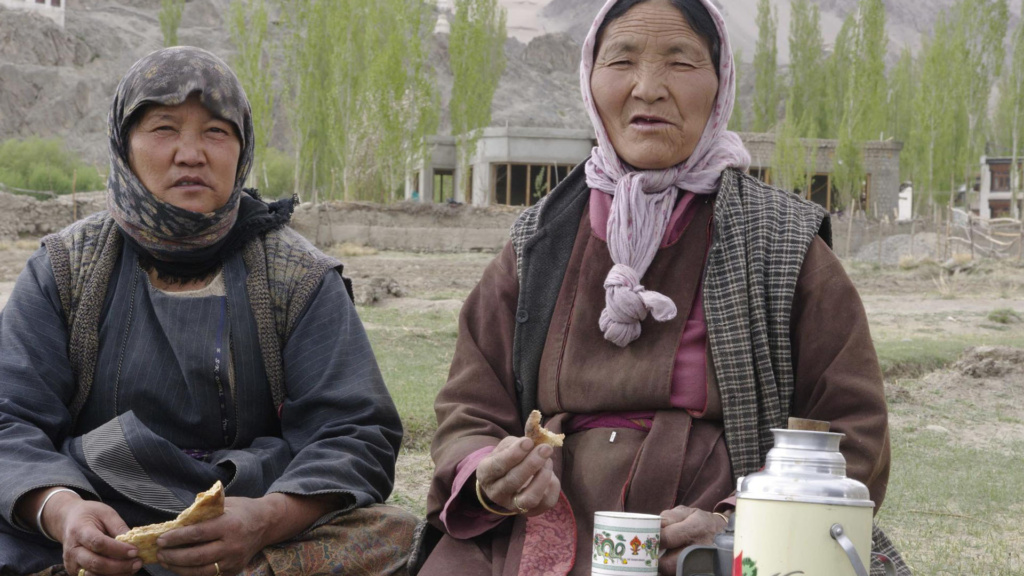
Tsering Dolma, whom everyone in the room called Aunty opened a string-tied bundle and put some of the fibre into my palm. It was pale, dusty and slightly untidy. Coarser hairs remained mixed through it. Nothing about it resembled the smooth folded shawls I knew from shop windows.
I rubbed it between my fingers.
“Raw,” she told me.
That single word corrected quite a lot.
On this earlier visit to Leh the exact year is something I still need to confirm from my notebooks I had come into the workshop thinking of pashmina as a finished object. A shawl. Something very soft and usually very expensive. I knew vaguely that goats were involved and that Ladakh mattered.
That was about the depth of my expertise.
The room itself was practical rather than picturesque. Bundles occupied one side. Thread had been wound and stored. A radio sat near folded cloth. Tea appeared before I had worked out what questions to ask.
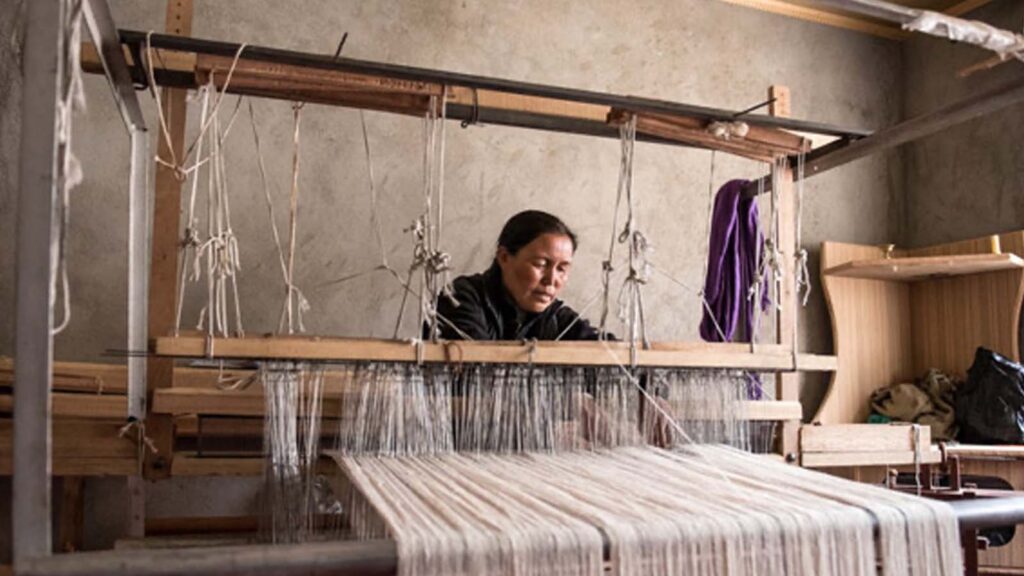
At the back was a loom.
That was where my understanding began to unravel.
weavers of leh
Before the thread
Aunty pulled several longer, stiffer hairs from the handful she had given me and separated them from the softer fibre.
This distinction is fundamental. Changthangi goats have a double coat: coarse outer guard hair and a much finer undercoat produced by secondary hair follicles. Indian animal-science research commonly discusses that fine undercoat as pashmina or cashmere; one detailed study of Changthangi goats found an average pashmina fibre diameter of about 12 micrometres in its sample.
I did not know any of that while sitting in the room.
I knew only that I could suddenly feel the difference.
The coarse strand resisted my fingers. The finer material hardly seemed to weigh anything.
At the loom
The workshop became easier for me to understand once people started working.
One woman loosened and prepared fibre. Aunty spun. My original description specifies a drop spindle and gives it a local name; I would want to check both details before restoring the terminology. What I remember securely is the change in the material.
Loose fibre was drawn out.
Twist entered it.
A strand began accumulating where before there had only been a soft mass.
It looked simple until I watched the corrections.
Too much material entered at one point and the strand thickened. Fingers went back, adjusted it and continued. The work depended on touch in ways I could observe without pretending to understand fully.
Then I moved towards the loom.
Padma, described in my notes as Aunty’s daughter, was working there. The wooden frame occupied much of the room. Threads were held under tension in front of her. Her feet worked treadles below while a shuttle travelled from side to side.
Click.
Cross.
Beat.
Again.
That rhythm is more useful to me now than every metaphor I originally built around it.
Each change of the treadles opened space between alternating sets of warp threads. The shuttle passed through with the weft. Then the new row was pushed into position.
Padma could do this while speaking to somebody else.
I could not do it while concentrating on nothing else.
Aunty handed me the shuttle.
My first attempt crossed successfully enough.
Then I struck the new row much too hard.
Nobody needed a speech about patience. The fabric itself looked wrong.
Padma stopped me, adjusted what I had done and demonstrated again. Less force. More consistency.
I tried once more.
Better.
Still recognisably the work of a visitor who would not be asked back as emergency labour.
The room carried on around me.
Somebody made tea. Conversation moved away from textiles. The radio occupied itself. Work stopped and restarted without ceremony.
That mattered.
The craft became more believable once everyone ceased behaving as though they existed for my education.
Where had the shawl really been made?
What I could know
The difficult question arrived later.
If the fibre came from Changthang and I had watched spinning and weaving in Leh, could I simply call the resulting cloth “Ladakhi pashmina”?
At the time, I probably would have said yes.
Now I would ask several more questions.
Where was this particular fibre collected?
Where was it cleaned and dehaired?
Was the yarn spun here?
Was it dyed here?
Was every part of the cloth woven in this room?
What happened during washing and finishing?
Were any stages outsourced?
None of those questions diminishes what I watched Padma doing. They simply stop one visible stage from standing in for an entire supply chain.
That distinction has become increasingly important in Ladakh itself.
In 2017, India’s Ministry of Textiles described new investment in a pashmina dehairing plant at Leh and in spinning wheels and handlooms specifically as measures to increase value addition in Leh. Recent Ladakh administration records continue to discuss expanding local dehairing, spinning and processing capacity. In other words, a stronger fibre-to-finished-textile industry within Ladakh has been something institutions and artisans have actively been building, rather than a production chain that can safely be assumed to have operated unchanged for centuries.
That also helps avoid an unnecessary rivalry with Kashmir.
Ladakh’s Changthangi goats are an important source of exceptionally fine fibre. Kashmir has its own long-established pashmina textile history and a separate registered GI, Kashmir Pashmina, dating from 2008. Both histories can be true without turning provenance into a contest over who “owns” pashmina.
Today the distinctions are even more explicit in India’s GI registry.
Pashmina Wool of Ladakh was registered in 2023 for Ladakh. A separate Ladakh Pashmina Textile registration followed in March 2026. Fibre and finished textile are therefore literally distinct registered goods.
That is almost exactly the distinction I had failed to make in the workshop.
A label saying pashmina did not answer every question.
Neither did handwoven.
And made in Leh would need a definition of which stage I meant.
A geographical indication can establish a regulated connection between a product and its geographic origin; it does not automatically answer every ethical, environmental or labour question a buyer might attach to the word “authentic”.
By the end of the visit, there were still things I could say with confidence.
I had held unfinished fibre.
I had watched coarse material being picked from finer material.
I had seen fibre becoming thread.
I had sat beside a loom while cloth accumulated one crossing at a time.
I had tried the shuttle and immediately demonstrated why skill cannot be inferred from the apparent simplicity of a repeated movement.
I had watched Padma correct my mistake and go back to work.
Those were not small things.
They were simply narrower than the claim I had first wanted to make.
Before that morning, provenance had meant something close to where I bought it.
The workshop made that definition unusable.
A finished textile can contain several geographies and several kinds of labour before it reaches a shop counter. Knowing one artisan or one origin is valuable. It does not automatically reveal the rest.