A 2016 August walk through lanes, water channels and river shade, where the villages revealed themselves at the speed of feet
The Indus was quietest near the willow bend.
That is where I began to understand this 2016 August stay in Dah and Hanu not at a viewpoint, not at a doorway, not through the usual stories outsiders carry into Brokpa country, but beside the river near my homestay, where the bank softened and a cluster of willows leaned over the water as if they had been listening for years.
I had come with a notebook and the usual traveller’s appetite for detail. Dah and Hanu slowed that appetite almost immediately. These were not villages to rush through in search of symbols. They were places of lanes, fields, water turns, apricot work, shade, kitchen smoke and people moving between tasks that had no reason to explain themselves to me.
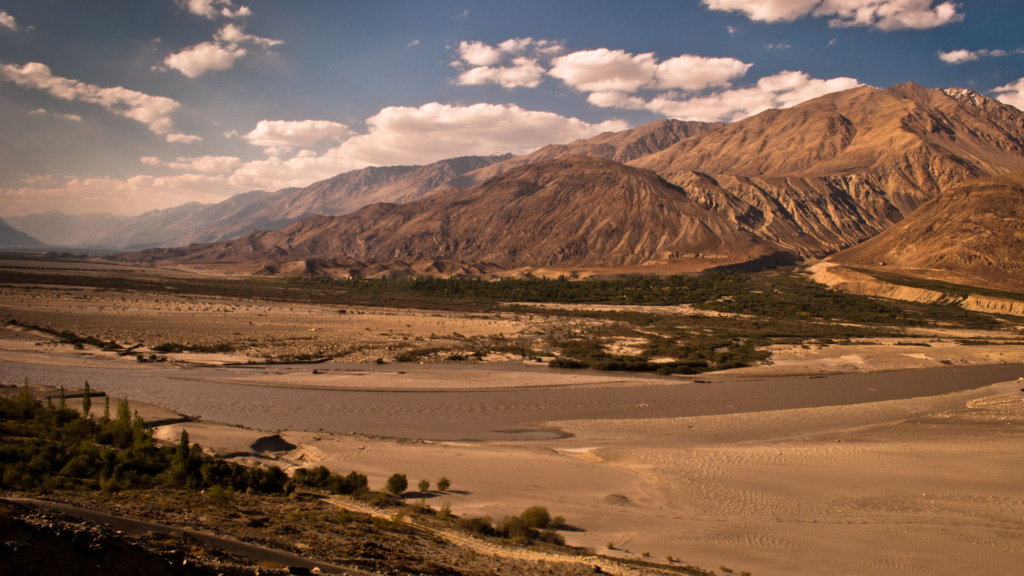
The Indus here did not roar. It moved with a low, steady force, green-grey in some light, darker where the bank shadowed it. Sand and silt held the marks of feet and animals. The willow leaves moved even when the rest of the afternoon seemed still. Behind me, a lane rose towards houses and terraces. Ahead, the river turned just enough to make the bend feel private without actually being hidden.
I walked alone that first morning and later with a local man who does not need to be named here. He did not guide me in the formal sense. He corrected pace, pointed out practical things, and let silences stay useful. That was better than commentary. The article I thought I would write began to change before I had written a line.
Along the indus
Water through the village
The khul was the first path I followed properly.
It ran close to the lane, narrow enough to step across in places, quick enough to remind me not to romanticise it. Irrigation water in a village is not scenery. It is timing, fairness, labour and argument prevented by habit. I saw the water directed, adjusted, checked and trusted. The full story of a dawn water-turn belongs elsewhere, but even in passing it changed how I walked. I stopped treating the lane as a route and began seeing it as a system.
Terrace walls held the path in place. Some stones were smooth at hand height. Some corners had been repaired more than once. The houses did not sit apart from the fields; they leaned into them. Apricot trees appeared over walls, not in blossom as a spring visitor might expect, but in August fullness: fruit, shade, drying stones, the smell of ripeness and storage. Later reading confirmed what the villages had already made clear to the senses: August is a peak apricot harvest period in Ladakh for many varieties.
I met Chomo in an orchard space where work had priority over conversation. She may have spoken beautifully, but what I remember most is the movement of her hands: sorting, pointing, lifting a branch, testing fruit, dismissing my questions when they were too large for the moment. There were apricot stones drying, fruit handled with care, and the sense that every tree belonged to a calendar of use. I had been guilty before of thinking of apricots as colour. In Dah and Hanu, they became labour first.
A woman watered near a small channel. Children moved through lanes with the seriousness children acquire when they have been given a small responsibility. A dog followed me for a while, then decided I was unimportant. This was a useful decision. It allowed me to become less central in my own walk.
The local man walking with me for part of the day said little, but he knew when I was about to step badly, when to duck under a beam, where not to stand in someone’s way, and when I was looking too long at something that was simply a household getting on with its work. He did not make a lesson of it. He only moved correctly, and I tried to follow.
Between Dah and Hanu
The walks were not one continuous pilgrimage. They were several short walks across Dah and Hanu, stitched together by the river and my own slow improvement.
A path would leave one lane, pass a terrace wall, dip into willow shade, cross a channel, then return me to a doorway where someone was sweeping, sorting, washing, carrying or cooking. The rhythm was repetitive in the way useful things are repetitive. Shade, water, stone, field. Then again: shade, water, stone, field.
At Hanu, the walk widened. The light felt different, the wind more certain. I remember a teacher and a school scene because it broke the day’s agricultural rhythm without breaking its attention. There was a chalkboard, children’s traces, and the quick recognition that language in a place like this is not an academic subject only. Brokskat, Hindi, Ladakhi, English words from schoolbooks and tourism — they moved through the same rooms with different degrees of ease.
This is where the article needs restraint. It is tempting to turn Dah and Hanu into an identity paragraph, especially because so many travellers arrive with ready-made language about Brokpa people. I want to do the opposite. A study on the Brokpa of Dah–Hanu notes their Dardic language context and describes the “pure Aryan” image as a tourism-perpetuated impression rather than a straightforward fact. That is all the context this walk needs before it returns to the lane.
In the village, the correction was simpler. People were not there to confirm or deny a label for me. They were teaching, watering, laughing, cooking, carrying baskets, checking fields, calling children back, walking to and from work. Occasionally, flowered headgear appeared at a doorway or on a woman passing through the lane, but I kept those details light in my mind. There are other articles for headgear, consent and looking. This one is about walking past without turning every sight into possession.
At the willow bend later, children launched leaf boats in the shallows. A grandfather sat with a stick and a knife, working at the wood with an attention that made speech unnecessary. The children argued over which boat had the better line through the eddy. One boat sank almost immediately. Another made it to a stone and became important for thirty seconds. The old man watched without interfering. The river took each experiment with equal patience.
That scene stayed with me because it had no obligation to become profound. It was children, water, leaves, shade, an old man’s hands, and the mild competition of an afternoon. Travel writing often fails when it demands that such moments instruct the reader. They do not have to. It is enough that they happened.
Beyond “True Blood”: Unpacking the “Aryan” Myth in Brokpa Country
Evening through doorways
By evening, the village became a series of lit thresholds.
I returned towards the homestay with dust on my shoes and the pleasant fatigue that comes only from walking without needing to prove distance. Doorways collected colour: a shawl, a bowl, a string of drying greens, a flower tucked somewhere because the day allowed it. Headgear details appeared briefly coins, petals, a line of ornament catching the last light but they were not waiting for me. They belonged to women moving through their own evening, not to my idea of culture.
At the house, food gathered the day into the body. Salt tea first. Khambir. Stew. Buckwheat porridge. Apricot oil. Kernels. The details belong here because walking makes food honest. I remember the salt in the tea, the density of the bread, the warmth of the room, and the way the river sound seemed to enter through the walls after dark.
The conversation that night did not unfold like a set of quotations for an article. You told me the dialogue was verbatim, so I am preserving the spirit of its clarity, but trimming the temptation to make every line shine. Someone said I walked too fast. Someone else laughed because this was true. The correction was not cruel. It was practical. My city walking had too much arrival in it.
Later, lying down, I could hear the Indus from the room. Not loudly. More like a continuous pressure beneath the house. The rafters held smoke, darkness and the small noises of a place settling into night. Dogs argued somewhere. A vessel shifted. Someone moved quietly through another room. The river continued underneath all of it.
I slept with the feeling that the walk had not ended. It had only moved from feet to hearing.
Morning at the river
Before leaving, I walked back to the willow bend.
Morning made the river look newly made and very old at once. A thin softness lay over the water. The willows held their shape. On the far bank, stone and scrub were still half in shadow. I crouched near the edge, tested the water with my fingers and then washed my face.
The cold did what cold water should do. It removed all decorative thought. For a few seconds there was only skin, breath, river, hand, light. I cupped the water again and let it run down my cheeks. Behind me, the village had already resumed itself: khul water moving, someone sweeping, someone calling, a metal sound from a courtyard, a footstep in the lane.
That was the ending the walk deserved. Not a summary of what Dah and Hanu meant. Not a claim that I understood the villages. Only the physical act of washing my face in the Indus before leaving, with willow shade behind me and the road waiting somewhere beyond the lane.
I stood up, wiped my face with the back of my sleeve, and looked once more at the bend. The river did not ask to be remembered beautifully. It asked nothing. It kept moving, which was better.
“I thought I walked slow,” I protested, foolish.
“You walked respectfully,” she conceded. “Slowness is a different craft.”